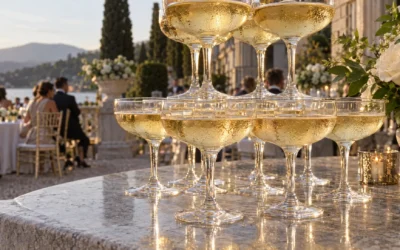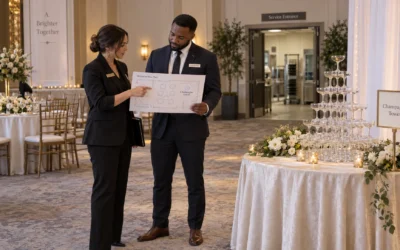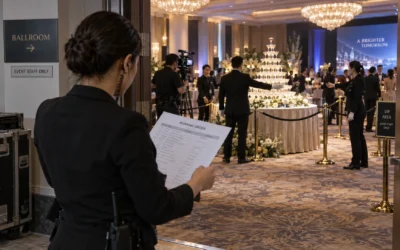


A champagne tower looks effortless only when the set up has been treated as a precision project. During the live pour, every guest sees the result of decisions made hours or weeks earlier: the glassware, the base, the sightlines, the timing, the lighting and the confidence of the person holding the bottle.
For luxury event agencies, wedding planners and brand teams, the champagne tower is rarely just a drinks feature. It is a ceremonial moment. It can open a gala, mark a hotel launch, give a VIP host a dramatic role or create the image that leads the post-event coverage. The visual payoff is immediate, but the margin for error is small.
These champagne tower set up tips focus on what matters most before the first bottle is poured, so the live moment feels calm, controlled and spectacular.
Start with the role of the tower in the event
Before choosing the height or glass count, define what the champagne tower must achieve. A tower built for an intimate wedding entrance has different needs from a tower designed for an F1 hospitality event, a luxury hotel opening or a corporate anniversary with press in the room.
The purpose shapes every practical decision. If the goal is an elegant toast, the tower may need to feel refined and close to the guests. If the goal is PR and social content, the design needs stronger sightlines, more lighting control and enough scale to dominate the frame. If the tower is part of a world-record concept, the planning moves into a different category entirely, with far more emphasis on engineering, documentation, team coordination and audience control.
A clear purpose also helps manage internal expectations. Stakeholders often ask for the biggest possible version, but the strongest event moment is not always the tallest tower. It is the one that fits the venue, feels intentional and can be poured without visible stress.
| Set up decision | Why it matters | Question to answer early |
|---|---|---|
| Tower purpose | Determines scale, location and choreography | Is this a toast, a reveal, a finale or a media moment? |
| Guest proximity | Affects safety, visibility and atmosphere | Should guests gather close or view from a controlled distance? |
| Pourer role | Shapes rehearsal and on-stage support | Will a VIP pour, or will the specialist team lead the moment? |
| Service plan | Influences hygiene, staffing and timing | Will guests drink from the tower, or will service be separate? |
| Media value | Drives lighting, backdrop and camera placement | What photo or video should define the event afterward? |
Choose the right scale for the room
A flawless pour starts with proportion. A champagne tower that is too small can disappear in a large ballroom. A tower that is too large for a narrow venue can create tension, block guest flow or feel out of place.
Scale should be judged from three positions: where guests first see the tower, where the live pour happens and where cameras capture the moment. If the tower only looks impressive from the front, the experience may feel weaker for guests standing to the side. Luxury events are often photographed from multiple angles, so the build should feel balanced in person and on camera.
For very large installations, the conversation should include venue load-in access, floor stability, working time, security, emergency access and the effects of guest movement around the display. If you are planning a substantial structure, it is worth pairing the creative brief with a specific safety plan, like the approach described in planning a large champagne tower without compromising safety.
Prepare a foundation that feels invisible but performs perfectly
Guests should never be thinking about the table. They should be looking at the tower, the host and the pour. That only happens when the foundation has been solved properly.
The surface must be rigid, level and suitable for the weight of the full installation. A standard event table can sometimes flex, shift or react to floor vibration, especially in busy venues where music, guests and service traffic create movement. The larger the tower, the more the base becomes a technical decision rather than a styling decision.
A professional set up includes checking the floor as well as the table. Old hotels, temporary structures, outdoor terraces and historic venues can have subtle slopes that are easy to miss during a site visit. A small unevenness at the base becomes more visible as the tower rises.
Linen and styling materials need the same attention. Heavy fabric, seams, folds or soft underlayers can create tiny irregularities. If a cover is used, it should be installed so it looks luxurious without compromising the stability of the glasses. Cable runs, florals, plinths and branding elements should not touch the tower or create pressure points around it.
Use glassware that is consistent, elegant and tested
Champagne towers are usually built with coupe glasses because their wide bowls allow the liquid to cascade from one level to the next. The shape looks classic, cinematic and generous, but not every coupe is suitable for a live tower.
Consistency is essential. Mixing glass batches can introduce small differences in rim width, height or weight. Those differences may seem insignificant during unpacking, but they can affect how the glasses connect as the tower grows. Every glass should be inspected for chips, cracks, irregular rims and wobble before the build begins.
Glassware also affects the mood of the event. Thin, elegant coupes may look beautiful but need careful handling. Heavier glass may feel more stable but can look less refined if the profile is too bulky. For a premium event, the best choice is rarely the cheapest or the most decorative glass. It is the glass that looks right, stacks predictably and performs reliably under live conditions.
Always keep more glasses available than the exact tower count. Breakage can happen during transport, polishing or set up. Replacing one glass should not become a crisis minutes before guests enter the room.
Position the tower for theatre and control
The tower should be placed where it can be admired before the pour and protected until the pour. Those two needs can conflict. A position in the center of the room may look impressive, but it can also expose the structure to guest traffic from every side. A position against a backdrop may be safer and more camera-friendly, but it needs enough depth for the pouring team, photographers and VIP movement.
The best location often sits between spectacle and operational control. Guests can approach visually, but not physically. The host can step in naturally. The specialist team can support without looking intrusive. Photographers have a clean angle. Service staff can move around the area without crossing the main camera line.
Lighting should be tested at the exact time of the pour, not only during the day or during technical rehearsals. Glass reflects everything: chandeliers, LED screens, flash photography, brand logos and dark corners. Good lighting gives the champagne a warm glow and makes the cascade visible without creating harsh reflections.
If social visibility is one of the main goals, the tower should be designed with filming behavior in mind. Guests tend to film vertical video from eye level, so height, backdrop and the first seconds of the pour all matter. For a more visual angle on this, see how to design a champagne glass tower guests will film.
Build slowly, inspect constantly
A premium champagne tower is not built with haste. The rhythm should be calm, methodical and focused. Each layer depends on the one below it, so the team must be comfortable pausing, checking and correcting before moving upward.
The base layer deserves the most time. It determines alignment, symmetry and confidence for the full structure. Once the first level is perfectly placed, each additional level should be checked from the front, sides and rear. This is especially relevant for events where guests will circulate around the tower before the pour.
A professional team will also manage the surrounding environment during the build. Doors opening behind the set up, staff moving too close, photographers trying to capture early content or last-minute decor adjustments can all introduce unnecessary risk. The tower area should become a controlled workspace until it is handed over as a finished feature.
A final inspection should happen shortly before guests arrive and again shortly before the pour. The room can change quickly once doors open. Vibration, temperature shifts, crowd movement and accidental contact nearby can affect the conditions around the tower.
Choreograph the live pour before the room is full
The live pour is a performance. It needs cues, positions and a shared understanding of who does what. A VIP host may only be involved for thirty seconds, but those thirty seconds should be rehearsed like any other key stage moment.
Decide who holds the first bottle, who opens additional bottles, who guides the pourer, who manages photographers and who watches guest distance. If the pourer is a CEO, bride, celebrity guest or brand representative, they should receive simple direction before stepping into the spotlight. The instruction should be calm and practical: where to stand, how high to hold the bottle, where to aim and how slowly to pour.
A continuous, controlled pour is usually more elegant than rushing to create a dramatic overflow. Too much speed can create foam, splashing and uneven distribution. Too little confidence can make the moment feel hesitant. The aim is not only to fill glasses, but to create a smooth cascade that looks intentional from the first drop.
For more detail on the pouring moment itself, this guide to pouring champagne tower displays without mistakes covers the practical risks that can appear once the bottle is in hand.

Decide whether the tower is ceremonial or service-focused
One of the most overlooked set up decisions is whether the tower is meant to serve guests directly. Many luxury events use the tower as a ceremonial centerpiece while guests receive fresh champagne separately from trays or a bar. This keeps the focus on the visual moment and can simplify hygiene, timing and service flow.
If the tower glasses will be served, the staffing plan becomes more demanding. The team must know when to collect glasses, how to distribute them, how to avoid crowding around the structure and how to replace the visual centerpiece once the pour ends. Guests should not be left to take glasses from the tower themselves unless the structure and service plan have been designed for that interaction.
For high-end weddings, galas and brand activations, separating the spectacle from the service is often the cleaner option. The tower delivers the memory and the content. The service team delivers the drink experience with precision.
Control the surrounding atmosphere
A champagne tower is sensitive to its surroundings. Loud bass, a crowded dance floor, sudden lighting changes, moving stage elements and enthusiastic guests all affect the moment. None of these are problems when they are planned for. They become problems when the tower is treated as decor rather than a live feature.
The run of show should protect the final minutes before the pour. Avoid scheduling a guest rush, confetti burst, artist entrance or major service movement at the same time unless the production has been choreographed around it. If the pour is meant to be the highlight, give it the space to breathe.
Sound also matters. A short MC introduction can focus the room and prevent guests from pushing forward unexpectedly. Music should support the reveal without overpowering verbal cues between the team members. Photographers and videographers should know the exact pour position in advance, so they do not crowd the host during the moment.
Plan for after the pour
A flawless live pour does not end when the champagne reaches the lower glasses. The minutes afterward influence how guests remember the experience. If staff rush in too quickly, the magic disappears. If no one steps in, the area can become crowded or messy.
Plan the exit as carefully as the entrance. The host may need a photo opportunity beside the finished tower. The photographer may need ten seconds of stillness. The service team may need a clear cue before approaching. If the tower is purely ceremonial, the breakdown should happen discreetly after guests have moved on.
Spill management should be invisible but ready. Towels, trays, replacement glasses and cleaning support should be nearby without being visible in the main guest view. A luxury experience depends on the feeling that everything is under control, even when liquid, glass and live performance are involved.
Champagne tower set up timeline for luxury events
The right timeline depends on the size of the tower, the venue and the ambition of the event. A small wedding feature may require a shorter lead time than an international brand activation or world-record attempt. Still, the planning logic is consistent: creative decisions first, technical validation second, live execution last.
| Timing | Main focus | What should be confirmed |
|---|---|---|
| Early planning | Concept and purpose | Event goal, audience, scale and desired media value |
| Venue coordination | Practical feasibility | Floor level, access, guest flow, power, lighting and restrictions |
| Production planning | Design and operations | Glassware, base structure, staffing, timing and safety measures |
| Event week | Final checks | Run of show, bottle count, spare materials and communication lines |
| Load-in | Technical set up | Level surface, controlled workspace, inspection and lighting test |
| Final minutes | Live performance | Pourer position, photographer placement, guest distance and cueing |
| After the pour | Guest experience | Photos, service transition, spill response and discreet breakdown |
This timeline also helps justify the investment to stakeholders. A champagne tower is not only an object placed in the room. It is a planned event moment with creative, operational and commercial value.
Common set up mistakes to avoid
Most champagne tower problems are preventable. They usually begin with small compromises that seem harmless during planning but become visible during the live pour.
Avoid these mistakes when preparing a premium tower:
- Choosing the height before checking the venue, guest flow and sightlines
- Using mixed or untested glassware because the difference seems minor
- Building on a surface that looks elegant but has not been checked for levelness
- Placing the tower where guests can brush past it during arrivals or dancing
- Letting a VIP pour without a short briefing or discreet professional support
- Forgetting the after-pour plan, including photos, service and cleanup
The standard should be simple: if a detail could distract from the pour, solve it before guests enter the room.
Frequently asked questions
How long does a champagne tower set up take? Set up time depends on the size of the tower, the venue conditions, glassware handling and the level of styling involved. Larger or more complex towers need more time for building, inspection, lighting tests and safety checks.
What type of glasses work best for a champagne tower? Coupe glasses are the traditional choice because their wide shape allows champagne to cascade between tiers. The most important factors are consistency, balance, rim quality and suitability for the chosen tower size.
Can a VIP or couple do the live pour themselves? Yes, if the moment is choreographed properly. A VIP pour should include a short briefing, a clear standing position and discreet support from the professional team so the moment feels natural rather than risky.
Should guests drink from the champagne tower? They can in some event formats, but many luxury events use the tower as a ceremonial feature and serve champagne separately. This can create a cleaner guest experience and preserve the visual impact of the tower.
Is a large champagne tower safe for a live event? A large tower can be safe when it is planned by specialists, built on the right foundation and protected by proper guest flow, staffing and venue coordination. The larger the structure, the more important professional assessment becomes.
Create a live pour that looks effortless
A champagne tower is one of the rare event features that combines luxury, suspense, craftsmanship and instant visual impact. When the set up is handled with precision, the live pour becomes more than a toast. It becomes the image guests remember, share and associate with the event.
Luuk Broos Events specializes in custom champagne towers, spectacular champagne pyramid experiences and world-record concepts for premium events. If you want a centerpiece that feels exclusive, technically controlled and worthy of the occasion, start the conversation with Luuk Broos Events and build the moment around your venue, audience and ambitions.