

The strongest creative activation ideas give guests a role in a brand story, not just a backdrop for photographs. At a luxury event, that role should feel like an invitation: witnessing exceptional craftsmanship, shaping a bespoke detail or joining a carefully staged reveal.
For event agencies and planners, the challenge is making that experience distinctive without adding friction to the evening. A beautiful installation that blocks service, creates queues or communicates nothing about the host has missed its purpose. The following concepts pair spectacle with a clear guest action, a brand connection and practical production considerations.
Start with the action you want guests to take
Before choosing an installation or performance, complete this sentence: After this experience, we want guests to remember, feel or do…
A hotel opening might need guests to associate the property with exceptional hospitality. A watch launch might need collectors to appreciate a particular finishing technique. A sponsor reception might prioritize conversations with a small number of valuable partners rather than maximum attendance.
That distinction changes the format. An intimate demonstration can support consideration, while a shared reveal can concentrate attention across a ballroom. Both can be luxurious, but they solve different problems.
Build the activation around one primary objective, then decide how participation should work. For VIP audiences, watching should remain a valid choice. Understanding what luxury corporate event guests remember most helps keep the focus on the experience rather than the installation alone.
Six creative activation ideas for luxury events
1. Turn a champagne pyramid into a signature brand reveal
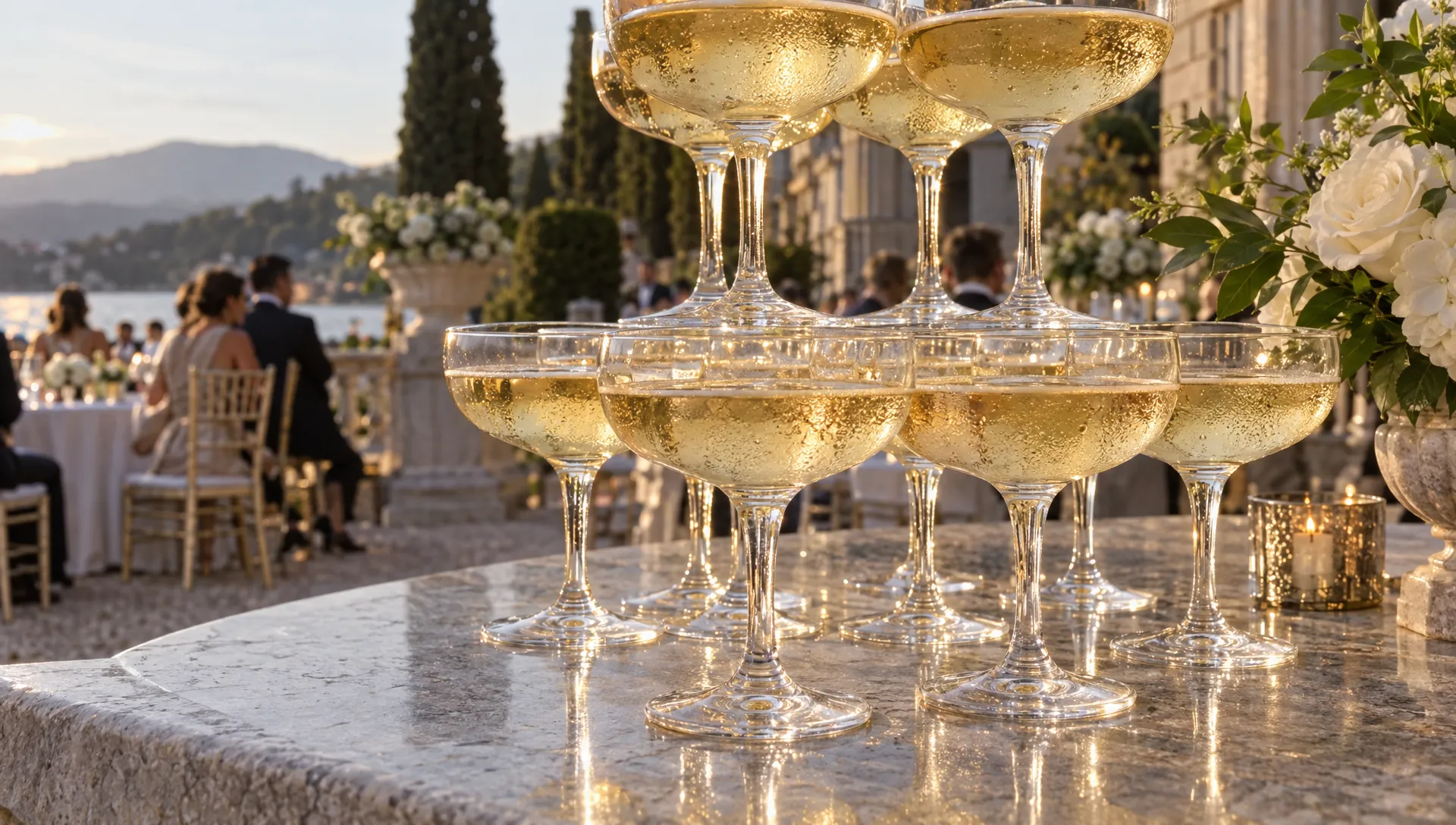
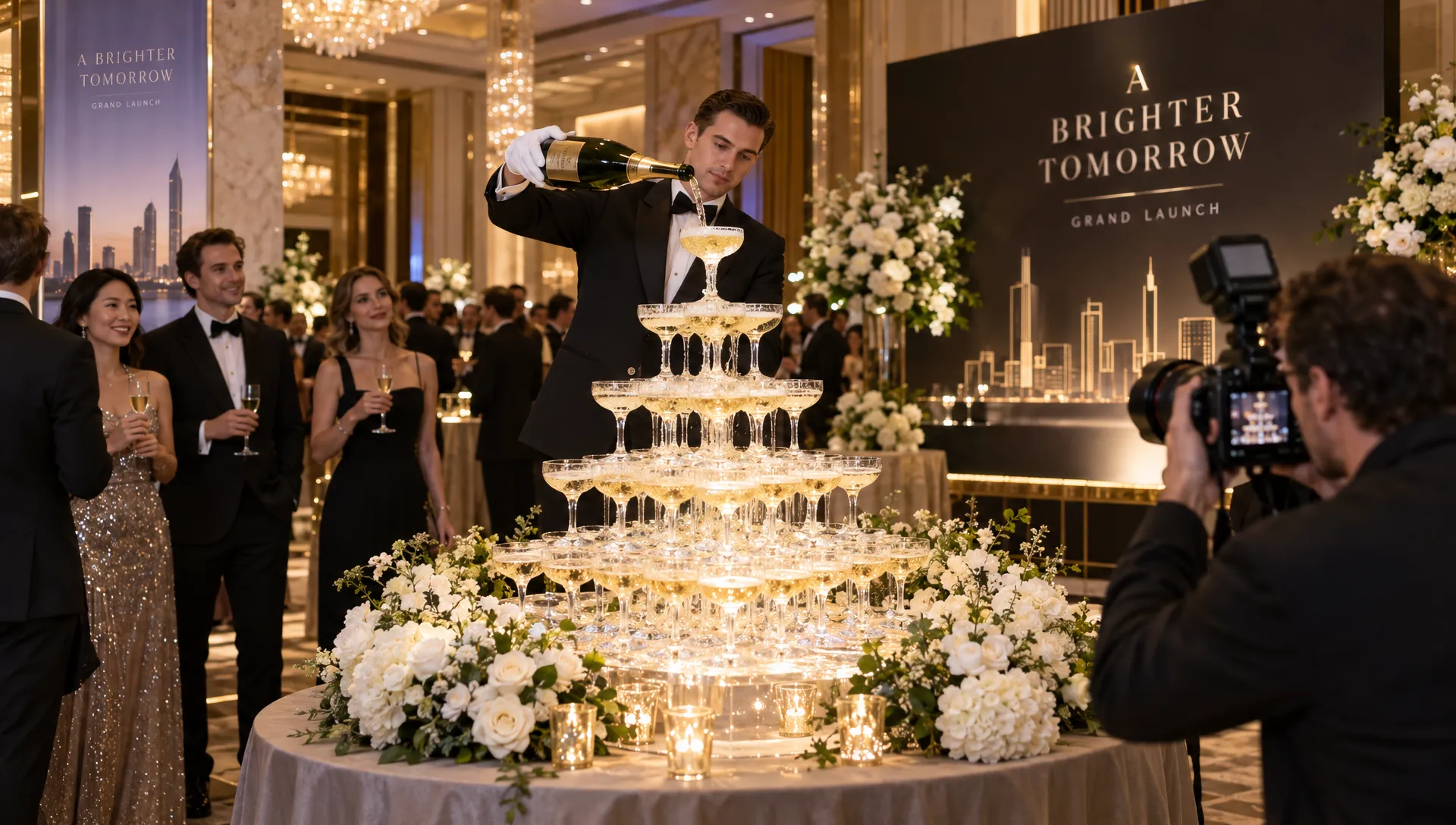
A champagne glass pyramid can become the focal point of a launch when its ceremonial pour marks a meaningful transition: the opening of a property, the unveiling of a collection or the celebration of an anniversary.
Build a short sequence around that moment. Guests gather with an unobstructed view, the host explains the occasion and the pour creates a shared visual peak. The brand connection can come through lighting, the setting and the story, without covering the structure in logos.
Luuk Broos Events specializes in champagne pyramids, from smaller towers to record-scale projects, supported by a professional building team. The appropriate scale depends on the venue, audience and ambition, not simply the largest structure available.
For projects considering a record attempt, explore how a world record brand activation can support premium exposure. Treat the attempt as a separate production and verification workstream, not an automatic addition to a reception.
Best fit: Hotel openings, prestige launches, major anniversaries and gala celebrations with a scheduled focal moment.
2. Create a private atelier with a meaningful guest choice
For a craftsmanship-led brand, creative activation ideas should make the work behind the product visible. A private atelier does this through a live demonstration and one carefully chosen opportunity to participate.
A leather specialist might demonstrate edge finishing before guests select a detail for an approved accessory. A fragrance house could guide visitors through ingredients connected to its collection. The interaction should reveal something specific about the brand, rather than offer unrelated entertainment.
Keep the choice narrow enough to feel considered. Two or three relevant options can support a more elegant experience than a large customization menu that requires lengthy explanations.
Capacity matters here. Establish how many guests the artisan can serve comfortably, then use appointments or discreet invitations if demand could exceed that number. Confirm which processes are safe to demonstrate in the venue and which should remain off-site.
Best fit: Collector evenings, private client events and launches where product understanding matters more than crowd size.
3. Design a hosted discovery route through a new property
A hotel or resort opening offers something a conventional ballroom event cannot: the property itself can become the activation.
Instead of sending guests on an unguided tour, create a short hosted route through selected spaces. Each stop should demonstrate a genuine distinction, such as a culinary technique, an architectural detail or a locally commissioned artwork. Finish in a setting where guests can stay and enjoy the hospitality.
The route should feel like access, not a checklist. Avoid compulsory stamps, repetitive speeches or constant requests to scan codes. Hosts need enough knowledge to adapt the conversation to a guest’s interests without extending the schedule indefinitely.
These creative activation ideas work best when the journey reveals what guests could experience on a future visit. A theatrical feature with no connection to the property’s actual offer risks creating the wrong expectation.
Best fit: Hotel openings, resort previews and private introductions for travel partners or prospective clients.
4. Stage a collector’s preview with genuine access
Exclusivity is more convincing when it provides something valuable: access to a designer, an archive piece, a prototype or a specialist who can answer detailed questions.
Create a small preview salon alongside the main reception. Invite guests in timed groups for a focused encounter with the object and the person behind it. A watchmaker might explain a finishing process, while an automotive designer could discuss an approved material sample or design study.
The guest action is conversation, not a staged photograph. Allow enough time for questions and avoid turning the encounter into a sales presentation unless that expectation has been established in advance.
Among creative activation ideas for VIP audiences, this format suits organizations with a substantive story to tell. Confirm object security, handling permissions, accessibility and photography rules before invitations go out. Scarcity should reflect real capacity or access, not an invented claim of rarity.
Best fit: Luxury product launches, collector hospitality and high-value relationship events.
5. Build a portrait experience around brand craftsmanship
A portrait activation can produce something guests genuinely want to keep, provided the result feels commissioned rather than promotional.
Replace the standard branded backdrop with a setting that expresses the event’s creative direction. That might involve a sculptural material used in the collection, a floral composition connected to the venue or lighting inspired by a campaign. Give the photographer a clear brief for a consistent, flattering result.
Separate the guest keepsake from the brand’s content requirements. Someone accepting a portrait should understand how it will be delivered and whether publication is optional. Obtain appropriate permissions for any intended marketing use and confirm the photographer’s usage terms.
Well-resolved creative activation ideas respect the guest’s time as carefully as the final image. Offer discreet booking or a host-managed waiting system, and make participation optional rather than a condition of entry.
Best fit: Fashion events, sponsor hospitality and celebrations where a personal keepsake complements the occasion.
6. Commission a reveal that brings several hosts into one moment
For an event involving a hotel, a luxury brand and a hospitality partner, separate sponsor presentations can fragment the evening. A commissioned reveal can give each organization a relevant role within one coherent sequence.
For example, a short musical performance could lead into the unveiling of a commissioned artwork, followed by a host-led toast. The artwork, performance and hospitality should all connect to the occasion, rather than compete for attention.
Keep the sequence concise and rehearse the transitions. Agree who speaks, who authorizes each cue and what happens if one element cannot proceed. A credible fallback should preserve the guest experience without depending on every technical component working perfectly.
For sports-related hospitality, confirm permissions for event names, team assets and athlete appearances. Proximity to an F1 race or the Olympic Games does not itself establish an official affiliation.
Best fit: Partnership launches, destination celebrations and hospitality events with several stakeholders.
Make the concept production-ready before approval
An attractive proposal is not yet an executable activation. Before presenting the final concept to stakeholders, establish what the venue can accommodate and which specialist owns each critical task.
Check the venue and the guest journey together
Assess access routes, installation time, floor capacity where relevant, power requirements, emergency exits and the space needed for safe operation. Consider the activation in its busiest condition, not only in an empty-room rendering.
Where will guests gather? Can service staff still circulate? Can seated guests see the reveal? Is there an accessible way to participate? For glass structures, live demonstrations or moving installations, have the relevant specialists assess the risks and define the operating boundaries.
The most persuasive creative activation ideas arrive with these answers, rather than leaving the planner to resolve them after the concept has been sold.
Assign responsibility for the live moment
The event agency, venue, technical team and activation specialist need a shared running order with clear approval points. Identify who can delay or stop the sequence if conditions are unsuitable.
For a proposed Guinness World Records title, consult the official application process and obtain the relevant category requirements before making public claims. An attempt, a completed build and a verified record are different things.
Also agree on photography positions, guest consent where applicable and the approved language for hosts and press materials. These decisions are easier to settle before the room fills.
Measure brand impact, not just activity
A crowded installation does not necessarily indicate a successful activation. Guests may remember the spectacle while forgetting who hosted it, or participate enthusiastically without taking the next step the event was intended to support.
Evaluate creative activation ideas against the original objective, using a small set of measures that the team can realistically collect.
| Objective | Useful evidence | What it helps you assess |
|---|---|---|
| Strengthen brand association | Post-event recall of the host and the intended message | Whether the experience communicated more than spectacle |
| Develop client relationships | Relevant conversations and agreed follow-up meetings | Whether hospitality supported relationship progress |
| Earn publicity | Relevant editorial coverage carrying the correct brand story | Whether attention translated into useful exposure |
| Create reusable content | Approved photographs and footage with suitable usage rights | Whether the event produced assets the brand can actually use |
Set expectations before commissioning the activation. Record incremental costs, including technical production, staffing, content capture and permissions, rather than comparing supplier fees alone.
For press-led concepts, prepare a factual story and a clear image brief. Coverage is never guaranteed, even when the event includes a remarkable visual centerpiece.
Frequently asked questions
What makes an activation feel luxurious rather than gimmicky? Relevance, restraint and attentive execution. The experience should reveal something credible about the brand, give guests a worthwhile role and fit naturally into the hospitality. More technology or a larger footprint does not automatically improve it.
Can creative activation ideas work in smaller venues? Yes. A private atelier, collector preview or appropriately scaled champagne tower can suit an intimate setting. Confirm sightlines, circulation and operating space first, then choose the format. Reducing a large concept without redesigning the guest experience can create avoidable problems.
How early should an activation specialist be involved? Before the layout, schedule and technical scope are fixed. Early input helps identify access restrictions, installation needs and dependencies while changes are still manageable. Record attempts require additional planning around the applicable rules and evidence requirements.
Should every guest participate? No. Some guests prefer to observe, particularly during a reception built around conversation. Offer a rewarding viewing experience and an easy way to decline direct participation without losing access to the main event.
Give your event a distinctive focal point
For a launch, gala or hospitality event that calls for a champagne centerpiece, discuss your brief with Luuk Broos Events. Its specialization in champagne pyramids combines visual spectacle with the precision of a professional building team, with marketing and publicity advice available to support the wider event objectives.
Share the occasion, venue, audience, timing and intended impact. Those details provide the starting point for deciding whether a smaller tower, a substantial centerpiece or a record-scale ambition belongs in your event.