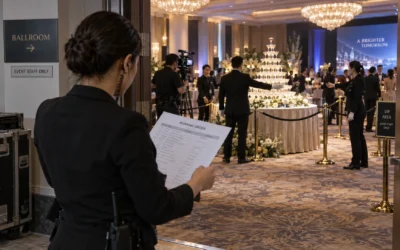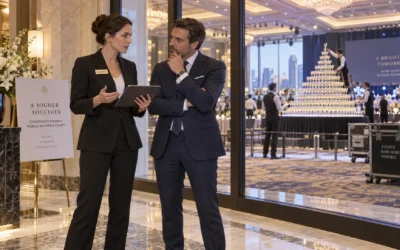


Planning a champagne tower for wedding guests to remember starts with what happens around the glassware: the anticipation, the couple’s pour and the toast that follows. The structure creates the focal point, but the production plan determines whether the experience feels effortless.
For luxury wedding planners, that means resolving scale, service, supplier responsibilities and venue requirements before discussing the finishing touches. A spectacular tower should fit naturally into the celebration without creating a queue, interrupting dinner service or leaving the couple waiting for a cue.
Define the experience before requesting a quote
Start with a short working brief that explains what the moment should achieve. A private celebration for 40 guests needs a different approach from a ballroom wedding where several hundred people must see the pour.
Establish whether the tower is primarily a ceremonial centerpiece, part of the drinks service or both. These are different production requirements and should not be left for suppliers to interpret independently.
Your initial brief should include:
- The intended experience: An intimate toast, a reception highlight or a larger theatrical reveal.
- Guest numbers and venue: Include the proposed room, access arrangements and whether the installation is indoors or outdoors.
- The couple’s involvement: Confirm who will pour and whether anyone needs assistance reaching or approaching the pouring position.
- Service expectations: Specify whether guests receive separately prepared drinks or glasses taken from the tower by authorized staff.
- Budget priorities: Identify whether scale, champagne choice or production impact matters most.
Share the same brief with the builder, venue and caterer. A common starting point reduces conflicting assumptions later.
Size a champagne tower for wedding guests, not one glass per person
The tower’s glass count does not automatically need to match the guest count. A smaller installation can provide the ceremonial focus while the catering team serves the toast separately. Conversely, a large structure may be chosen for its presence rather than its serving capacity.
Ask the specialist to recommend a scale based on the room, viewing distance, available footprint and intended pour. Request the proposed dimensions, not simply a photograph of a previous installation. Perspective can make a tower appear larger or smaller than it will feel in your venue.
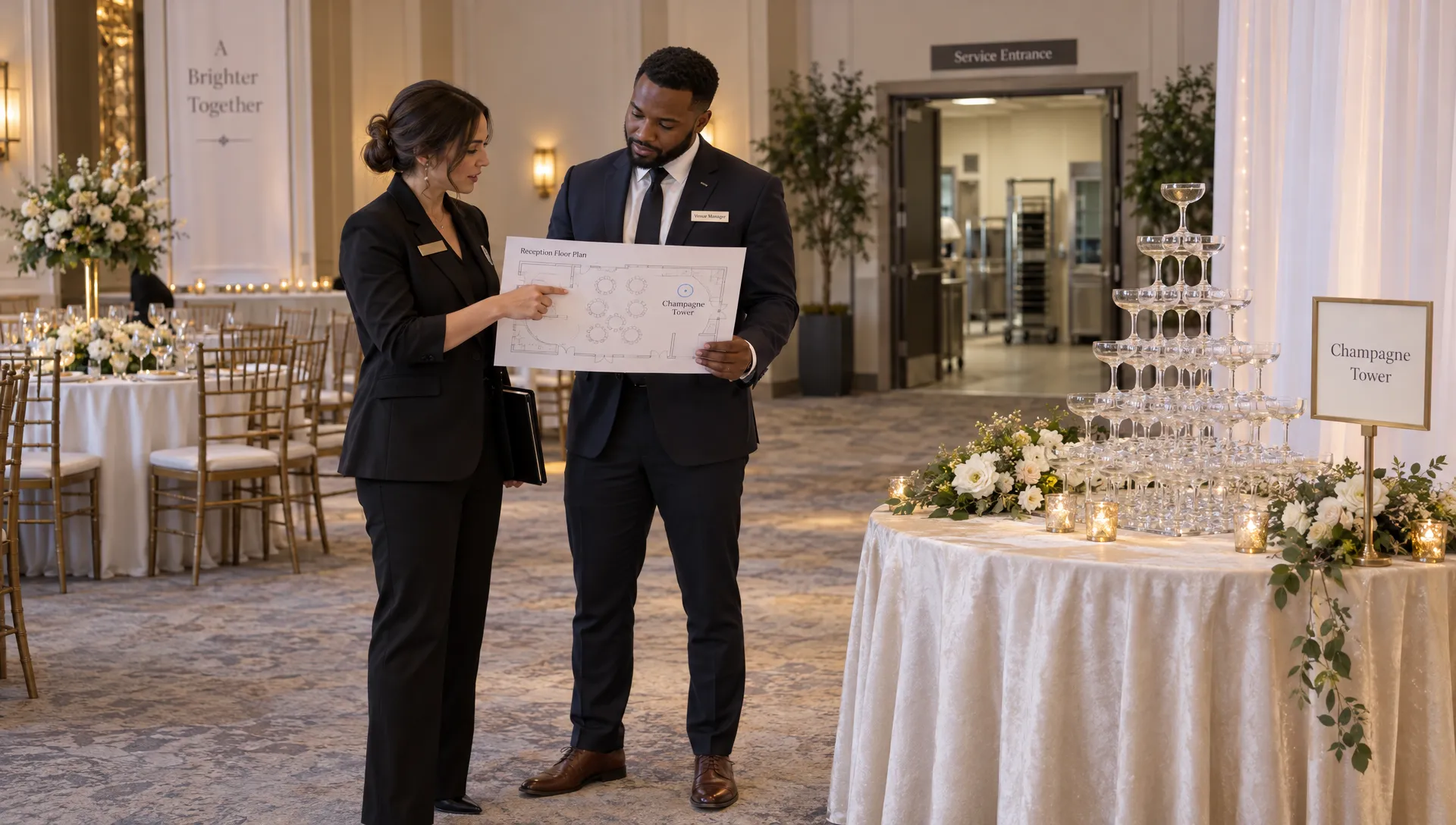
A floor plan should show the structure, its supporting surface, the couple’s position and the surrounding working area. It should also account for guests who remain seated or use mobility aids.
Avoid choosing the largest option that physically fits. The installation must leave room for hospitality staff, photography and comfortable circulation. The broader considerations in choosing a champagne tower for your event can help frame that conversation before dimensions are approved.
Separate the ceremonial pour from drinks service
A champagne tower for wedding celebrations needs two connected plans: one for the spectacle and another for getting drinks into guests’ hands. Do not assume that an impressive cascade will also deliver a fast, consistent toast service.
Confirm who supplies the champagne, who chills it, where bottles are held and which team opens them. Agree whether the tower glasses will be served afterward and, if so, who is authorized to remove them and when. Guests should not help themselves from the structure.
For the beverage order, distinguish the theoretical serving requirement from the operational allowance. As an illustrative calculation, 120 guests receiving a 100 ml toast require 12 liters, equivalent to sixteen 750 ml bottles. That is a mathematical baseline, not a final purchasing recommendation.
The final order must account for the agreed cascade, liquid retained in the installation, handling losses and any reserve. If the toast is served independently, make that allocation explicit so nobody assumes the tower’s bottles also cover the trays.
Arrange alcohol-free drinks with the same attention to presentation and timing. Guests who do not drink champagne should be included in the shared toast rather than served as an afterthought. The caterer should confirm appropriate beverage choices, ingredient information and any relevant dietary requirements.
Build a supplier budget you can actually compare
When commissioning a champagne tower for wedding celebrations, compare the complete delivery scope rather than the headline installation price. Two proposals may look similar while assigning very different responsibilities to the planner.
Use a scope comparison like this when reviewing quotations:
| Budget area | What to establish |
|---|---|
| Tower and glassware | Proposed size, glassware provision and responsibility for breakage |
| Build and removal | Crew, access requirements, installation window and dismantling arrangements |
| Supporting setup | Who provides and approves the table, platform or other supporting surface |
| Beverage service | Champagne supply, chilling, opening, pouring and guest service |
| Production coordination | Rehearsal, venue liaison and integration with the wedding schedule |
| Logistics | Transport, loading access, parking and any venue-specific charges |
Ask what changes if access is delayed, the room must be reset or the wedding schedule runs late. Confirm payment terms, cancellation provisions and the process for approving changes.
For a private wedding, value is not necessarily measured through publicity or social reach. More useful criteria are the quality of the shared experience, the couple’s comfort and how reliably the installation fits the wider production. Protect essential staffing and safe delivery before spending on additional decorative layers.
Approve the technical plan and the fallback
The technical plan for a champagne tower for wedding guests should be agreed by the specialist, venue and relevant production teams. Assign a named owner to each approval rather than relying on a general assurance that everything is covered.
The builder and venue should confirm that the proposed location and supporting surface are suitable for the installation’s load and stability requirements. Also resolve protection for surrounding finishes, spill management, nearby electrical equipment and access for installation and removal.
Keep the tower away from guest circulation routes, moving furniture and areas where children might approach unnoticed. Required clearances should come from the specialist’s assessment of the specific setup, not a generic distance copied from another event.
Outdoor proposals need an agreed alternative. Wind, rain, temperature and uneven ground can affect suitability, so identify an approved indoor location or another workable plan before the wedding day. Name who makes the relocation decision and the latest point at which it can happen.
Finally, request the relevant insurance documentation and any risk assessment or working-method information required by the venue. These documents support coordination, but they do not replace a site-specific discussion between the people delivering the installation.
Rehearse the handoffs, not just the pour
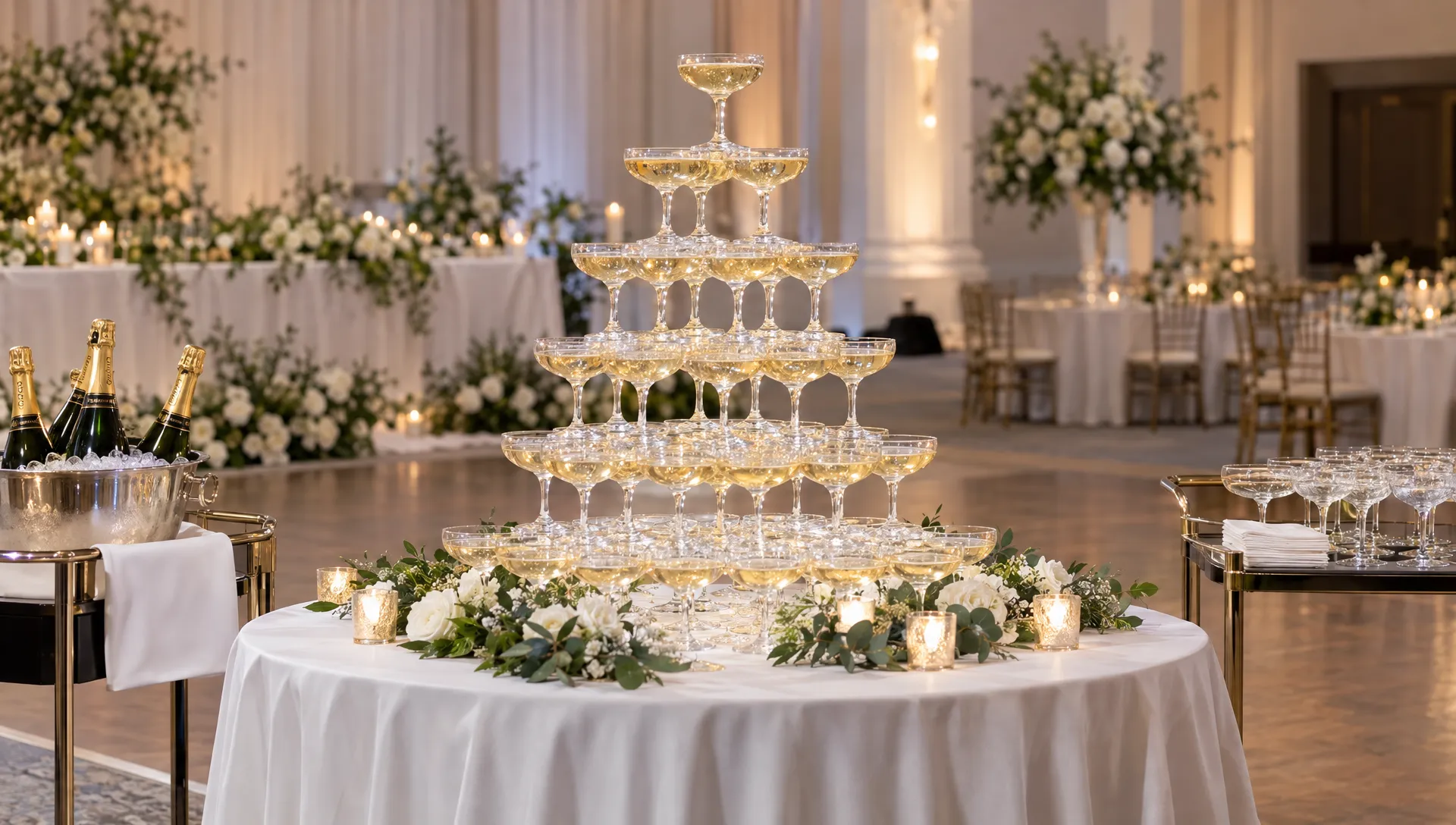
A champagne tower for wedding celebrations depends on several suppliers acting in sequence. The builder may be ready while the photographer is elsewhere, the couple is greeting guests or the service team is still preparing the toast.
Create a short cue sheet with one person authorized to release the moment. That person should receive confirmation from the tower specialist, catering lead and photography team before inviting the couple forward.
The sequence should cover the guest announcement, the couple’s approach, the specialist’s guidance, the pour, the photograph and the transition into the toast. Specify where the couple places the bottle afterward and how staff regain control of the area.
Rehearsal does not need to recreate the entire event. A practical walkthrough should confirm positions, access, communication and the couple’s comfort. Nobody should be discovering an awkward reach or an obstructed route during the live pour.
Place the cue within a schedule that already works for the wedding. The considerations in choosing the best moment for a champagne tower at your wedding can help, but the final decision should reflect the actual meal service, speeches and entertainment arrangements.
Include a hold procedure too. If the couple is delayed or a technical issue arises, the coordinator needs authority to pause the announcement rather than allowing guests to gather before the team is ready.
Plan what happens after the photograph
The experience of a champagne tower for wedding guests continues after the cascade stops. An elegant pour can lose its impact if guests then wait without a drink or staff have to work through a crowd to clear the area.
Agree how the toast reaches each guest group, including anyone seated farther away. Keep trays and service staff positioned so they can move efficiently without entering the main photograph or blocking the couple’s exit.
The specialist should confirm when the installation can be approached and how it will be dismantled. Assign responsibility for clearing liquid, inspecting the surrounding floor and returning the space to its next use. These tasks belong in the schedule, particularly if dancing or entertainment will follow nearby.
Close the planning process with a shared final document containing the approved layout, supplier contacts, service quantities, cue sequence and fallback decision. Circulate revisions through one lead coordinator so every team works from the same version.
Frequently asked questions
How far in advance should we book a specialist? Begin discussions while the venue layout and supplier budget are still flexible. Availability, access requirements and custom scale can affect feasibility. Ask the specialist for project-specific lead times rather than assuming a standard booking window.
Does a champagne tower for wedding receptions need a glass for every guest? No. It can function as a ceremonial centerpiece while guests receive separately prepared drinks. Confirm that distinction in the brief so the tower size and beverage order support the same service plan.
Can the couple pour the champagne themselves? Discuss this with the specialist during planning. Their participation should depend on the approved setup, comfortable access and clear guidance. The couple should not need to climb, lean across glassware or improvise their position.
Can the tower be moved after it has been built? Do not plan around moving an assembled tower. Agree its final location before installation and let the specialist determine any safe handling or relocation method. A room change may require dismantling and rebuilding rather than a simple move.
Bring a clear brief to a specialist team
Luuk Broos Events specializes in champagne pyramid experiences, including smaller towers and record-breaking installations, with a professional builder team and a tailor-made project approach.
To start a focused conversation, share your wedding date, venue, guest count, intended experience and working budget with Luuk Broos Events. Ask for a proposal that connects the visual ambition with the practical delivery scope, so the tower is planned as carefully as every other part of the celebration.