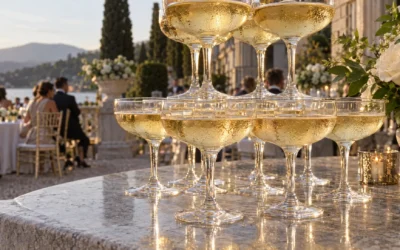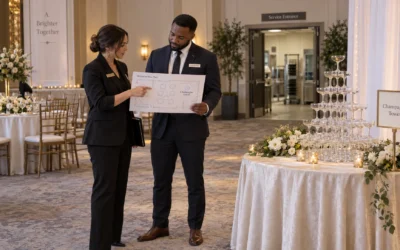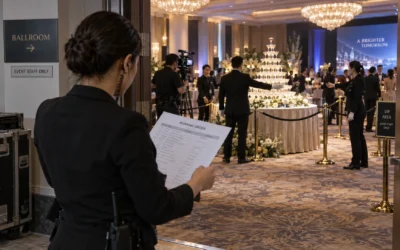


A large champagne tower is never only a visual feature. At a luxury gala, hotel opening, brand activation, wedding, or VIP hospitality event, it becomes a signal of ambition. It tells guests that the host is prepared to create a moment that feels rare, theatrical, and worth remembering.
But the larger the tower, the more precision matters. A beautiful tower can only feel luxurious when it also feels controlled. Guests should see elegance, not risk. Event directors should feel confidence, not tension. The champagne pour should appear effortless, even when the planning behind it is highly technical.
For luxury event planners, the essential question is not simply, “How high can we build?” It is, “How do we create maximum impact while protecting the guest experience, the venue, the brand, and the reputation of everyone involved?”
Safety is not separate from spectacle
In premium events, safety is part of the experience design. A large champagne tower that feels unstable, crowded, or improvised quickly loses its sense of exclusivity. Guests may not understand the technical details, but they can sense when something has been properly planned.
A safe tower starts long before the first glass is placed. It begins with a clear event purpose, an honest assessment of the venue, a realistic build schedule, a trained team, and a pour plan that has been designed around people, not just aesthetics.
This is especially important when senior stakeholders, sponsors, celebrities, press, or VIP clients are present. The tower may become the most photographed moment of the evening. That visibility is powerful, but it also means execution must be disciplined.
Define the purpose before choosing the scale
A common mistake is assuming that bigger always means better. Scale matters, but only when it serves the event goal. A large champagne tower for a global brand launch has a different purpose than one for an intimate luxury wedding or a hotel opening.
Before deciding on height, glass count, or placement, define what the tower must achieve. Is it meant to create a grand entrance moment? A ceremonial toast? A press image? A social media centerpiece? A finale? A world-record attempt?
The answer affects almost every safety decision, including build location, guest distance, pouring style, staffing, lighting, and timing. If you are still comparing formats, this guide on choosing the right champagne tower for event goals offers a useful strategic starting point.
| Event goal | Suitable tower approach | Key safety focus |
|---|---|---|
| Luxury wedding toast | Elegant medium to large tower | Guest proximity, photography flow, smooth pour |
| Hotel opening or gala | Large centerpiece tower | Venue access, sightlines, controlled crowd movement |
| Brand activation | Branded visual spectacle | Media angles, sponsor visibility, guest barriers |
| World record attempt | Highly specialized large-scale build | Structural planning, official coordination, extended build schedule |
| VIP hospitality event | Refined, premium tower moment | Discretion, service choreography, flawless timing |
This early clarity prevents overdesign. It also helps the production team explain why certain safety measures are necessary, not restrictive.
Start with a serious venue assessment
The venue determines what is possible. A large champagne tower depends on more than floor space. It requires the right surface, ceiling height, access routes, environmental conditions, and crowd layout.
Important questions include whether the floor is level, whether the platform can support the full installation, how close guests will stand, whether the tower is near doors or vibration sources, and how easily the build team can load in and out. Airflow, temperature, and nearby entertainment also matter. A tower placed too close to powerful speakers, dance floors, or heavy guest movement can be exposed to unnecessary vibration.
For luxury venues, surface protection and aesthetic integration are also essential. The safest solution should still look intentional and refined. In destinations such as Dubai, where premium events are often connected with high-end hotels, villas, and branded interiors, the same site-first mindset used by luxury renovation experts in Dubai applies: assess the structure, access, materials, and finishing details before installing a high-impact showpiece.
The best planning conversations happen early. If the tower is only discussed after the stage, lighting, catering, entertainment, and guest flow have already been fixed, the safety margin becomes smaller.
Build on a stable foundation
Every glass in a champagne tower relies on the precision of the glasses below it. With a small tower, minor imperfections may be manageable. With a large tower, small errors compound quickly.
The foundation should be stable, level, and designed for the full weight of the structure, including glassware, liquid, decorative elements, and any supporting platform. The surface should not flex, shift, or vibrate during the event. If the tower is elevated, the platform must be planned as part of the installation, not treated as furniture.
The glassware itself also matters. Consistency is vital. Differences in shape, rim thickness, or stability can affect how glasses sit together and how champagne travels during the pour. A premium tower is not created by simply stacking whatever glasses are available on-site. It requires a controlled system.
For large-scale towers, the build process should be handled by a specialist team. Patience, repetition, and calm coordination are essential. The result may look glamorous, but the work itself is methodical craftsmanship.
Design guest flow around the tower
A large champagne tower attracts people. Guests want to photograph it, stand near it, and gather around it before the pour. That attention is exactly why the concept works, but it must be managed.
Safe guest flow should be designed into the floor plan from the beginning. The tower needs a natural viewing zone, a service zone, and a protected build zone. These areas should not feel like barriers at a luxury event. With the right staging, florals, lighting, furniture, or subtle rope lines, they can feel like part of the design.
The goal is to let guests enjoy the spectacle without crowding the structure. Photographers and videographers also need designated positions, because media teams often move quickly when the key moment begins. A clear plan helps them capture the image without creating pressure around the tower.
For VIP events, it can be helpful to decide in advance who is allowed to participate in the pour. A CEO, couple, celebrity guest, or hotel owner may be part of the ceremony, but they should be guided carefully. The simpler the movement, the more elegant it looks.
Choreograph the pour before the event begins
The pour is the emotional peak of the tower experience. It is also one of the moments that requires the greatest control. Timing, bottle handling, guest positioning, lighting cues, photography, music, and service staff all need to align.
A flawless pour does not happen by chance. The team should know where bottles are staged, who handles them, who cues the moment, how the pour begins, and what happens immediately afterward. The visual rhythm should feel natural, but the operational plan should be precise.
This is where an experienced champagne tower team adds significant value. The goal is not simply to pour champagne into stacked glasses. It is to create a cinematic moment that feels composed under live event pressure. For a deeper look at this specific stage, see how champagne pouring into stacked glasses can be planned without stress.

Control the environment around the tower
Luxury events are dynamic. Guests move, music changes, service teams circulate, and entertainment cues happen throughout the evening. A safe champagne tower plan must account for these moving parts.
The tower should not compete with high-traffic service routes. It should not be placed where guests might back into it while taking photos. It should not sit directly beside a dance floor unless the distance and protection are carefully planned. If pyrotechnics, confetti, moving lights, or live performances are part of the event, their proximity must be reviewed.
Lighting deserves special attention. The tower should be lit beautifully, but the build team also needs practical visibility. Dramatic lighting that looks beautiful to guests may create shadows that make setup harder. A balanced lighting plan supports both aesthetics and precision.
Temperature and humidity can also influence the experience. Cold bottles, condensation, slippery surfaces, and busy service moments all need to be considered. The more premium the event, the less visible these operational details should be to guests.
Create a clear responsibility structure
One of the biggest safety risks in complex events is unclear ownership. When several suppliers are involved, assumptions can create gaps. The venue may assume the event agency is responsible. The agency may assume the tower supplier is handling everything. The catering team may assume the floor plan is final.
A strong project structure avoids this. Everyone should know who owns the tower design, who approves the final location, who manages the build zone, who controls guest access, who cues the pour, and who handles cleanup.
For a large champagne tower, responsibility should be clearly assigned across these areas:
- Tower design and technical feasibility
- Venue surface, access, and layout approval
- Glassware logistics and build schedule
- Guest flow and safety perimeter
- Pour choreography and bottle handling
- Photography, video, and media positioning
- Post-pour service and dismantling
This is not about making the process complicated. It is about making the event feel effortless because the complexity has already been handled.
Plan the build schedule with enough margin
A rushed build is rarely a luxury build. Large champagne towers require time, concentration, and controlled conditions. The setup schedule should allow for access, unloading, surface preparation, glass placement, checks, adjustments, lighting review, and final cleaning.
If the event includes a world-record element or a very large structure, the schedule may extend far beyond a typical event installation. Record-level builds can require days of preparation, careful coordination, and a disciplined team environment. The story behind building the world’s largest champagne pyramid illustrates how much planning sits behind a moment that guests may experience in only a few minutes.
Event planners should also protect the build area during setup. It is difficult to maintain precision if other suppliers are still moving equipment nearby, testing sound, installing furniture, or walking through the tower zone.
Think about risk, but communicate elegance
Safety planning does not need to make the event feel clinical. In fact, the best safety measures are often invisible to guests. The tower can still feel glamorous, open, and photogenic while being protected by intelligent layout and professional staffing.
The language used with clients and stakeholders matters. Instead of presenting safety as a limitation, frame it as part of the premium standard. A large champagne tower deserves the same level of care as a luxury stage show, a high-end hospitality build, or a major brand reveal.
For corporate clients, safety planning also supports ROI. A successful tower can generate social media content, press value, sponsor visibility, and long-term memory. A poorly controlled tower can create exactly the wrong kind of attention. Protecting the moment protects the investment.
Match ambition with the right specialist
Not every event supplier is suited to large champagne tower production. The concept looks simple from a distance, which can lead stakeholders to underestimate the skill involved. In reality, scale, symmetry, stability, guest flow, and pour choreography all require specialist experience.
When evaluating a partner, look for evidence of large-scale execution, calm project management, premium venue experience, and a clear process. Ask how they assess the venue, how they adapt the tower to the event goal, how they manage safety zones, and how they coordinate with other suppliers.
For luxury event agencies and planners, the right partner should reduce complexity, not add to it. They should understand the importance of brand image, stakeholder confidence, and guest experience. They should also be able to advise when a smaller or differently positioned tower will create a better result than simply increasing scale.
Frequently asked questions
How large can a champagne tower be at a luxury event? The right size depends on the venue, surface, ceiling height, guest flow, timing, and purpose of the event. A specialist can assess whether a large tower, smaller tower, or world-record-style concept is suitable.
Is a large champagne tower safe for guests? It can be planned safely when handled by an experienced team with the right venue assessment, stable foundation, controlled guest flow, and professional pour choreography. Safety should be built into the design from the start.
How early should we plan a large champagne tower? The earlier the better, especially for luxury venues, international events, and large-scale productions. Early planning allows the tower to be integrated with staging, lighting, catering, media, and guest movement.
Can a champagne tower be used for branding or PR? Yes. A large champagne tower can create strong visual content, sponsor value, press interest, and social media visibility when the concept is aligned with the event story and executed professionally.
Does every event need the largest possible tower? No. The most effective tower is the one that fits the event goal. Sometimes a refined, perfectly placed tower creates more luxury impact than an oversized installation in the wrong setting.
Create the spectacle without losing control
A large champagne tower should feel unforgettable for the right reasons. It should create anticipation, admiration, photography, conversation, and a sense of occasion. At the same time, it should be planned with the discipline required for a premium live experience.
Luuk Broos Events specializes in spectacular champagne pyramid experiences, from elegant smaller towers to world-record-level concepts. With a focus on precision, teamwork, personal collaboration, and event impact, the team helps clients transform a champagne tower into a safe, memorable, and highly visible centerpiece.
If you are planning a gala, hotel opening, brand activation, luxury wedding, anniversary, or international hospitality event, contact Luuk Broos Events to explore how a large champagne tower can be designed around your venue, audience, safety requirements, and desired level of spectacle.