

For luxury event planners, the question is rarely whether a champagne tower looks impressive. It does. The more strategic question is what level of investment is required to make it feel effortless, safe, camera-ready and worthy of the guests in the room.
That is why champagne tower price can vary significantly from one event to another. A private wedding toast, a hotel opening, a Formula 1 hospitality evening and a world record attempt may all involve stacked coupe glasses and champagne, but they are not the same production. The price reflects scale, precision, preparation, staffing, logistics, creative direction and the level of risk the specialist team is expected to manage.
At the premium end of the market, a champagne tower is not just a drinks feature. It is a centerpiece, a ceremony, a photo moment and often a brand statement. Understanding the cost drivers helps agencies, event managers and wedding planners brief suppliers properly, compare proposals more intelligently and protect the quality of the final experience.
Why champagne tower price varies so much
A champagne tower can look simple from the guest perspective. The beauty is in that apparent simplicity. Behind the scenes, every detail has to align: the floor, the glassware, the build sequence, the timing, the pour, the lighting, the audience flow and the cleanup.
The table below summarizes the main variables that influence the final investment.
| Price driver | Why it matters | Typical impact on investment |
|---|---|---|
| Tower scale | More glasses, height and tiers require more planning, time and precision | Higher scale usually increases staffing, setup time and risk control |
| Design complexity | Custom bases, branding, lighting and styling turn the tower into a tailored centerpiece | Raises creative, material and production requirements |
| Venue conditions | Access, floor stability, ceiling height, outdoor exposure and security all affect feasibility | Can add technical checks, transport planning or additional crew |
| Champagne and glassware | Product choice, glass quality, quantity and breakage allowances affect the scope | Can become a major cost line when premium champagne is included |
| Specialist team | Experienced builders reduce risk and protect the visual outcome | Premium teams cost more, but also protect the event moment |
| Choreography | VIP pours, reveals, countdowns and media moments require coordination | Adds rehearsal, show calling and timing work |
| PR or record ambition | Publicity, evidence, official requirements and media coordination increase complexity | World record or brand campaigns require a much broader production model |
In short, price is not only about the number of glasses. It is about the level of certainty you want around a highly visible moment.
Scale is only the starting point
The most obvious factor is size. A small champagne tower for an intimate wedding reception will not require the same structure, setup time or team as a large tower designed for a gala, hotel launch or international brand activation.
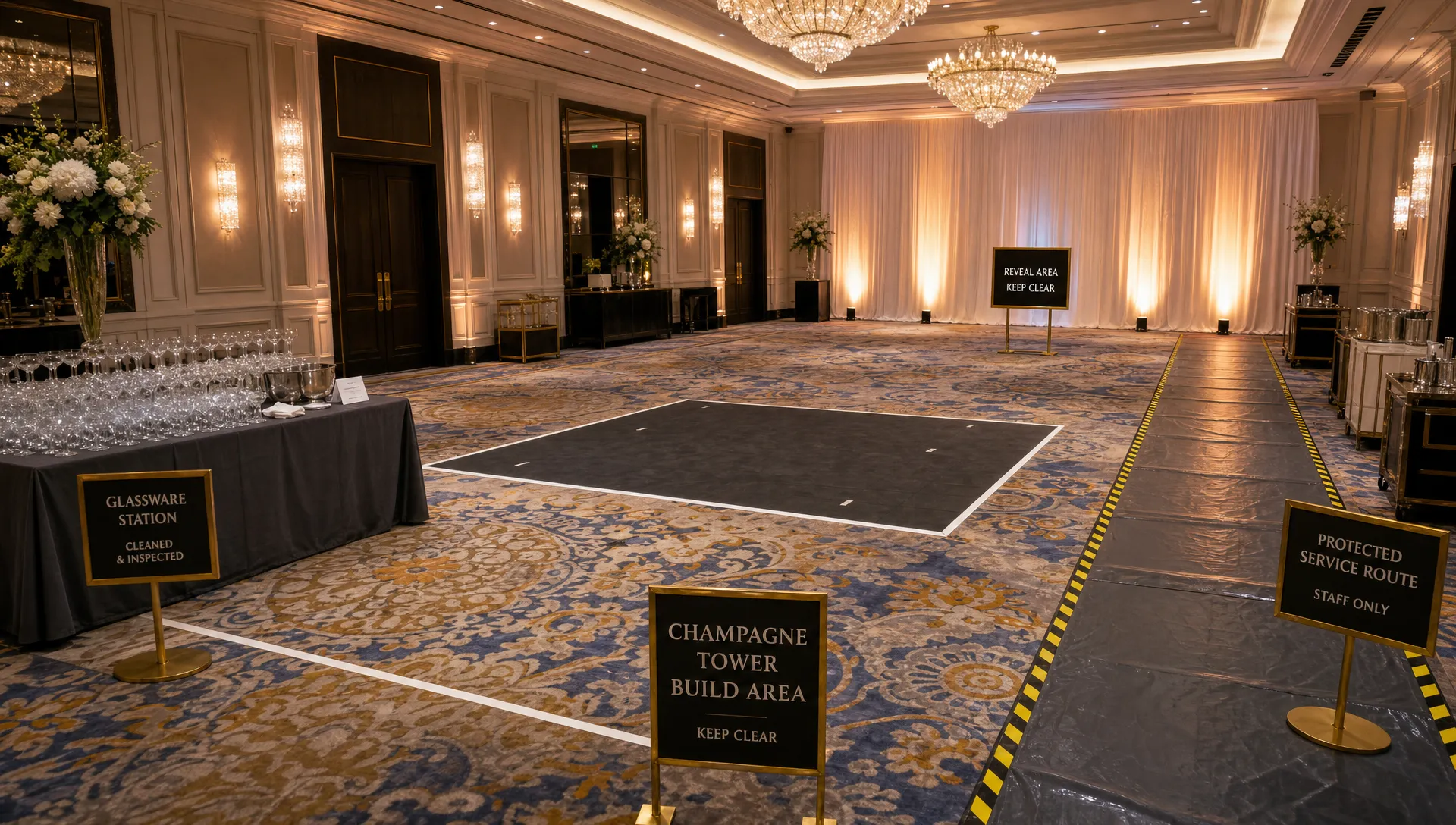
As the tower grows, complexity increases faster than many clients expect. A larger base requires more floor space. A taller structure requires greater control over balance, movement and surrounding activity. Setup may need to happen earlier in the day, and the team may need a protected area so the tower is not disturbed before the reveal.
This is why two towers with a similar visual concept can carry very different costs. A tower for a calm, controlled indoor dinner may be straightforward. A tower in a crowded hospitality suite, outdoor terrace or media-heavy launch environment needs a more robust production plan.
If you are still defining the right format, it is worth considering the relationship between tower size and event purpose. A dramatic centerpiece is powerful when it supports the event goal, not simply when it is the tallest option available. For a more strategic approach, this guide on how to choose the right champagne tower for event goals explains how to align scale with audience, venue and desired impact.
Design ambition and brand integration
At luxury events, the tower rarely stands alone. It sits within a complete environment: floral design, lighting, stage direction, table styling, sponsor visibility, photography angles and guest movement. The more the champagne tower is integrated into that world, the more design planning it requires.
A classic clear-glass tower can be elegant and timeless. A bespoke tower for a luxury brand launch may involve a custom plinth, branded backdrop, curated lighting, color accents, product reveal moments or coordination with a campaign theme. Each of these elements can improve impact, but also adds layers to production.
For weddings, design decisions may include floral framing, candlelight, linen coordination, placement near the cake or dance floor, and the timing of the couple’s first pour. For corporate events, the tower may need to align with brand colors, sponsor positions, camera sightlines and guest flow.
The best champagne towers feel intentional. They do not appear as an add-on. They look as though they belong to the architecture of the event. That level of refinement is a major reason premium experiences command a higher price.
Venue logistics can change the scope completely
A champagne tower is sensitive to its environment. Luxury venues are often beautiful, but not always simple from a production perspective. Historic ballrooms, rooftop terraces, beach clubs, hotel lobbies, yachts and temporary structures can all create different practical considerations.
Key venue questions include:
- Is the floor level, stable and suitable for the planned tower?
- Is there enough ceiling height and surrounding clearance?
- Can the team access the space with equipment at the right time?
- Will the tower be protected from wind, vibration or guest traffic?
- Are there restrictions around glassware, alcohol service or setup hours?
- Does the venue require insurance documents, safety plans or technical approvals?
These factors do not make a champagne tower impossible, but they do influence the plan. A premium supplier will want to understand the room before confirming what is realistic. This is not hesitation. It is professional risk control.
A low-cost provider may simply agree to the request. A specialist will ask the questions that protect the client, the venue and the guest experience.
The professional team behind the moment
One of the most important cost drivers is expertise. A spectacular champagne tower is built on patience, precision and calm under pressure. Guests see the final pour, but the quality of the moment depends on everything that happened earlier.
A professional team may be involved in pre-production calls, venue assessments, transport planning, setup, build supervision, rehearsal, live event timing and breakdown. For larger towers, the team structure becomes even more important. There may be builders, production leads, event coordinators and support crew working around catering, security, photography and venue operations.
This is where specialist experience matters. The larger or more public the event, the less room there is for improvisation. A champagne tower at a luxury gala is not the place to learn through trial and error.
Luuk Broos Events specializes in champagne glass pyramids and has experience with high-profile projects, premium brands and world record concepts. That focus matters because the service is not simply about stacking glasses. It is about delivering a controlled visual spectacle in front of important guests.
Champagne, glassware and service expectations
Another major variable is what the quoted scope includes. Some events require the tower build only. Others require glassware, champagne, service coordination, bar integration, cleanup or a complete ceremonial moment.
The choice of champagne can also have a major impact when the beverage itself is part of the proposal. A tower using premium cuvées for a luxury wedding or brand dinner naturally carries a different product cost than a visual installation where the pour is symbolic or limited to a specific ceremonial quantity.
Glassware quality matters as well. Coupe glasses must suit the desired look, the height of the structure and the safety requirements of the build. Breakage allowances, transport, cleaning and handling can all affect the final production model.
For planners comparing proposals, the key is to check what is included and what remains the responsibility of the venue or caterer. A lower quote may exclude elements that still need to be sourced, coordinated and paid for elsewhere.
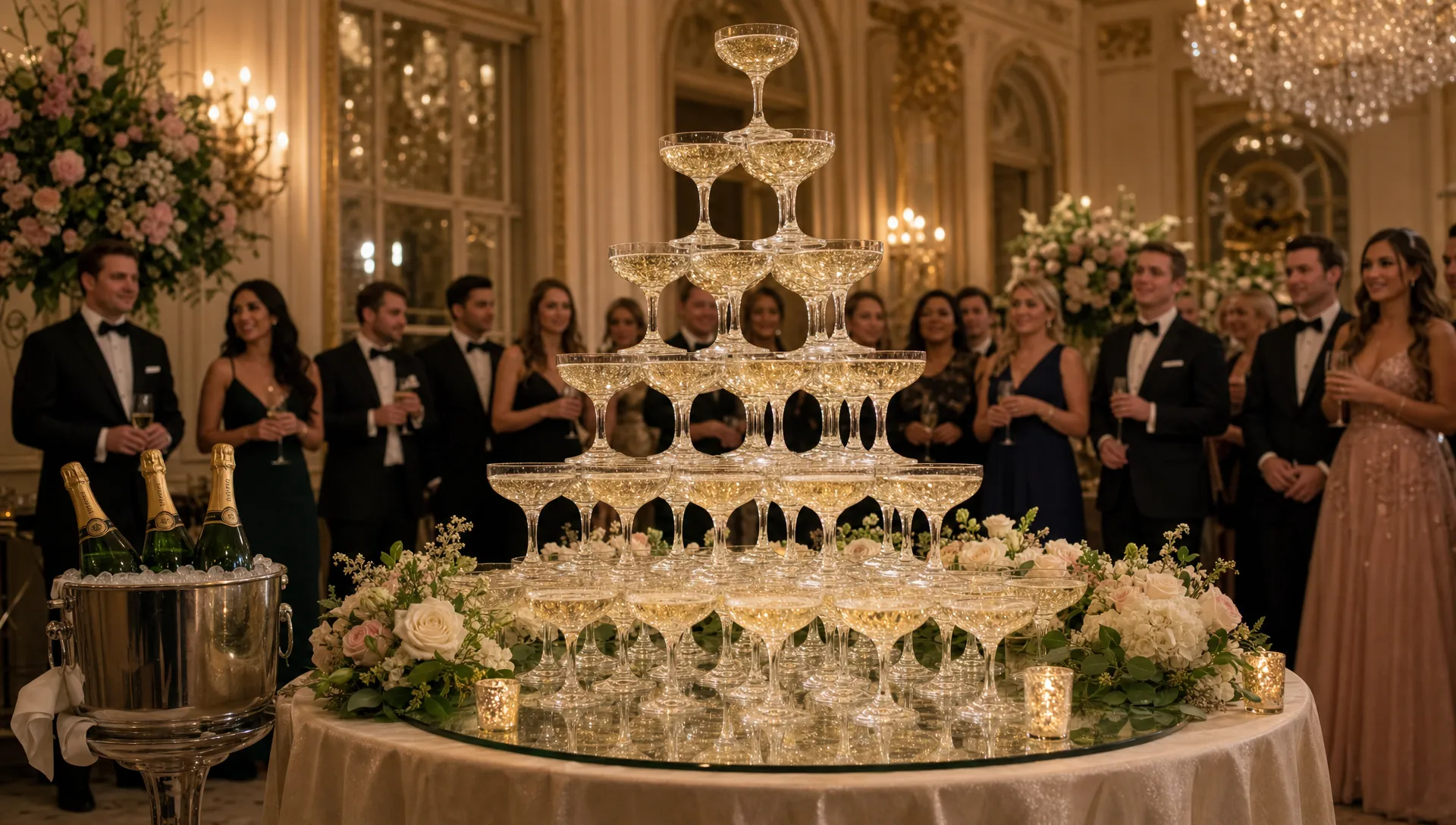
Timing, choreography and guest experience
A champagne tower becomes most powerful when it is treated as a moment, not only an object. Timing can transform the same tower from a decorative feature into the emotional highlight of the evening.
For a wedding, the pour may follow speeches or open the evening celebration. For a hotel opening, it may mark the official reveal. For a brand activation, it may be choreographed with lighting, music, a countdown or a VIP appearance. For a corporate gala, it may serve as a transition from dinner to celebration.
This choreography affects price because it requires coordination. The tower must be ready at the right second. Photographers and videographers need the correct angles. The host or VIP needs to know where to stand. Catering teams need to understand when service begins. Security or guest management may need to protect the area.
A refined event moment feels relaxed because the pressure has been removed from the client. That calmness is part of what premium production buys.
World record ambition and publicity value
A world record champagne pyramid is in a different category from a standard luxury tower. It can generate extraordinary attention, but it also introduces additional planning, documentation and stakeholder management.
Official record attempts require clear criteria, evidence and process. Guinness World Records explains that record applications involve guidelines and supporting evidence, which means the event must be planned with verification in mind from the beginning.
For a luxury brand, resort, destination or sponsor, the value of a world record concept can go beyond the room itself. It can become a press story, a social media asset, a hospitality talking point and a symbol of ambition. However, the production cost must reflect the added requirements: scale, crew, documentation, marketing coordination, safety planning and contingency thinking.
This is why record-level champagne towers should not be priced like ordinary event decor. They are closer to live brand productions. If you are considering a major installation, this article on large champagne tower planning for high-profile events gives useful context on the operational and strategic decisions involved.
The difference between cost and value
In premium events, price should be judged against the value of the moment it creates. A champagne tower can support several objectives at once: guest excitement, luxury positioning, visual storytelling, sponsor visibility, media coverage and social sharing.
For a private wedding, the value may be emotional. It creates a memory and a signature image. For a corporate event, the value may be strategic. It can bring guests together, create a natural photo opportunity and signal that the brand is willing to do something distinctive. For a hotel or venue opening, the value may extend into publicity and long-term brand perception.
This does not mean every event needs the largest or most complex tower. It means the right tower should be measured against the desired outcome. A beautifully executed smaller tower can be more valuable than an oversized concept that does not fit the room, audience or event rhythm.
Luxury is not only scale. Luxury is appropriateness, proportion and precision. The best investment is the one that creates the strongest experience with the least compromise.
What to include when requesting a quote
A detailed brief helps a specialist provide a realistic proposal and prevents surprises later in the planning process. Before asking for a champagne tower price, gather the information that affects scope and feasibility.
Useful details include:
- Event type, date, city and venue name
- Indoor or outdoor setting
- Estimated guest count and audience profile
- Desired tower size or visual ambition
- Purpose of the tower, such as toast, reveal, centerpiece or PR moment
- Preferred timing within the event program
- Champagne and glassware expectations
- Branding, lighting, floral or staging requirements
- Access times, setup restrictions and venue rules
- Media, sponsor or world record ambitions
The clearer the brief, the better the proposal. It also allows the supplier to advise where the investment will create the most impact and where complexity can be reduced without weakening the guest experience.
When a lower price may be false economy
For high-profile events, the cheapest quote is rarely the safest benchmark. A champagne tower is highly visible. If it looks unstable, feels poorly placed or disrupts the flow of the evening, the damage is not only practical. It affects the perception of the entire event.
A lower price may mean fewer team members, less pre-production, limited safety assessment, lower-quality glassware, weaker design integration or less experience with premium venues. These compromises may not be obvious on paper, but they can become very obvious in the room.
The right supplier should inspire confidence before the event begins. They should ask intelligent questions, understand the level of the audience and collaborate smoothly with other event partners. That professionalism is part of the investment.
If your event is designed to impress VIPs, sponsors, luxury guests or international media, the champagne tower should feel as considered as every other premium detail. For a deeper look at the standards behind this kind of experience, explore what defines a truly luxury champagne tower experience.
Frequently asked questions
How much does a champagne tower cost? The cost depends on scale, venue conditions, design complexity, staffing, glassware, champagne requirements and whether the event includes PR or world record ambitions. A specialist proposal is the most reliable way to understand the investment.
Is a larger champagne tower always more expensive? Usually, yes, because larger towers require more glasses, more setup time, more space and stronger risk control. However, design complexity and venue logistics can make a smaller bespoke tower more complex than a larger simple one.
Does champagne tower price include the champagne? It depends on the supplier and the event scope. Some proposals focus on the tower build, while others may include glassware, champagne, service coordination or a complete ceremonial experience. Always confirm inclusions before comparing quotes.
Can a champagne tower be used for outdoor luxury events? Yes, but outdoor conditions require careful assessment. Wind, floor stability, temperature, guest flow and weather contingency planning all affect feasibility and price.
Why hire a specialist instead of a general event supplier? A specialist brings experience in structure, precision, safety, timing and visual impact. For luxury events, that expertise reduces risk and helps ensure the tower feels like a premium centerpiece rather than a decorative experiment.
Create a champagne tower moment worth remembering
A champagne tower should not feel generic. It should feel aligned with the event, the venue, the guests and the ambition behind the occasion. The right price reflects more than materials. It reflects craftsmanship, preparation, confidence and the ability to deliver a flawless spectacle when everyone is watching.
If you are planning a luxury wedding, gala, hotel opening, corporate celebration, brand activation or world record concept, Luuk Broos Events can help you explore the right champagne pyramid for your goals. With a specialist approach, proven record-breaking experience and a focus on premium execution, the result is not only a tower of glasses. It is a moment guests remember long after the event ends.