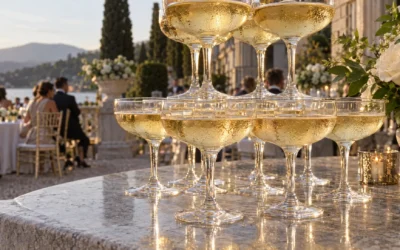


For a high-profile event, a champagne tower is rarely just a decorative feature. At the right scale, in the right setting, it becomes a ceremony, a photo moment, a brand statement and a signal of hospitality all at once.
That is why planning a large champagne tower requires more than choosing glassware and champagne. It asks for creative direction, venue coordination, safety planning, guest-flow design, service choreography and, in many cases, publicity strategy. The goal is not simply to build something tall. The goal is to create a controlled moment of spectacle that feels effortless to every guest in the room.
For luxury event agencies, brand teams, wedding planners and hospitality leaders, the question is not whether a large champagne tower can impress. It is how to make it feel refined, intentional and flawlessly executed.
Start with the purpose of the moment
The most successful champagne tower concepts begin with a clear event objective. A tower for a hotel opening should not be planned in the same way as one for a private wedding, a Formula 1 hospitality evening or a corporate anniversary. The architecture may look similar at first glance, but the emotional purpose is different.
For some events, the tower is the grand reveal. For others, it is a ceremonial toast led by a VIP guest, a sponsor moment for photography or a luxury focal point that anchors the room. When the objective is defined early, every decision becomes sharper, from scale and placement to lighting and service timing.
| Event objective | Planning priority | Desired guest impression |
|---|---|---|
| Brand launch | Strong sightlines, logo integration and media-friendly timing | This brand creates moments worth sharing |
| Hotel opening | A tower positioned to frame the venue as the hero | This property feels prestigious and alive |
| Gala or fundraiser | Elegant ceremony with a clear host or VIP role | This evening has emotional significance |
| Luxury wedding | Refined styling and intimate guest participation | This celebration feels personal and unforgettable |
| VIP hospitality event | Precision, exclusivity and smooth guest flow | Every detail has been considered |
A large champagne tower should feel like a natural extension of the event narrative. If the event is about legacy, the tower can become a symbolic toast. If the event is about innovation, the reveal can be staged with lighting, music and photography that make the moment feel contemporary. If the event is about luxury, restraint matters as much as scale.
Choose a scale that suits the room, not just the ambition
A common planning mistake is assuming that bigger automatically means better. In reality, a large champagne tower works best when its size is proportional to the venue, guest count, ceiling height, camera angles and surrounding design.
An oversized tower in a narrow space can feel forced. A tower that is too modest in a large ballroom can disappear. The ideal scale creates visual dominance without disrupting comfort, service or movement. It should command attention, but it should not make the room feel tense.
Before confirming scale, consider these questions:
- Where will guests see the tower for the first time?
- Will the tower be viewed from one main angle or from all sides?
- How close can photographers and videographers stand without blocking guests?
- Will the tower sit in a lobby, ballroom, terrace, marquee or outdoor hospitality area?
- Does the event need a ceremonial pour, a static visual installation or both?
For planners still comparing formats, the guide on how to choose the right champagne tower for event goals is a useful starting point for aligning the tower with the purpose of the event.
Treat the tower as part of the overall design language
A premium champagne tower should never look as if it was added at the last moment. It needs to belong to the room. That means the glassware, base, lighting, florals, champagne selection, staging and surrounding negative space all need to work together.
The base or plinth is especially important. It defines the visual weight of the tower and affects how elegant the structure feels. A mirrored surface can amplify light and reflections, while a darker base can create contrast and drama. Floral work should enhance the tower without competing with its geometry. Lighting should reveal the glass, not flatten it.
For branded events, restraint is often more powerful than heavy logo placement. A champagne tower already communicates prestige, celebration and abundance. The brand should be visible in a way that feels curated, through the backdrop, bottle presentation, step-and-repeat placement, menu design or event color palette.
When every viewing angle matters, it is worth thinking like a camera director. Guests will photograph the tower from the front, sides, close up and sometimes from balconies or upper levels. Planning for these perspectives is what helps a champagne tower feel flawless from every angle, both in person and in the content that circulates afterward.
Plan the venue like a production environment
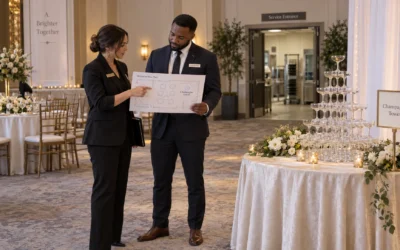
A large champagne tower may look graceful, but behind the scenes it is a precision build. The venue must be assessed as a production environment, not only as a beautiful location. The floor surface, levelness, access routes, guest flow, temperature, lighting rig, service routes and installation schedule all influence the final result.
This is where the difference between a general event supplier and a specialist becomes clear. A professional team understands that the guest should see only the magic, while every technical detail is handled quietly in the background.
| Planning area | What to confirm | Why it matters |
|---|---|---|
| Floor and surface | Levelness, stability and protection | Supports a precise and secure build |
| Access and load-in | Routes, timings and venue restrictions | Prevents last-minute production pressure |
| Guest flow | Barriers, sightlines and service paths | Keeps the experience comfortable and controlled |
| Lighting | Direction, reflection and intensity | Makes the tower photograph beautifully |
| Service coordination | Catering team, champagne handling and timing | Ensures the pour feels seamless |
| Contingency planning | Weather, schedule shifts and venue changes | Protects the event experience under pressure |
For outdoor or semi-outdoor venues, conditions require even closer attention. Wind, uneven surfaces, direct sunlight, temperature changes and guest proximity can all affect the plan. This does not mean outdoor towers are impossible. It means the design must be adapted intelligently.
Choreograph the pour as a luxury performance
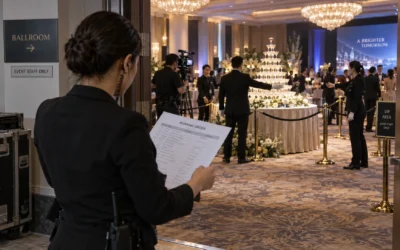
The pour is often the emotional peak of the experience. It is the moment guests raise their phones, photographers move into position and the room turns its attention toward one shared focal point. Because of that, the pour should be planned like a performance.
Timing is critical. If the pour happens too early, key guests may miss it. If it happens too late, the room may lose momentum. The best moment is often after arrivals and before dinner, during a toast, at the end of a speech or as a transition into celebration.
The choreography should answer practical questions in advance. Who initiates the pour? Where do they stand? How close can VIPs be? What does the lighting cue look like? Is there music? Is there a master of ceremonies? Where should photographers stand? Who manages guests who want to get closer?
A high-profile event should feel relaxed, but the production should not be casual. The pour must be calm, controlled and confident. Guest participation can work beautifully, but only when roles are clearly defined and the specialist team remains in control of the technical execution.
Build safety into the luxury experience
Safety is not a separate layer added after the creative concept. It is part of what makes the experience premium. Guests should never feel nervous around the tower, and planners should never feel that the spectacle depends on improvisation.
Important safety considerations include the building surface, the stability of the structure, controlled access, distance from high-traffic areas, environmental conditions, glass handling and the experience level of the team building the tower. The more visible the moment, the more invisible the safety planning should feel.
For a more detailed operational perspective, explore the guide to planning a large champagne tower without compromising safety. It is especially relevant for large venues, outdoor settings, VIP environments and events where many teams are working in the same space.

Coordinate logistics for destination and international events
High-profile events often involve guests, crews, suppliers and brand representatives traveling across cities or countries. When the champagne tower is part of a destination event, logistics become part of the guest experience. The tower team, venue team, catering team, production crew, security, PR contacts and transport partners all need to work from the same schedule.
This matters because a champagne tower is usually connected to a precise moment in the run of show. A late VIP arrival, delayed bottle delivery, blocked loading route or changed room setup can affect the timing. Strong coordination reduces that risk.
For destination events, transport planning should be treated as part of production planning. At events in South Africa, for example, planners may coordinate executive movement and local travel through trusted providers such as premium car hire in South Africa, helping key guests, teams and stakeholders move between airports, hotels and venues with confidence.
The same principle applies anywhere in the world. The larger the event profile, the more valuable it becomes to reduce friction. Guests remember the spectacle, but they also feel the smoothness of the entire experience around it.
Turn the tower into a content and publicity asset
A large champagne tower has strong visual value before, during and after the event. For corporate events, hotel openings, luxury brand activations and international celebrations, this can create value beyond the room itself.
To maximize that value, the tower should be planned with content in mind. The best photographs usually come from a combination of clean sightlines, controlled lighting, elegant guest positioning and a clear hero moment. Video teams need a defined sequence, such as the reveal, the approach, the pour, the reaction and the toast.
Useful success indicators can include:
- Quality and volume of guest-generated content
- Press photography or media pickup
- Sponsor and partner visibility in key shots
- VIP engagement around the tower moment
- Reusable post-event assets for brand channels
- Increased perceived prestige of the event experience
The strongest publicity does not come from forcing attention. It comes from creating a moment that people naturally want to record and share. A champagne tower works well because it is instantly understandable. It signals celebration without needing explanation.
Make the investment measurable
For luxury planners, beauty alone is not always enough to justify a major event feature. Internal stakeholders often want to understand the return. That is why it helps to define the event value model before the concept is approved.
A large champagne tower can support several forms of return. It can increase sponsor appeal, improve guest engagement, create a media hook, elevate brand perception and generate premium content. It can also help an event feel less generic, which is often one of the biggest challenges for planners working with demanding audiences.
The key is to connect the tower to a specific outcome. If the goal is PR, build a story around the moment. If the goal is hospitality, make the guest experience feel elegant and easy. If the goal is sponsor value, ensure the tower is positioned where sponsor visibility is natural. If the goal is emotional impact, make the pour part of a meaningful ceremony rather than a standalone attraction.
Use a planning timeline that protects quality
Premium execution requires enough time for creative alignment, feasibility checks and final coordination. A champagne tower can appear effortless only when the planning process has been disciplined.
| Planning phase | Key focus | Who should be involved |
|---|---|---|
| Concept development | Purpose, scale, guest experience and desired impact | Event planner, client, champagne tower specialist |
| Venue feasibility | Placement, access, surface, lighting and guest flow | Venue manager, production lead, specialist team |
| Creative refinement | Styling, branding, photography angles and ceremony design | Creative director, brand team, florist, lighting team |
| Operational planning | Run sheet, service plan, safety controls and contingency | Catering, security, production and tower team |
| Final coordination | Timing, responsibilities, cues and communication channels | All key event leads |
| Event execution | Build, reveal, pour, guest management and breakdown | Specialist team and event operations |
The earlier the tower team is involved, the easier it is to prevent compromises. Late planning can still work in some cases, but high-profile events benefit from giving specialist suppliers enough room to protect the quality of the result.
Know when a world-record concept is the right move
Not every event needs a world-record attempt. Some occasions call for quiet elegance rather than maximum scale. But for organizations seeking international attention, sponsor value and a powerful story, a record-breaking champagne pyramid can become a defining event concept.
A world-record approach is most suitable when the event has ambition beyond the room itself. It may be a global launch, a landmark anniversary, a luxury hospitality statement or a public celebration designed to attract media. In those cases, the tower becomes more than an installation. It becomes the headline.
This level of concept requires advanced planning, a trusted specialist team and a clear publicity strategy. The impact can be exceptional, but only when the creative idea, technical execution and communication plan are aligned from the beginning.
Frequently asked questions
How large can a large champagne tower be? The right size depends on the venue, ceiling height, floor conditions, guest flow, visual goals and safe build approach. A specialist team can recommend a scale that feels impressive without compromising elegance or control.
Is a large champagne tower suitable for corporate events? Yes, especially for launches, galas, anniversaries, award ceremonies, hospitality events and brand activations. It works best when the tower supports a clear objective, such as PR visibility, sponsor value or VIP guest impact.
Do guests drink from the champagne tower? This depends on the service plan, venue rules and event objectives. Some events use the tower primarily as a ceremonial and visual centerpiece, while champagne service is managed separately. Others integrate the pour into a controlled hospitality moment.
How early should planners start organizing a large champagne tower? Ideally, planning should begin as soon as the venue, guest flow and event program are being developed. Early involvement gives the specialist team time to assess feasibility, refine the design and coordinate with production, catering and venue teams.
Can a champagne tower help generate media attention? Yes, when it is connected to a strong story, a striking visual setup and a well-timed reveal. A world-record concept, luxury brand partnership or high-profile location can increase the publicity potential significantly.
Create a champagne moment guests will remember
A large champagne tower is at its most powerful when spectacle and precision work together. It should feel glamorous to guests, reliable to planners and valuable to the brand or host behind the event.
Luuk Broos Events specializes in spectacular champagne pyramid experiences, from tailor-made towers to world-record concepts. With a focus on craftsmanship, teamwork and premium execution, the team helps turn high-profile events into memorable visual moments that guests keep talking about long after the final toast.