


Knowing how to break a world record means planning two outcomes: a remarkable live experience and a result that can withstand independent review. For a hotel opening, luxury brand activation or gala, the spectacle may last minutes. The proof must remain clear long after the guests leave.
Build the evidence plan before locking the production plan. Camera positions, counting methods, witness access and announcement timing can all affect the event design. A successful attempt needs more than an impressive photograph. It needs a documented chain from the approved rules to the final result.
Choose an eligible record and a credible recognizing body
Start with the exact record title, its current benchmark and the organization that will assess the attempt. A Guinness World Records title and recognition from another record organization are not interchangeable. Each organization sets its own eligibility criteria, application process and evidence requirements.
Do not assume that an unusual event concept automatically qualifies as a new category. Submit the proposal through the chosen organization’s process and establish whether the achievement is measurable, repeatable and eligible under its criteria.
Before committing publicly, verify the current world record and its applicable conditions. Record the source and date of that check, then confirm the target through your application correspondence.
For a luxury event, also ask whether the record can be verified within the venue’s practical constraints. A visually outstanding concept is unsuitable if its measurement requires access, visibility or uninterrupted time that the program cannot accommodate.
Confirm how to break a world record under the approved rules
An application is not confirmation that a record has been achieved. Treat eligibility acceptance, receipt of guidelines, the attempt itself and final recognition as separate milestones.
For Guinness World Records, begin with its official guidance on setting or breaking a world record. Application routes, fees, review times and options for on-site adjudication vary. Confirm the route appropriate to your organization and event rather than relying on another applicant’s experience.
Once the applicable guidelines arrive, identify the details that affect production:
- The qualifying target and exact measurement or counting method.
- Required equipment, conditions and start or finish definitions.
- Witness independence, qualifications and documentation.
- Required video, photographs, statements and supporting records.
- Participant eligibility, restrictions and submission instructions.
Resolve ambiguities with the recognizing organization in writing. Keep the response with the applicable version of the guidelines.
Do not quietly adapt a criterion to suit the creative concept. A change to materials, dimensions, participant roles or measurement may change whether the result qualifies. Obtain clarification before rehearsing the wrong format.
Build an evidence matrix with named owners
For the production team, the question of how to break a world record becomes practical: who proves each requirement, with what evidence and at which moment?
Create one evidence matrix from the approved guidelines. The following is a planning template, not a universal submission checklist. Replace each example with the actual requirements for your chosen title.
| Requirement to verify | Capture method | Accountable role | Readiness check |
|---|---|---|---|
| Correct setup and materials | Photographs, specifications or inspection records as required | Technical lead | Required details are visible and documented |
| Valid count or measurement | Approved tally, measurement record or equipment output | Measurement lead | Method matches the guidelines |
| Complete attempt sequence | Continuous video where required, with supporting views | Evidence camera lead | Relevant actions remain visible |
| Independent observation | Statements and credentials where required | Witness coordinator | Eligibility and availability are checked |
| Final qualifying result | Required result images and signed records | Evidence producer | Recorded figures agree |
| Submission completeness | Indexed files and completed forms | Submission owner | Every required item is accounted for |
Give the evidence producer authority to flag a readiness problem before the attempt begins. This person should not simultaneously be responsible for hosting VIPs or directing the entertainment.
Allocate budget to verification personnel, equipment, rehearsal time and file handling. These are part of delivering a credible result, not optional additions to the photography package.
Separate verification footage from the brand film
A brand film tells a story through selected moments. Verification footage must show what happened without concealing information the reviewer needs.
When planning how to break a world record, treat the evidence camera as a fixed production requirement rather than a roaming creative resource. If continuous footage is required, do not divert that camera for a guest reaction or sponsor shot.
Build the capture plan around the likely points of uncertainty. Can the reviewer see the relevant area? Could a crowd, floral installation or lighting change obscure the count? Are close-up details supported by a wider view that establishes context?
Use backup recording where feasible, while recognizing that a second camera does not automatically satisfy a requirement for one uninterrupted view. Test power, recording duration, storage and low-light performance under show conditions.
Keep original files intact. Edited highlights can support publicity, but they should not replace the source material required for assessment.
Rehearse the measurement, not just the spectacle
A rehearsal should test the proof as carefully as the performance. Walk through setup inspection, counting or measurement, witness positioning, the start cue, the finish condition and the collection of statements.
Rehearsal is where a plan for how to break a world record becomes a testable production sequence. Ask someone unfamiliar with the build to review the test evidence against the guidelines. Missing context is easier to spot before the live event.
For a champagne pyramid, for example, the relevant rules may require details that a distant beauty shot cannot establish. Depending on the title, those details could concern individual glasses, the completed configuration or a defined completion condition. Use the approved criteria rather than assuming that height or appearance proves the result.
Test how the count will be recorded and reconciled. Identify any planned pause points where checks can occur without invalidating the attempt. Settle discrepancies before the final reveal, not while the host is waiting for a number.
A useful rehearsal deliverable is a short sample evidence package. It tests whether the team can produce reviewable documentation, not merely operate the equipment.
Protect safety, accessibility and witness access
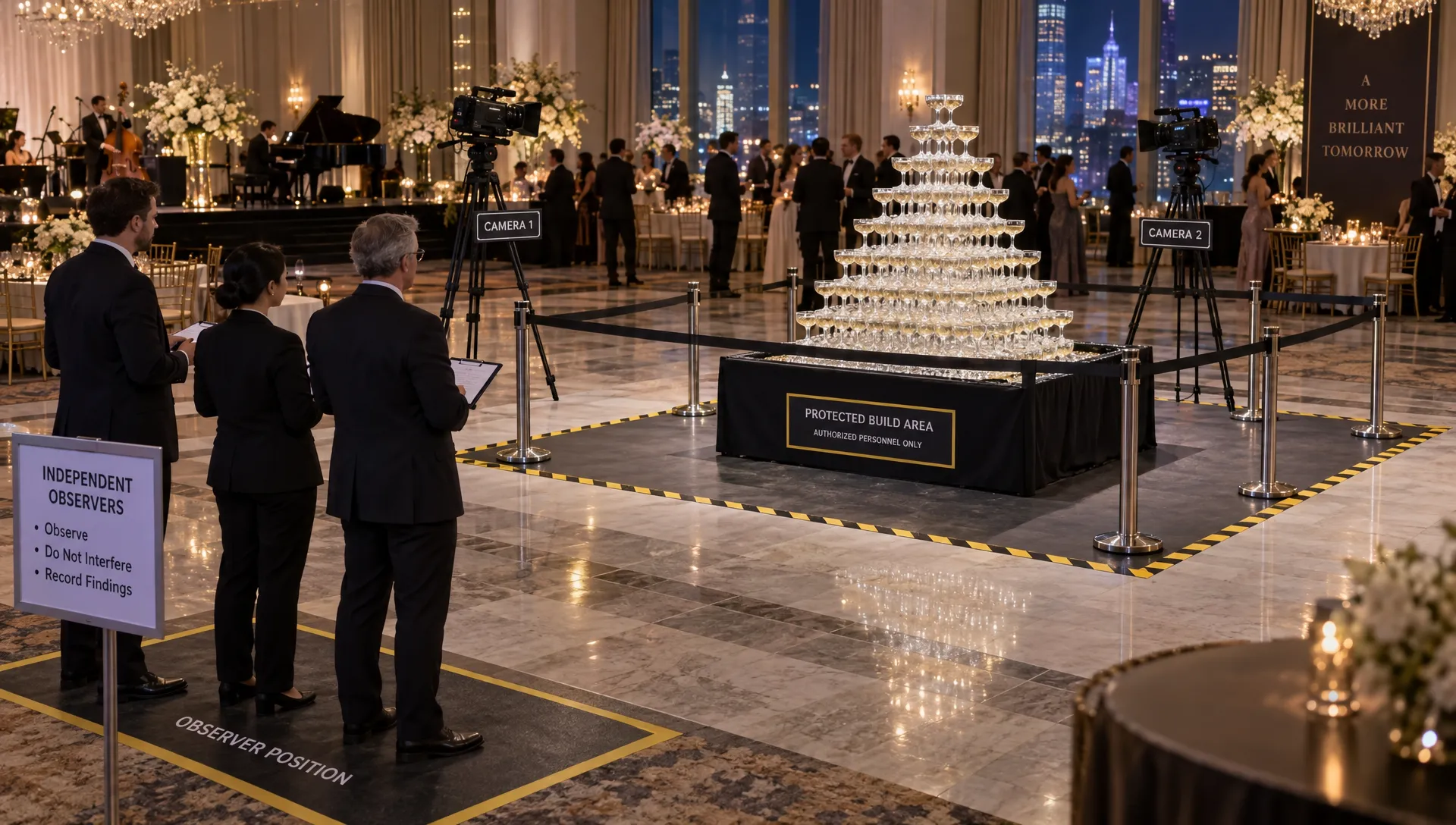
Verification positions must work alongside safe working areas, guest circulation and emergency access. A clear camera angle is not a reason to place an operator inside a restricted build zone.
A credible approach to how to break a world record also accounts for who can participate and under what conditions. Check age restrictions, participant eligibility and any activity-specific requirements with the recognizing organization. Address local rules concerning alcohol, glass, occupancy and public participation where relevant.
Plan accessible routes and viewing positions early. If an adaptation affects the measured activity, seek confirmation that it remains compatible with the record criteria. Accessibility should not depend on an unapproved rule change on the day.
Where independent witnesses are required, check the organization’s definition of independence and any qualifications it specifies. Disclose potential conflicts rather than assuming a client representative, supplier or guest qualifies. Give witnesses the guidelines and sufficient access to observe what they must attest to.
Run the attempt against clear verification gates
Use a concise run sheet with evidence checkpoints alongside lighting, sound and hospitality cues. Each checkpoint should have an owner and a clear condition for proceeding.
Before the start: Confirm the correct setup, required witnesses, measurement equipment and recording coverage. Check that files are actually recording, not simply that cameras are powered on.
During the attempt: Maintain the required observation and capture conditions. Log relevant incidents and rule-defined milestones. Avoid introducing effects, performers or guest movement that obstruct essential evidence.
At completion: Apply the specified finish condition, record the result and capture any required final-state evidence before dismantling or changing the setup.
On show day, knowing how to break a world record includes knowing when not to proceed. A missing witness, blocked view or unverified measurement can justify a delay even when the room is ready for the reveal.
Keep the host’s language aligned with the status of the attempt. Unless an authorized adjudication process has confirmed the outcome, the event team should not announce an officially recognized record.
Decide what happens if evidence is compromised
Prepare a recovery decision before the event. If a camera stops, a tally conflicts or the setup changes unexpectedly, who assesses the issue and who authorizes the next step?
Do not assume missing footage can be replaced by a written explanation. Whether a restart, repeat measurement or additional evidence is acceptable depends on the rules and circumstances. Seek guidance from the recognizing organization where necessary.
If the proof is incomplete, preserve what exists and document the problem honestly. Do not reconstruct footage or describe an unobserved result as independently verified.
The guest experience can still continue with a planned celebration or presentation. Keeping the live program successful does not require overstating the record outcome.
Submit an indexed, traceable evidence package
The final stage of how to break a world record is making the achievement assessable by someone who was not in the room. The submission should explain how each requirement was met without asking the reviewer to guess.
Follow the organization’s submission instructions first. Within those requirements, make the material easy to navigate through consistent filenames, clear descriptions and a record of which file supports which criterion.
Useful internal controls include:
- A requirement-to-file index referencing the applicable guidelines.
- Original video and photographic files, preserved separately from edited publicity assets.
- Completed statements and measurement records with consistent identifying details.
- An incident log explaining interruptions, discrepancies and corrective action.
- Secure backups and a named owner for review correspondence.
Check that the claimed result agrees across the application, statements and measurement documents. Resolve legitimate clerical errors transparently, without altering source evidence.
Arrange backups before cards or devices are cleared. Restrict access to identifiable footage and personal information, and plan notices, permissions and retention arrangements appropriate to the event and applicable law.
Submission is a distinct project milestone. Keep responsibility assigned until any follow-up questions have been answered and the organization has communicated its decision.
Match publicity to the confirmed result
Evidence planning also protects the brand’s announcement. Agree on wording for three situations: an attempt is planned, an attempt has taken place with review pending and recognition has been confirmed.
For teams learning how to break a world record for commercial impact, this distinction matters. Sponsor decks, press releases and social captions should not imply official recognition before it exists. Use the recognizing organization’s name, marks and certification language only in accordance with the relevant permissions.
Prepare draft communications in advance, but retain an approval checkpoint before release. Do not promise same-evening confirmation unless the chosen adjudication arrangement supports it.
This lets the event deliver an immediate visual story while reserving the verified achievement for an accurate announcement. It also prevents a successful evening from becoming a correction exercise the next morning.
Frequently asked questions
Can any event concept become a world record? No. The recognizing organization must accept the category and its criteria. A distinctive spectacle may still be better presented as a signature event experience rather than an official record attempt.
What is the easiest way to break a world record at an event? Choose an eligible record that fits the venue, team and available preparation time. When assessing how to break a world record, prioritize reliable execution and clear verification over an apparently low benchmark.
How many independent witnesses are needed? Follow the requirements issued for the specific record and service route. There is no single witness number or qualification standard that applies to every organization and attempt.
Does an on-site adjudicator replace the evidence plan? Do not assume so. Confirm what the adjudicator will assess, what supporting material remains necessary and how the result will be communicated.
How long does approval take? Application and evidence-review timelines depend on the organization, category, service option and completeness of the submission. Confirm current timings before making public commitments.
Create a spectacle with verification designed in
Luuk Broos Events specializes in record-breaking champagne pyramids and smaller champagne towers, combining a professional building team with a tailored approach to each event. Its experience with premium brands and international venues brings relevant craftsmanship to an ambitious centerpiece.
If a champagne pyramid suits your occasion, discuss the concept with Luuk Broos Events before finalizing the venue layout and reveal. Share the proposed record, recognizing organization, event date and available guidelines so that the physical spectacle and its verification requirements can be considered together.