


When you plan a champagne tower for wedding celebrations, the photographer needs more than its position on the reception timeline. They need to know where the couple will stand, how the pour will unfold and which images matter most. The first stream of champagne, the couple’s reaction and the room’s response happen on their own terms, not on request.
For luxury wedding planners, the brief should connect the creative ambition with the practical production plan. A beautiful reference image is useful, but it cannot replace clear camera access, agreed lighting and one person responsible for the start cue.
The aim is a short, usable document that helps the photographer capture the spectacle without interrupting it.
Define the image the couple actually wants
Start by choosing one priority photograph. This might be an architectural view of the complete tower, an intimate image of the couple pouring together or a wider frame showing the reception around them.
Share two or three references and explain what matters in each: the composition, the atmosphere or the relationship between the couple and the glassware. Separate those preferences from details that cannot be reproduced at your venue.
Frame the champagne tower for wedding photography
Ask the photographer to plan a sequence rather than deliver several variations of the same pouring shot. The finished gallery should establish the setting, build anticipation and show what the experience felt like.
A compact shot list makes those priorities clear without directing every movement.
| Moment | Essential photograph | What the brief should clarify |
|---|---|---|
| Completed setup | Full tower before guests approach | When the builder will release the area for photography |
| Design details | Glass rims, table finish and nearby styling | Which details are meaningful to the couple |
| Couple’s arrival | Approach and first reaction | Their route and final standing positions |
| Opening pour | Faces, bottle and top glass in one composition | Who pours and where the photographer can stand |
| Flow through the tower | Champagne moving between the glasses | Whether a second camera angle is available |
| Shared reaction | Couple, family or guests responding | Any priority people to include |
| Closing moment | Acknowledgment, toast or portrait | What happens before service begins |
Protect the opening pour as the priority. Detail photographs should not cause the photographer to miss the couple’s expressions. If there is only one photographer, agree which perspective takes precedence rather than expecting simultaneous coverage from opposite sides.
Give the photographer a location and lighting brief
Lighting a champagne tower for wedding photography means balancing transparent glass, reflective surfaces and faces in the same scene. A setup that looks impressive to guests may still place the couple against a distracting doorway or leave their faces much darker than the background.
Send the photographer a floor plan, the proposed tower position and photographs of the surrounding space. Include the table dimensions and planned tower dimensions once the specialist confirms them. These help the photographer assess sightlines and lens choices without guessing the scale.
Review the light at the actual event time
A daytime venue visit will not necessarily reveal the conditions during an evening reception. Share the lighting plan and flag any changes scheduled immediately before or during the pour.
Ask the photographer and lighting team to agree how they will retain detail in the glass while keeping skin tones flattering. Avoid prescribing universal camera settings: the right exposure depends on movement, ambient light and the photographer’s approach.
Confirm venue restrictions on flash, lighting stands and electrical access. Any additional equipment needs an approved position outside guest routes and the tower’s working area.
If the background or decor is still being developed, resolve those choices alongside your champagne wedding tower styling, rather than asking the photographer to disguise unresolved production details afterward.
Rehearse the sequence and assign one cue caller
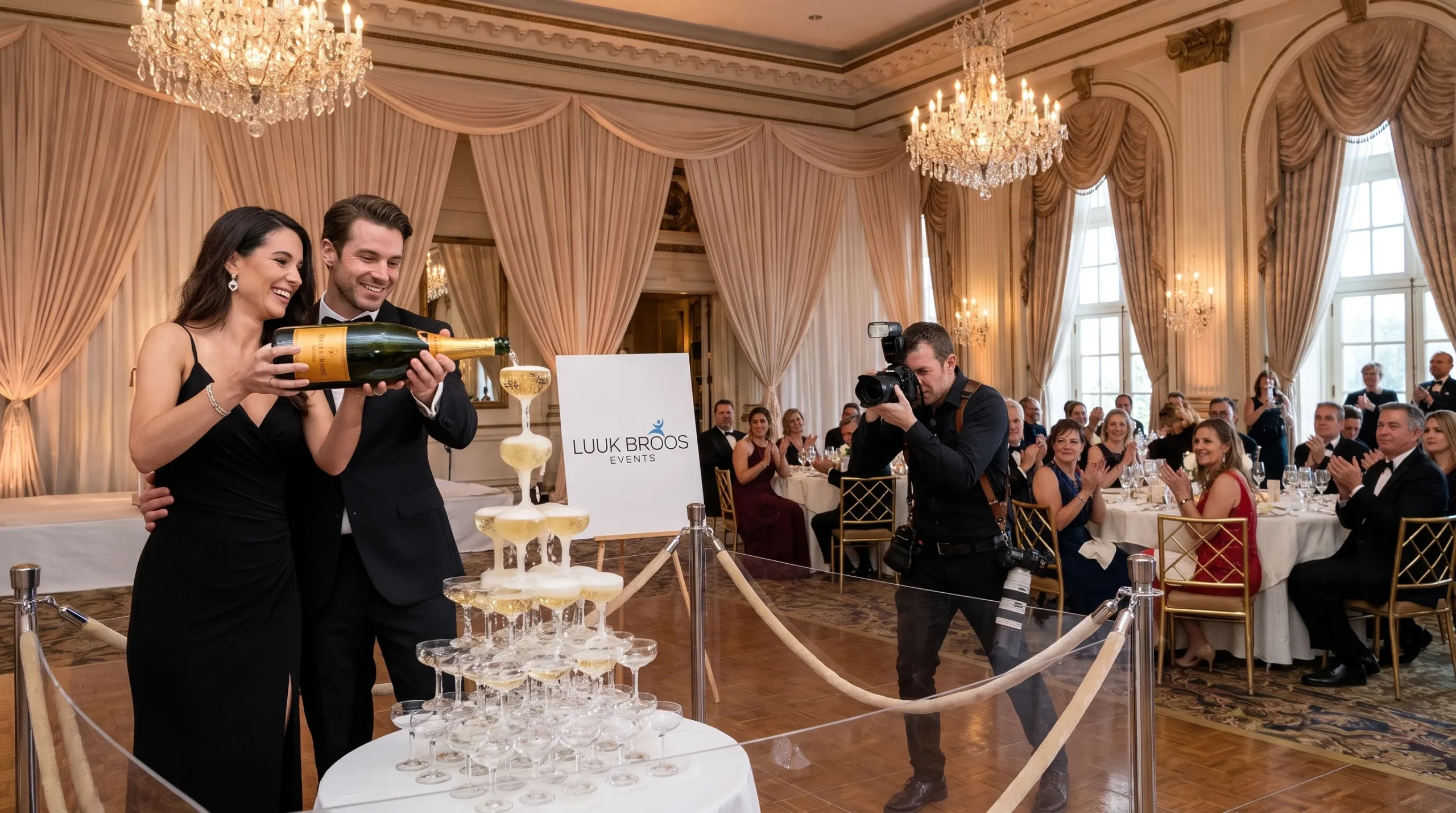
For a champagne tower for wedding celebrations, the opening pour should begin on one agreed cue. Otherwise, the couple may start while the photographer is changing position, the videographer is adjusting equipment or service staff are still crossing the frame.
Name a cue caller, usually the planner or designated production lead. That person checks readiness with the tower specialist, photography team, videographer and venue before inviting the couple forward.
The tower specialist should explain the approved pouring position and handling requirements. The photographer can then confirm where the couple’s faces, hands and bottle will sit within the composition. If those needs conflict, adjust the camera position or staging before the live moment.
Put the photography windows into the run of show
Reserve a clear opportunity to photograph the completed tower before guests gather. Identify when the couple will receive their instructions and what follows the final pour.
The brief should also say whether speeches, an announcement or music will accompany the moment. These affect where the couple looks and when the photographer can expect reactions.
Your choice of timing for the wedding champagne tower should support both the guest experience and workable photographic conditions. Do not let an unplanned portrait session delay dinner service or leave guests waiting without direction.
Agree camera access, guest positions and a recovery plan
A champagne tower for wedding portraits still needs a working safety perimeter, even when the finished composition looks intimate. The tower specialist should define access and handling limits; the photography team should work within them.
Mark the intended camera positions on the floor plan rather than relying on “somewhere in front.” Include the videographer’s position so neither team has to cross the other’s frame during the pour. Where a second photographer is booked, allocate complementary views rather than duplicate coverage.
Tell the planner where immediate family and guests may stand. An enthusiastic guest holding a phone can block the main angle, but managing that guest should not become the photographer’s job at the critical moment.
Keep contingencies out of the couple’s hands
Agree who pauses the sequence if there is a spill, damaged glassware or an access problem. Venue staff and the tower specialist should manage the response, with photography resuming only when the area is released as safe.
For an outdoor installation, confirm how any weather-related relocation changes the camera positions and lighting plan. If the planned tower cannot proceed safely, the photographer should know which alternative moment the planner has approved.
Never assume a missed photograph justifies another pour, moving the completed tower or removing glasses. Any adjustment requires the specialist’s approval.
Send a one-page brief the team can actually use
Keep the working document short enough to consult on the wedding day. Attach the floor plan and selected references separately, then distribute the same version to the planner, tower specialist, photographer, videographer and venue lead.
Use the following template when briefing a champagne tower for wedding coverage. Replace the bracketed fields with confirmed information, and label anything still awaiting approval.
Creative priority: [Describe the single most important image.] The supporting sequence should show [setting, anticipation, pour and reactions]. Reference images are attached with notes explaining the relevant details.
Installation and background: The tower will stand at [approved location], with [confirmed dimensions] and [background description]. The preferred photographic view is [direction], subject to the specialist’s access requirements.
People and positions: [Names] will pour from [approved side]. Their approach route is [route]. Priority family reactions are [names or relationships]. Guest viewing positions are shown on the floor plan.
Timing and cues: Completed-tower photography is scheduled for [time or production milestone]. The couple will be briefed at [time]. [Named role] gives the start cue after all teams confirm readiness. The next scheduled activity is [activity].
Lighting and coverage: Expected lighting conditions are [details]. Approved additional equipment is [details]. The lead photographer covers [priority angle]; any second photographer or videographer covers [complementary angle].
Safety and contingency: The tower specialist controls access and handling. [Named role] pauses proceedings if necessary. The approved relocation or alternative moment is [plan], with revised photography positions attached where applicable.
Contacts and delivery: Day-of contacts are [names and numbers]. Agreed image formats, preview arrangements and usage permissions are recorded in [contract or production document].
Confirm delivery, editing and publication permissions
The photographic brief should continue beyond the live moment. Agree how the images will be used before requesting particular crops, turnaround times or supplier access.
For a champagne tower for wedding celebrations, the couple’s album may be the primary destination, but planners may also want photographs for a portfolio, venue submission or social post. Those uses are not automatically interchangeable.
Confirm whether the contracted coverage includes horizontal scene-setting photographs, vertical compositions and detail images suitable for the intended channels. Ask the photographer to prioritize what is achievable without compromising the main coverage, rather than promising every format from every moment.
Separate the couple’s gallery from supplier publicity
Record any agreed preview deadline, delivery method and credit requirements. If rapid publication matters, negotiate it in advance instead of making an urgent request during the reception.
Discuss publication permissions with the couple and photographer, including any venue or supplier requirements. Receiving a photograph does not automatically grant unrestricted commercial usage.
Also align expectations around editing. Do not assume that removing guests, changing the background or reconstructing a missed champagne stream is included. A clean background and well-managed viewing positions are production decisions first, not retouching requests later.
Frequently asked questions
Does the photographer need to attend the tower setup? Not necessarily throughout construction. They need a confirmed opportunity to photograph the completed installation before the area becomes busy. An earlier technical review is useful when the venue layout, lighting or installation scale makes camera access difficult.
Is a second photographer necessary? Not for every wedding. One photographer can capture a strong sequence when the priorities and positions are clear. A second photographer is worth discussing when the couple wants simultaneous coverage of the pour, a wide room view and guest reactions. Confirm whether that coverage is included or separately contracted.
Can the couple pause during the pour for photographs? Any pauses must be agreed with the tower specialist beforehand. The photographer should plan around the approved sequence, not introduce handling instructions during the live moment. Posed photographs can be scheduled separately when the specialist confirms they are appropriate.
Should guests be asked to put their phones away? If an unobstructed view is important, the planner can arrange a brief announcement and clearly defined guest positions. This is usually more effective than asking the photographer to manage phones while covering the pour.
Bring the tower specialist into the photographic brief early
The strongest images of a champagne tower for wedding celebrations begin with a shared production plan. Involve the specialist before camera positions, lighting and the couple’s choreography are treated as final.
Luuk Broos Events creates tailor-made champagne pyramids, from smaller towers to world-record-scale spectacles. Discuss your venue, desired scale and photographic priorities with the team so the wedding planner and photographer can build their brief around the installation’s confirmed requirements.