



Knowing how to break Guinness World Records starts with more than choosing an extraordinary challenge. For a luxury launch, gala or hospitality event, the real task is making a demanding attempt work within a live production. The team must deliver precise execution without compromising safety, guest experience or the conditions required for official recognition.
A focused rehearsal plan turns that ambition into something testable. Rather than repeating the entire spectacle and hoping it improves, each session should resolve a specific uncertainty: technique, coordination, measurement, timing or readiness under event conditions.
Confirm the rules before rehearsing the performance
Start with the exact record title and the current record-specific guidelines supplied through the official application process. Check the benchmark directly with Guinness World Records rather than relying on an older article, video or supplier presentation. Ask how changes to the record before your event would affect the attempt.
The official guide to setting or breaking a record is a useful starting point. A proposed new title must be accepted before you can confidently rehearse against its requirements.
Translate the guidelines into a working brief covering permitted materials, valid performance conditions, measurement and evidence. Record the guideline version and keep unresolved questions visible until they receive clarification.
For a brand-led event, confirm the appropriate application or commercial route and allow for its lead times. Do not commit the production to a particular outcome before the record's feasibility is understood.
How to break Guinness World Records with a focused rehearsal plan
Build the schedule backward from the event, leaving room to correct problems after the final major rehearsal. A rehearsal held immediately before guest arrival may confirm readiness, but it leaves little opportunity to redesign equipment, replace unsuitable materials or change the production sequence.
The following framework is illustrative, not an official Guinness World Records requirement. Its duration should reflect the attempt's scale, complexity and approved rules.
| Rehearsal stage | Main question | Required output |
|---|---|---|
| Technical baseline | Can the method produce a valid result? | A repeatable working method |
| Team coordination | Can people and materials move without conflict? | Clear roles and tested handovers |
| Environmental testing | Does the method work under representative event conditions? | Resolved venue and production issues |
| Full dress rehearsal | Can the complete operation run together? | A documented readiness decision |
| Final checks | Has anything material changed? | Confirmation or a targeted retest |
Give every session an owner, a defined objective and a short debrief. Success means resolving the question the session was designed to answer, not simply completing another run.
Stage 1: establish a repeatable technical baseline
For teams learning how to break Guinness World Records, the first rehearsal should establish a reliable method rather than chase the most impressive result.
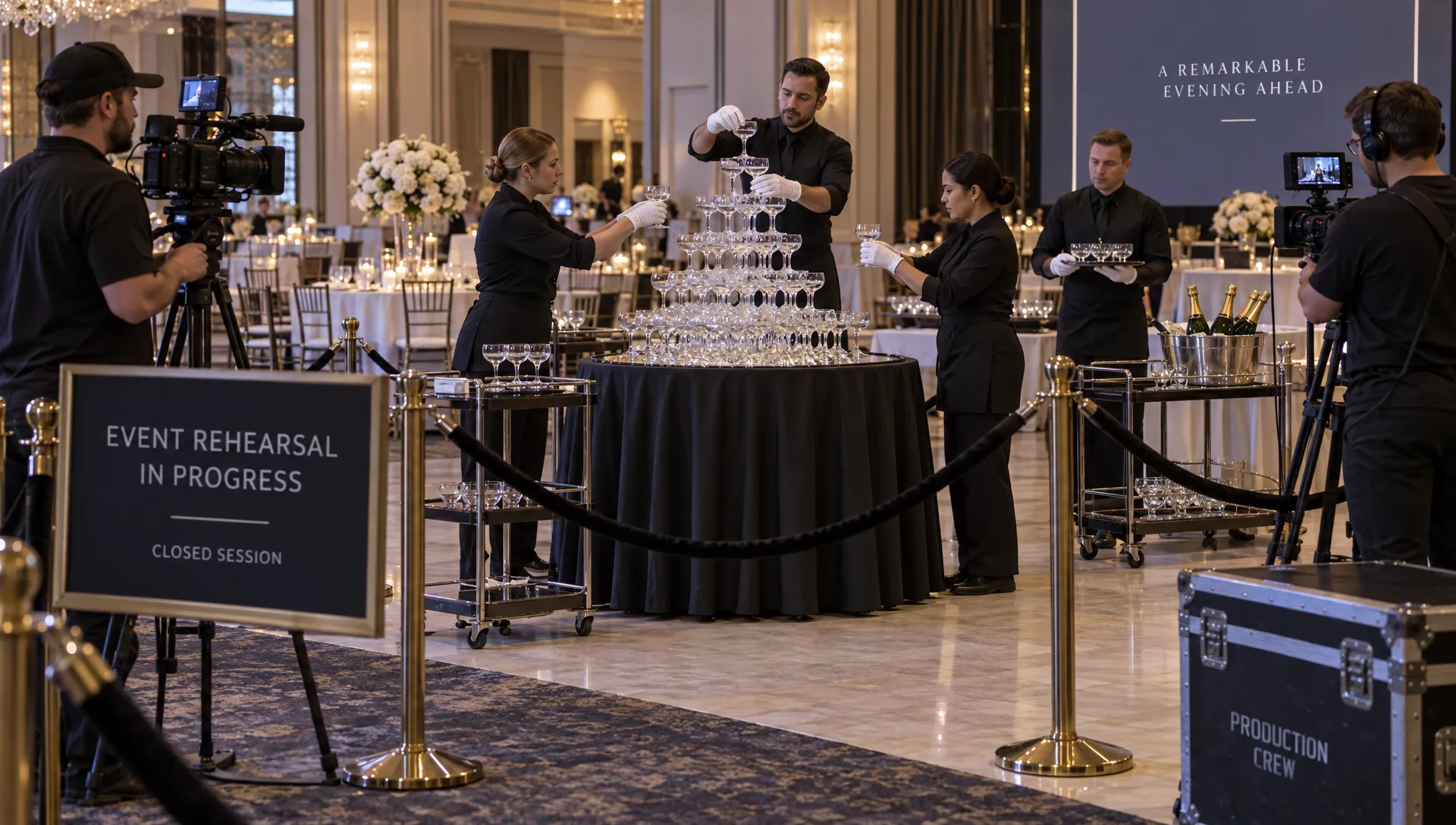
In a champagne pyramid project, this may mean testing the selected glassware, the agreed assembly sequence and the suitability of the proposed working area. The responsible specialists should determine what needs testing and whether venue or engineering input is required. A successful small assembly does not, by itself, demonstrate that a much larger structure will be safe.
Record what actually happened: setup duration, handling difficulties, damaged materials, interruptions and any deviation from the approved method. Separate hands-on task time from preparation and reset time, because the event schedule must accommodate all three.
Use representative materials wherever practical. If substitutes are necessary, document what they cannot prove. Practicing with different glassware, for example, may help people learn their positions without validating the final construction method.
End this stage with a method the team can repeat and a list of remaining uncertainties. An isolated best performance is not yet a dependable production plan.
Stage 2: rehearse the handovers between people
Individual skill does not guarantee a coordinated attempt. Problems often appear where responsibilities meet: materials arrive late, two people enter the same working space or nobody knows who can authorize a pause.
Assign responsibility for the performance, safety decisions, material supply, evidence capture and communication with event production. Smaller teams may combine compatible responsibilities, but nobody should be given simultaneous tasks that prevent proper attention to either one.
Rehearse the actual handovers. Test how replacement materials reach the working area, how a concern is reported and how the event director learns that the attempt is ready. Use the same communication channels planned for the event, including radios where appropriate.
Understanding how to break Guinness World Records also means understanding how to stop an attempt cleanly. Agree who can call a pause, who can authorize a restart and what requires abandonment rather than recovery.
Afterward, replace vague observations such as “communication needs improvement” with an actionable correction: name the responsible person, specify the cue and test the revised handover in the next session.
Stage 3: test the conditions that could change performance
A quiet rehearsal space cannot reproduce every pressure of a hotel opening, sponsor activation or VIP reception. Identify the environmental differences that could materially affect execution, then test those differences deliberately.
Relevant variables may include lighting, airflow, access restrictions, floor conditions, nearby production activity and the distance between storage and the working area. Assess them with the venue and the responsible technical specialists rather than assuming an attractive location is automatically suitable.
For planners researching how to break Guinness World Records at a live event, this is where rehearsal becomes production risk management. Test whether the team can work within the actual access window and whether other departments can operate without entering restricted space.
Introduce one complication at a time during controlled exercises. A simulated late delivery can test escalation and contingency planning. A delayed stage cue can test communication. Do not create physical hazards or destabilize a structure to make practice feel more realistic.
Log each problem with an owner and a retest date. A discussed problem remains open until the revised approach has been checked.
Stage 4: run the complete show, including verification
The dress rehearsal should connect the attempt to the surrounding event. Include load-in assumptions, setup, technical checks, performer or builder positions, witness arrangements where required, camera coverage, host cues and the planned transition afterward.
Evidence capture needs its own rehearsal. Check that the required action remains visible, that any timing or measurement can be documented as specified and that the recording workflow can cover the necessary duration. An elegant promotional film is not automatically suitable verification evidence.
Our guide to an event-ready evidence plan explores that documentation work in more detail. Here, the objective is to prove that it functions alongside the live production rather than competing with it.
A practical answer to how to break Guinness World Records must account for what happens immediately after the performance, too. Rehearse the hold before an announcement, the protection of any evidence still needed and the safe release of the working area.
Do not repeat an expensive or physically demanding full-scale attempt without a clear purpose. A complete rehearsal should answer questions that smaller technical sessions cannot, with its scope agreed by the relevant specialists.
Set clear go, revise and stop criteria
Before the dress rehearsal, agree what would make the team ready to proceed. This prevents enthusiasm, sunk costs or the arrival of important guests from becoming the deciding factor.
Use the official requirements as non-negotiable conditions. Alongside them, establish internal production criteria appropriate to the event. These are your team's readiness measures, not additional Guinness World Records rules.
A useful readiness review checks whether:
- The proposed method follows the current record-specific guidelines.
- Required personnel understand and have practiced their responsibilities.
- Safety concerns have been resolved by the appropriate responsible parties.
- Measurement and evidence arrangements have passed a realistic test.
- The schedule includes workable preparation, recovery and clearance time.
Learning how to break Guinness World Records includes recognizing when not to proceed. A critical unresolved safety issue, an untested material substitution or missing required evidence arrangements should trigger a pause and review, not an optimistic assumption.
Keep a brief decision log stating the issue, the supporting observation, the owner and the decision. A late change should prompt a proportionate retest of the affected work. If the change undermines the method itself, a quick verbal approval is not enough.
The aim is not to remove every uncertainty. It is to distinguish manageable variation from conditions that invalidate the attempt or make delivery unacceptable.
Protect the guest experience without pressuring the attempt
A luxury audience should experience a composed production, even when the work behind it is demanding. Build flexibility into the running order so the technical team is not forced to choose between an unsafe shortcut and an awkward silence.
Prepare host language for three outcomes: readiness, delay and an attempt that cannot proceed. Keep the wording accurate and restrained. An attempted record is not a confirmed record, and official recognition must follow the applicable verification process.
For an agency deciding how to break Guinness World Records while protecting a client's reputation, that distinction belongs in the communications plan as well as the rehearsal brief. Ensure sponsors, presenters and social teams understand what they may announce and when.
Where appropriate, consider a separately planned non-record experience as a fallback, such as a smaller champagne tower. It must be feasible, approved and rehearsed in its own right, not improvised after a problem.
Finally, protect the rehearsal budget. Account for specialist time, venue access, consumables, replacement stock and documentation. Cutting the tests that establish readiness can leave a premium production dependent on assumptions nobody has checked.
Frequently asked questions
How many rehearsals does a record attempt need? There is no universal number. A familiar individual task and a large team-built installation require different preparation. Continue until the relevant technical, coordination, environmental and production questions have been resolved. Schedule sessions around decisions rather than an arbitrary rehearsal count.
Can we propose a completely new record? Yes, you can submit a proposed title, but Guinness World Records decides whether to accept it and what criteria apply. Seek acceptance and the relevant guidelines before investing heavily in specialized equipment or a full rehearsal program.
Does an official adjudicator have to attend? An adjudicator is not required for every application route. Confirm the options available for your attempt, including evidence-based review and any applicable adjudication services. Attendance, availability, costs and arrangements must be confirmed directly, not assumed from another event's experience.
Do successful record breakers receive prize money? Guinness World Records does not pay people for breaking records. Successful verification provides official recognition, with certificate arrangements depending on the relevant process. Application routes and optional services may involve costs, so check the current terms before budgeting. For commercial organizers considering how to break Guinness World Records, sponsorship and publicity value are separate from recognition and are never guaranteed.
Plan a champagne spectacle around proven readiness
A record ambition becomes more credible when every rehearsal has a purpose and every unresolved issue has an owner.
Luuk Broos Events specializes in champagne pyramids, from smaller towers to world-record projects, with a track record of multiple record-breaking builds. Its professional team combines specialist craftsmanship with a client-focused approach and marketing and publicity advice.
Discuss your venue, audience, event date and ambitions with Luuk Broos Events. Start by establishing the right scale and preparation requirements, then build a rehearsal plan that supports both the spectacle and the standard of execution your guests expect.