

An interesting world record can turn a tiny movement into a moment of suspense. A glass settles into place, a playing card holds its load or a performer takes one measured step, and an apparently impossible achievement becomes real.
The seven feats below explore balance and precision at very different scales. For luxury event planners, their appeal goes beyond size: each makes exceptional control visible to an audience.
These are documented record milestones, not a claim that every achievement remains the current titleholder. Record marks change, so dates matter as much as impressive numbers.
1. A champagne pyramid made from 54,740 glasses
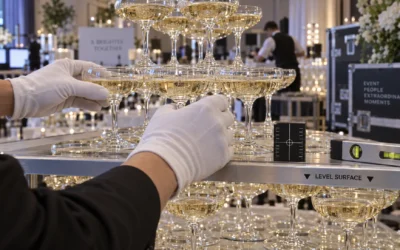
In December 2021, Luuk Broos and his team built a pyramid of 54,740 champagne glasses for Moët & Chandon at Atlantis, The Palm in Dubai. The structure reached 8.23 meters, establishing a milestone in the largest drinking glass pyramid category.
What makes this an interesting world record is the relationship between spectacle and restraint. Guests see an extraordinary silhouette. Behind it lies the disciplined placement of thousands of individual glasses, where consistency matters more than any single dramatic gesture.
Unlike a solid sculpture, a glass pyramid makes its apparent fragility part of the experience. Repetition gives it visual order, while the material catches light and creates depth. Its scale is immediately understandable, even before anyone hears the final count.
For a hotel opening or prestige celebration, that clarity is valuable. The centerpiece can carry the room visually without requiring a lengthy explanation. Yet the record-scale version is not the only option: a smaller, professionally built champagne tower can express the same craftsmanship when the venue or occasion calls for a more intimate installation.
2. Bryan Berg’s 7.86-meter house of cards
American cardstacker Bryan Berg built a 7.86-meter house of cards in Texas in 2007, a documented achievement in the tallest house of cards category.
The familiar material makes the feat especially compelling. Most people have struggled to balance even a few playing cards, so they understand the difficulty without needing technical knowledge. Increasing the height transforms an everyday tabletop activity into an architectural challenge.
An interesting world record becomes more engaging when viewers recognize the material but cannot imagine reproducing the result. Berg’s work creates exactly that contrast: ordinary cards, extraordinary structural discipline.
Its lesson for event design is not simply to build something tall. It is to make skill legible. A centerpiece becomes more memorable when guests can understand what makes its construction demanding.
This also changes how an installation should be presented. Clear sightlines and appropriate separation help an audience appreciate delicate work without interfering with it. A crowded position beside a busy service route would undermine both the viewing experience and the care invested in the structure. The surroundings need as much consideration as the object itself.
3. Auldin Maxwell’s 1,840-block Jenga balance
In 2023, Canadian stacker Auldin Maxwell achieved a record by balancing 1,840 Jenga blocks on one vertical Jenga block. Guinness World Records documents the feat under most Jenga blocks stacked on one vertical Jenga block.
The striking detail is the base. A broad structure rests on a single narrow support, making the relationship between its footprint and overall mass immediately visible.
Unlike a conventional tower, this arrangement demands attention to how weight is distributed around that support. Adding another block changes the balance of the whole assembly, rather than merely increasing its height.
That makes it an interesting world record to study for its visual storytelling. The audience does not need to see every placement to understand the central challenge: an unexpectedly large construction depends on a remarkably small point of support.
For planners, the useful principle is contrast. Something substantial balanced on something apparently insufficient creates a strong focal point. However, a fragile balancing structure belongs within a controlled display environment. Guest participation, vibration and accidental contact introduce conditions very different from those of a dedicated record attempt, so the concept should never be transferred casually into a reception space.
4. Nik Wallenda’s blindfolded high-wire walk in Chicago
In November 2014, professional high-wire performer Nik Wallenda completed a record-setting blindfolded tightrope walk between Chicago’s Marina City towers.
Here, the precision came from a person rather than a structure. Removing vision eliminated an obvious source of orientation, leaving the performance dependent on trained balance, body awareness and controlled movement.
The setting made the challenge readable at a distance. Two towers, a wire and one performer created a scene with very little visual ambiguity. Viewers could understand the achievement immediately, without graphics or a complicated explanation.
Its appeal also reveals an important boundary for event producers. Real physical danger is not a prerequisite for a memorable experience. This was specialist high-wire work, not a template for guest entertainment or an activity to imitate.
As an interesting world record, it demonstrates how a clear objective can hold attention more effectively than a crowded program of competing effects. The transferable lesson is disciplined staging: establish one focal point, give the audience an unobstructed view and allow the action enough time to register. The hazardous conditions themselves are not the element to reproduce.
5. A domino chain reaction involving 4,491,863 pieces
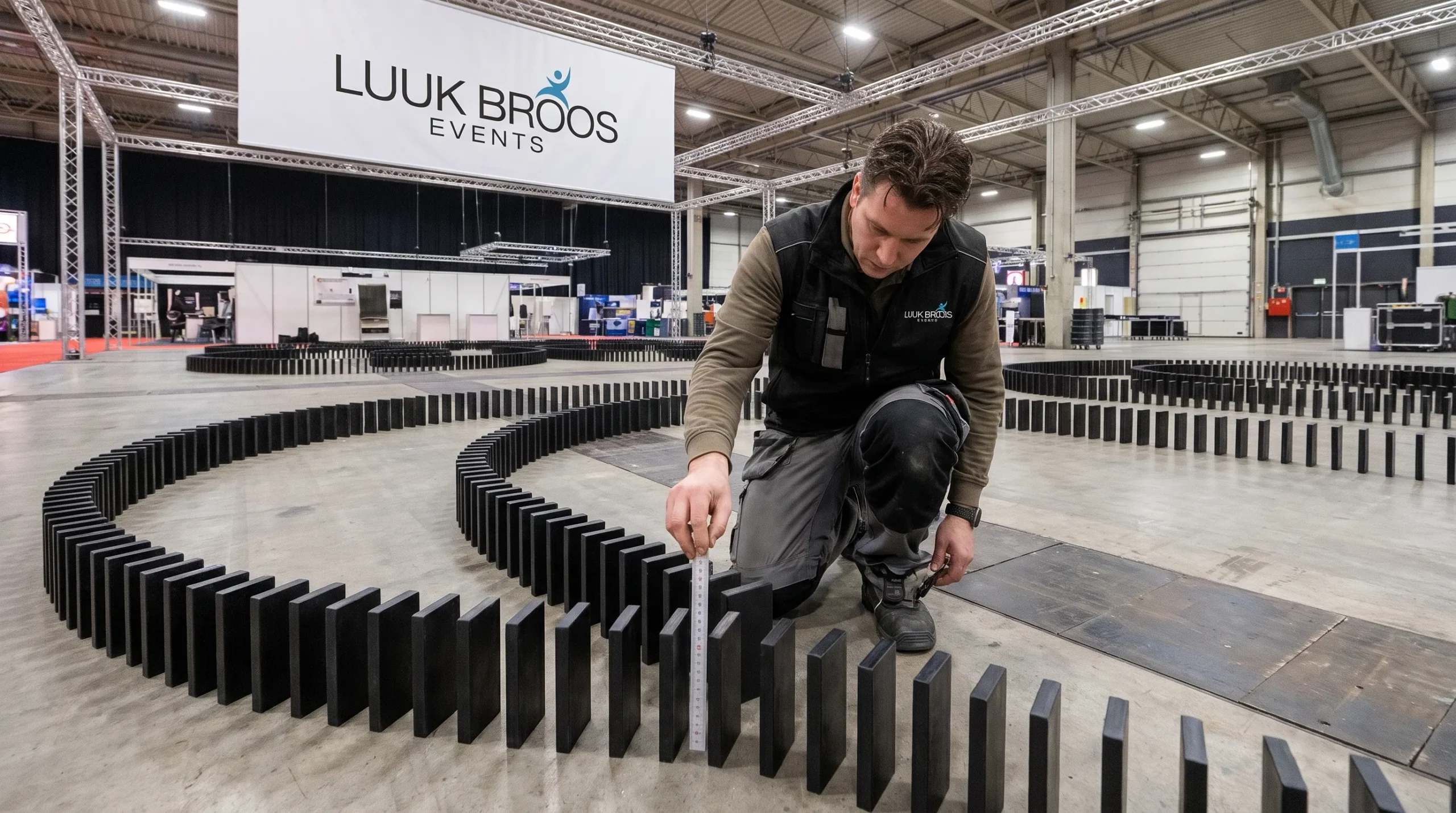
At Domino Day in Leeuwarden, the Netherlands, in November 2009, a team toppled 4,491,863 dominoes. Guinness World Records documents the achievement in its most dominoes toppled by a group category.
Dominoes reverse the usual purpose of a balanced installation. The pieces must remain upright throughout preparation, then fall in a planned sequence. Success depends on stability first and controlled movement afterward.
The distinction between pieces arranged and pieces successfully toppled is essential. A large setup does not automatically produce an equally large verified result. The outcome must satisfy the relevant record rules.
For an audience, the attraction is progression. One movement triggers another, creating anticipation as the sequence travels across the space. Unlike a static centerpiece, the experience has a clear beginning, development and finish.
That makes dominoes a useful reference for reveal choreography. A luxury event can borrow the principle of an unfolding sequence without attempting a vast domino installation. Lighting, music and a centerpiece reveal can direct attention in stages, provided their timing has been rehearsed and their operation does not depend on an untested chain of cues.
6. Max Park’s 3.13-second Rubik’s Cube solve
At Pride in Long Beach in June 2023, Max Park solved a standard 3×3×3 Rubik’s Cube in 3.13 seconds, setting a world record at that time. His competition history is documented by the World Cube Association.
This example belongs to a different recognition system from Guinness record categories. Competitive speedcubing uses the World Cube Association’s regulations, results and rankings. Keeping that distinction clear avoids treating every world record as though it has the same governing body.
The achievement is a feat of precision rather than precarious balance. Recognition, decision-making and finger movements must come together within a remarkably short interval. The finished cube offers an unmistakable result, but the execution can happen faster than a spectator can comfortably follow.
That creates a useful contrast with the larger installations on this list. A record can command attention through compression rather than scale: an exceptional amount of skill becomes visible in just a few seconds.
For event presentation, very short performances need thoughtful framing. Guests should know what they are watching before the action begins. A clear introduction and a well-positioned demonstration area can matter more than adding extra production effects around the performer.
7. Milan’s LEGO tower: an interesting world record at 35.05 meters
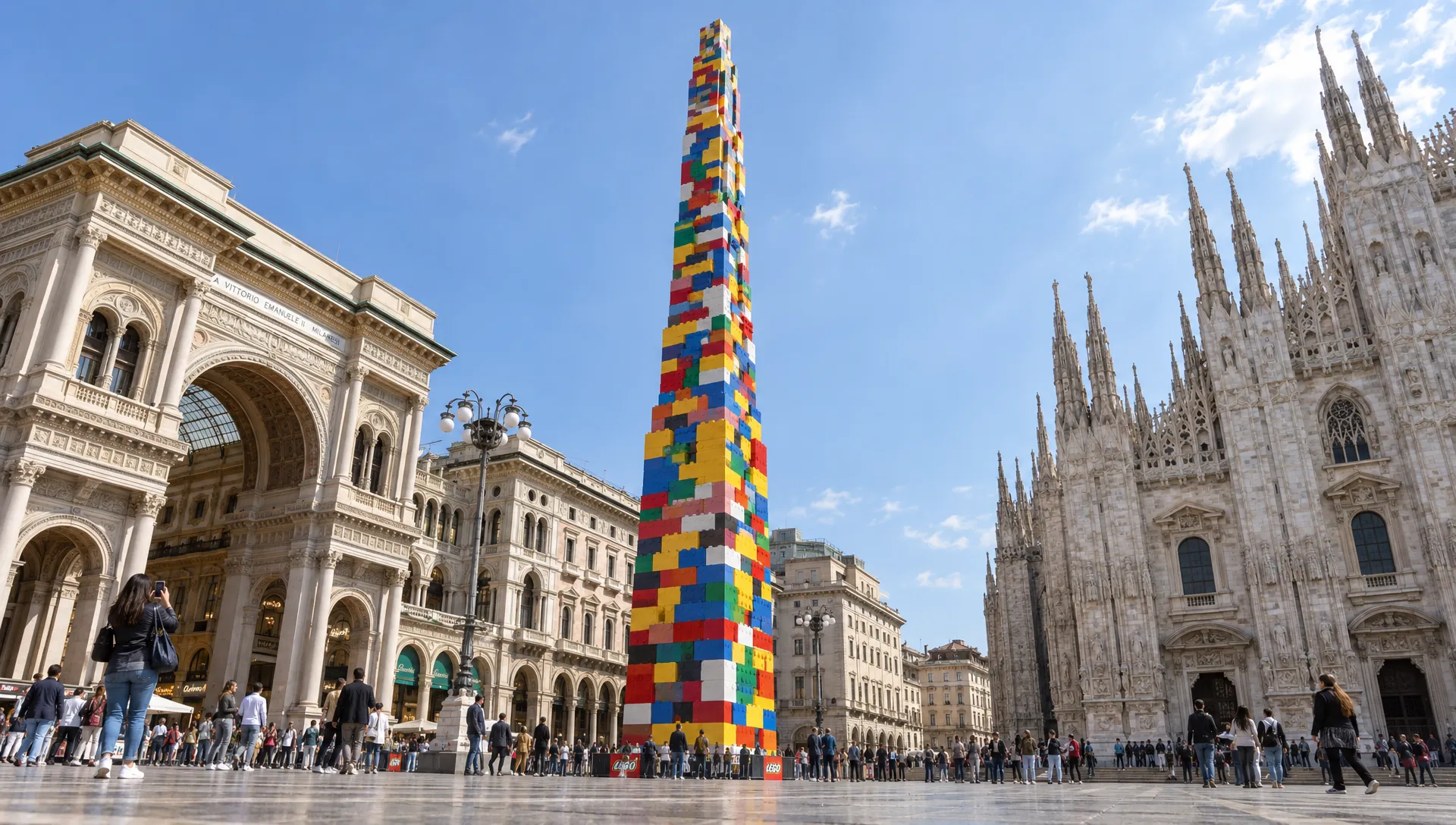
In 2015, a LEGO tower in Milan reached 35.05 meters, establishing a record milestone in the category of tallest structure built with interlocking plastic bricks.
The appeal comes from a familiar construction system taken far beyond its everyday scale. Individual bricks are small and recognizable. Together, they create something closer to a temporary landmark than a tabletop model.
This feat also highlights collective precision. Large builds depend on repeatable connections and coordinated work, not just one person’s final placement. The visible result represents many small actions performed consistently.
For brands, that makes the concept especially relevant to stories about teamwork, participation or cumulative achievement. The audience can connect the finished structure with the contribution of its individual components.
The practical distinction is equally important: toy-sized materials do not make a large installation a casual undertaking. A tower at architectural scale requires professional planning for stability, assembly and public access. Any event interpretation should start with the venue’s constraints and an appropriate technical assessment, rather than treating a historical height as a design specification.
What makes these records difficult to beat?
An interesting world record is rarely difficult for only one reason. Across these seven examples, the limiting factors include material consistency, structural behavior, trained movement, coordination and the ability to deliver a valid result under defined conditions.
A taller structure may require a different venue. A faster performance may depend on years of specialist practice. A larger domino arrangement introduces more opportunities for interruption. Increasing the headline number can change the entire production challenge.
Before commissioning an attempt, distinguish three things: the historical achievement that inspired the idea, the current recognized benchmark and the rules that would apply to a new attempt. They are not interchangeable.
Our guide to verifying a current world record before planning an attempt explains that first check. Understanding how different world records are measured and verified then helps turn an appealing concept into a realistic brief.
For a premium event, successful delivery should remain the priority. A carefully scaled spectacle can serve the occasion better than a larger attempt that compromises the guest experience.
Frequently asked questions
Which interesting world record works best as a luxury event centerpiece? A champagne glass pyramid has a natural connection with hospitality and celebration. The appropriate scale depends on the venue, audience and production requirements. A record attempt is optional, not essential to its visual impact.
Are all seven achievements still world records? This article presents dated record milestones, not a live ranking. Check the relevant Guinness World Records category or World Cube Association results before describing a historical achievement as the current record.
Can guests attempt these feats during an event? These examples are not guest activity instructions. High-wire performance, tall structures and large glass installations require specialist assessment and controlled conditions. Any participatory alternative should be designed separately around suitable materials and manageable risks.
Bring precision to the centerpiece
The strongest connection between these achievements is visible craftsmanship: guests can recognize the care behind the result.
Luuk Broos Events specializes in champagne pyramids, from smaller towers to world-record-scale projects, supported by a professional building team and marketing and publicity advice. To explore a centerpiece suited to your celebration, discuss your event with Luuk Broos Events, starting with the venue, desired scale and the moment you want guests to remember.