


Before you brief a venue, approve a production budget or promise media a historic moment, verify the current world record with the same discipline you would apply to safety, logistics and guest experience. A record attempt can create extraordinary prestige for a luxury event, but only when the title, rules and benchmark are clear before the creative concept is sold internally.
For event agencies, brand teams, hotel groups and wedding planners, this verification step protects the entire production. It prevents an elegant idea from becoming an expensive misunderstanding and gives stakeholders the confidence to invest in a spectacle with genuine PR value.
How to verify a current world record before planning an attempt
A record is not simply a striking claim like “largest,” “tallest” or “most glasses.” It is a defined title, measured against specific criteria and validated by an official body. The first task is to identify which organization recognizes the record and whether the category still exists in the form you want to attempt.
For Guinness World Records, start with the official Guinness World Records records database and search for the precise wording of the title. If your concept is still at the creative stage, this is also a good moment to review practical guidance on using the Guinness World Records website before an attempt, especially if your client expects official recognition rather than a marketing-only claim.
Identify the exact record title
Many record concepts look similar from a distance but are judged differently in practice. “Largest champagne glass pyramid,” “tallest champagne tower” and “most champagne glasses stacked” could each involve different definitions, measurements and evidence requirements, depending on the official category.
This distinction matters because a luxury event concept is designed around the record title. The number of glasses, the height, the pouring moment, the build time, the venue layout and the photography angle can all change once the official wording is confirmed.
Use official sources, not social posts
A viral video, a press article or a brand campaign may describe a record in broad language. That does not make it the benchmark you need to beat. The safest source for the current world record is the official record holder page, a formal response from the record authority or the official guidelines issued after an application.
Save every source you use. Record pages can be updated, categories can be retired and new achievements can be verified between your first brainstorm and the event date. A dated verification file gives your team a factual starting point if questions arise later.
Confirm the record holder and measurement
Do not stop at the name of the record holder. Confirm the actual number, height, volume, time or other measured result. For premium events, the benchmark should be translated into operational terms as early as possible.
If the record is based on height, your production team needs to understand ceiling clearance, platform stability, sightlines and guest distance. If the record is based on quantity, the team needs to plan inventory, setup time, redundancy, transport and safety protocols.
Build a verification file before the creative proposal
A strong record concept should be supported by a simple but complete verification file. This does not need to be overcomplicated, but it should be clear enough for a client, venue, sponsor or legal team to understand why the attempt is credible.
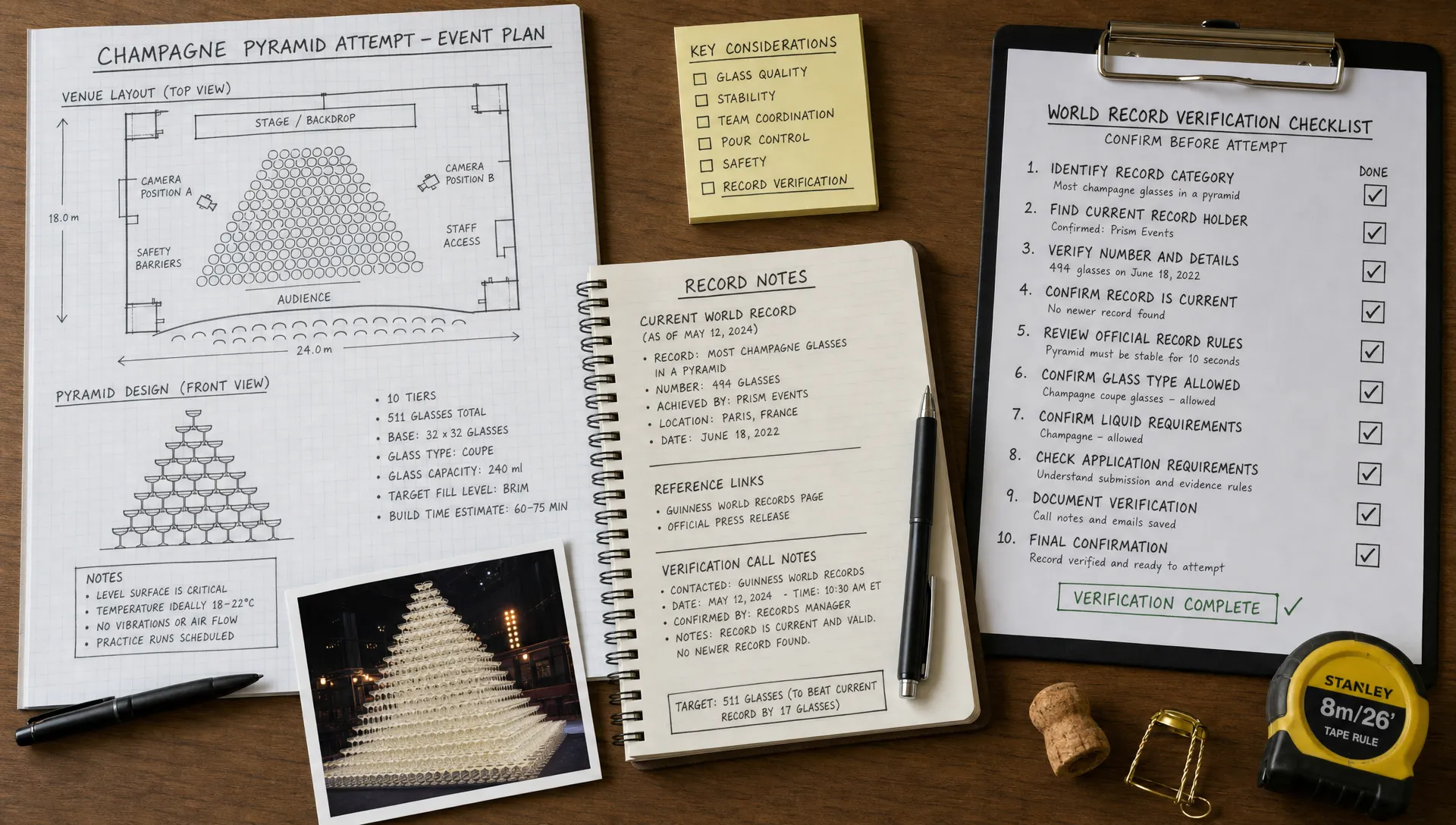
The file should show which current world record you are targeting, where the benchmark came from, when it was checked and which official rules apply. This becomes the factual backbone of the proposal and helps avoid late-stage changes that can damage timelines or budgets.
| Verification point | Why it matters | What to save |
|---|---|---|
| Exact record title | Prevents planning for the wrong category | Official title wording and link |
| Record holder | Confirms the achievement currently recognized | Name, location and date if published |
| Measured benchmark | Defines what must be exceeded | Number, height, time or other metric |
| Official rules | Shapes venue, staffing and evidence planning | Guidelines, application notes or email confirmation |
| Date checked | Proves when the information was verified | Screenshot or dated internal note |
| Evidence route | Clarifies how the attempt will be judged | Adjudication plan or evidence checklist |
For high-value events, this file is also useful in stakeholder meetings. It turns a spectacular idea into a managed project with visible controls, which is often what decision-makers need before approving an ambitious live experience.
Separate inspiration from verification
Moodboards, previous event videos and competitor activations are useful for creative direction. They are not verification. Treat them as inspiration only, then validate the record independently through official channels.
This distinction is especially relevant for luxury brands. A bold claim can generate attention, but an unsupported claim can create reputational risk. Official recognition gives the event story substance and makes the media angle easier to defend.
Match the record benchmark to event feasibility
Once the benchmark is confirmed, test the concept against the realities of the venue and guest experience. A record attempt should not feel like a technical exercise hidden in the background. For luxury audiences, it needs to be elegant, safe, photogenic and integrated into the event flow.
The current world record may set a minimum target, but your event strategy should decide how far beyond that target you need to go. A narrow margin can be risky if the record changes before the attempt or if minor execution variables affect the final result.
Check venue constraints early
Venue feasibility can decide whether a record concept is viable. Ceiling height, floor load, service access, backstage storage, temperature, guest circulation, rigging restrictions and local safety requirements can all affect the attempt.
For champagne glass pyramids, even a smaller tower requires precision. At record scale, every layer, surface, glass type and movement around the structure becomes part of the risk calculation. The more ambitious the concept, the earlier the technical review should begin.
If you are still deciding how the record fits into the wider event, this broader guide on organizing a world record event with total confidence can help you connect verification with production planning.
Validate the PR value, not only the number
A record attempt is most powerful when the achievement is easy for guests and media to understand. A visually obvious record, such as a spectacular champagne glass pyramid, can create stronger impact than a technically impressive but hard-to-explain category.
The goal is not merely to beat a number. The goal is to create a moment that feels exclusive, credible and worth sharing. That is why record verification should sit beside brand strategy, guest journey design and media planning from the beginning.
Plan for the record changing before event day
Record status is not fixed forever. Another team may submit evidence, an adjudication may be completed or a new benchmark may be published after your planning starts. If your event depends on achieving the title, build a monitoring rhythm into the timeline.
For a major event, recheck the current world record at key milestones: before the proposal is finalized, before production orders are locked, before media messaging is approved and shortly before the attempt. This simple discipline reduces the chance of discovering a changed benchmark too late.
Create a margin above the benchmark
Where practical, do not aim to exceed the record by the smallest possible amount. A wider margin gives the attempt more resilience if the benchmark increases or if some elements cannot be counted on the day.
The correct margin depends on the category. In some records, exceeding by a small amount is enough. In others, the safest approach is to design a target that looks unquestionably larger, stronger or more impressive while still remaining elegant and controlled.
Keep communications flexible
Avoid announcing overly specific claims too early. Phrases such as “attempting to break an official record” are safer before final verification than claiming a guaranteed title. Once the record body, benchmark and adjudication route are confirmed, your team can make the messaging more precise.
This is especially important for sponsors, press releases and VIP invitations. A premium event should feel confident, but confidence comes from controlled facts, not from premature promises.
Red flags that need extra checking
Some record ideas look exciting but become fragile under scrutiny. Before committing budget, review the concept for warning signs that could weaken credibility or make official recognition harder.
Be cautious if you see these issues:
- The record claim only appears in blogs, social captions or promotional videos.
- The title wording changes from one source to another.
- The measurement is unclear or impossible to reproduce.
- The official record page cannot be found.
- The rules do not match the live event environment.
- The attempt depends on guest behavior that cannot be controlled.
- The concept looks impressive but has limited relevance to the brand or occasion.
A weakly verified record can still create a beautiful moment, but it should not be sold as an official record attempt. If the objective is prestige, sponsor value and press attention, the current world record must be verifiable and the attempt must be structured around recognized standards.
Decide whether official adjudication is needed
Some clients want the strongest possible credibility, which may require official adjudication or a formal evidence review. Others may use a record-inspired spectacle as a centerpiece without pursuing certification. Both approaches can work, but they should be chosen deliberately.
An official attempt usually requires more planning, documentation and timeline control. A record-inspired centerpiece can be more flexible, but the language around it must be honest. For luxury brands, clarity is part of the premium experience.
Turn verification into a stronger event story
Verification is often seen as administration, but it can improve the creative result. Once the benchmark is known, the team can design the reveal, guest viewing angles, sponsor moments, photography plan and media narrative around a concrete achievement.
An official title can also make the event feel rare. Guests are not simply attending another gala, launch or anniversary. They are witnessing a carefully prepared attempt to achieve something measurable. That sense of rarity is one reason an official world record can add prestige to an event, especially when the concept is visually spectacular.
For champagne pyramid events, the record story is naturally cinematic. The build requires patience, discipline and craftsmanship, then culminates in a moment that is easy to photograph and understand. When the current world record has been verified correctly, that moment carries more authority.
Frequently asked questions
How do I know if a world record is still current? Check the official record authority, not only media coverage. For Guinness World Records, search the official database, review the published record page and confirm the latest benchmark before making production decisions.
Can a record change after we start planning? Yes. Another attempt may be verified before your event takes place. Recheck the record at major planning milestones and design a margin above the benchmark where possible.
Is a press article enough to verify a record? No. Press coverage can help you find leads, but it should not be treated as final verification. Use official pages, written confirmation or formal guidelines from the relevant record organization.
Should every luxury event pursue an official record? Not always. Some events benefit more from a beautiful record-inspired centerpiece than a formal attempt. The right choice depends on the brand goal, venue, timeline, budget and appetite for official documentation.
What should be verified before announcing an attempt? Verify the exact title, record holder, benchmark, rules, evidence requirements, adjudication route and feasibility at the chosen venue. This gives your announcement credibility and reduces reputational risk.
Plan a record attempt with precision and confidence
Verifying the record is the first serious step toward a premium, high-impact event. It protects your concept, strengthens the business case and gives every stakeholder a clearer reason to support an ambitious live spectacle.
Luuk Broos Events specializes in record-breaking champagne glass pyramids, from intimate luxury towers to world record attempts designed for international attention. If you want a centerpiece that combines precision, visual impact and a proven record-setting mindset, contact Luuk Broos Events to discuss what is possible for your venue, brand or celebration.