

Guinness World Record requirements should shape a luxury event before the centerpiece is designed, the venue is contracted or the announcement is written. A spectacular champagne pyramid may command the room, but official recognition depends on satisfying the rules for the specific record and demonstrating that compliance.
For event agencies, hotel launches and premium brand activations, the challenge is to coordinate two outcomes: an exceptional guest experience and a verifiable achievement. The most reliable approach is to turn the official guidelines into clear production responsibilities, evidence checks and approval points.
Separate the spectacle from official recognition
A record attempt has several distinct milestones: application acceptance, receipt of record-specific guidelines, execution of the attempt and verification of the result. An accepted application is not confirmation that a record has been achieved.
Start with the official Guinness World Records process. Confirm the appropriate application route for a commercial event, the relevant services and the timing available before promising a result to sponsors.
The production schedule should distinguish the live achievement from its official status. If evidence will be reviewed afterward, the event announcement must reflect that distinction. If an official adjudicator is being considered, confirm availability and scope directly rather than assuming attendance is included.
This separation protects the brand from announcing recognition prematurely and gives the event team a realistic basis for planning.
Turn Guinness World Record requirements into acceptance tests
Once you receive the guidelines, translate each requirement into something a named person can check. A general instruction such as “capture the attempt” is not precise enough for a production brief.
Use a compliance matrix that connects the official wording to an operational check. The following is a planning template, not a substitute for the rules issued for your record.
| Area | Question to resolve from the guidelines | Production responsibility |
|---|---|---|
| Record definition | What exactly counts toward the achievement? | Record lead |
| Measurement | Which method, equipment and qualifications are required? | Measurement lead |
| Witnessing | Who must observe, and what must they document? | Evidence coordinator |
| Recording | Which stages and details must be visible? | Camera lead |
| Submission | Which forms, files and statements are required? | Submission owner |
Keep the guideline version and any written clarifications together. When a requirement is ambiguous, obtain clarification before making a design decision that depends on it.
Assign one compliance owner. That person should maintain the matrix and coordinate answers, even when specialists remain responsible for individual checks. Otherwise, the builder, agency and camera crew can each assume another supplier has covered the same requirement.
Confirm the measurement before approving the design
For a champagne pyramid, Guinness World Record requirements must inform what is built and how the achievement will be demonstrated. Do not assume that height, total glass count and the number of filled glasses describe interchangeable records.
The exact title determines the relevant measure. Any rules governing configuration, materials, filling, support or completion must come from the issued guidelines, not from photographs of a previous attempt.
Before approving the creative concept, document the proposed measurement method and test whether it can be carried out in the finished venue. A design that looks exceptional from the ballroom entrance may be difficult to inspect or record from the necessary angles.
It also helps to verify the current record before planning an attempt. A published figure is a starting point, not a reason to skip confirmation of the applicable benchmark and required target.
Keep a controlled record of design changes. Replacing glassware or modifying the arrangement should trigger a fresh compliance review rather than being treated as a purely aesthetic adjustment.
Build evidence coverage into the production plan
Evidence is a production workstream, not something to assemble after the guests leave. Its purpose is to establish what happened, not simply to produce an attractive event film.
Translate Guinness World Record requirements into a camera and documentation plan with your evidence coordinator. Where continuous coverage is required, a promotional edit cannot replace it. Where measurements or counts must be visible, a wide shot alone may be insufficient.
Book the witnesses and specialists specified by the guidelines. Confirm their qualifications, independence where required and availability for the full period in which they are needed. Give them the relevant documentation in advance.
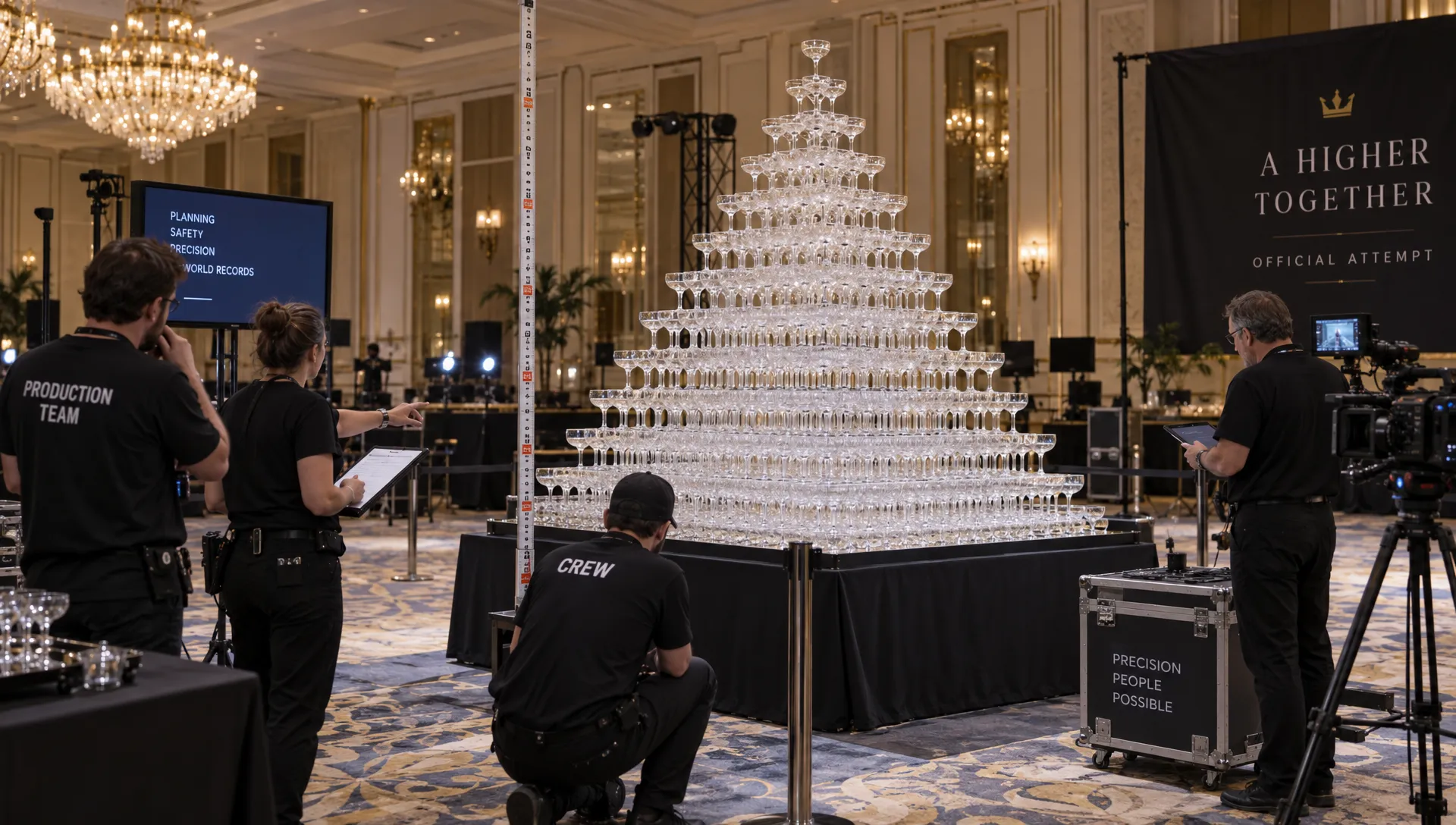
The technical rehearsal should test whether cameras can capture the necessary detail under actual event lighting. Guest movement, reflections from glassware, staging and photographers can all obstruct a critical view.
Retain original files and keep backups. Use consistent names for recordings, photographs, measurement records and statements so the submission owner can connect each item to the requirement it supports. A polished highlight reel can serve the campaign separately without becoming the only surviving record of the attempt.
Put venue safety ahead of spectacle
Guinness World Record requirements do not replace venue approval, local obligations or a project-specific risk assessment. Official recognition and safe event delivery are separate responsibilities that must both be addressed.
For a large glass installation, the responsible production specialists and venue team should assess the proposed location, supporting surface, loading, access and protection from accidental contact. Engineering review may be necessary depending on the installation and venue.
The same discussion should cover build access, exclusion zones, spills, broken-glass response and dismantling. If beverages are involved, confirm applicable alcohol-service rules and any relevant record policies rather than assuming the display is exempt.
Give a named person authority to pause work or stop the show when conditions become unsafe. Sponsor expectations and a live countdown should never override that decision.
Resolve these matters before the ballroom is dressed. Moving a centerpiece after staging, lighting and guest circulation have been approved can create avoidable production pressure.
Rehearse the decisions, not just the build
A useful rehearsal tests handovers and failure responses as well as craftsmanship. The team should know who declares the installation ready for inspection, who authorizes the attempt to begin and who communicates any interruption to show control.
Walk through realistic disruptions: an obstructed camera, a missing witness, a delayed build or a measurement that needs checking. Decide which issues permit a pause and which require a restart or another attempt under the applicable rules.
Review the Guinness World Record requirements at the final readiness meeting, with evidence, measurement and safety leads present. Each should confirm that their part of the plan is ready rather than relying on a general production sign-off.
A compact readiness check can cover:
- Compliance: The approved design and method match the issued guidelines and written clarifications.
- Evidence: Required people, equipment, documentation and backup arrangements are in position.
- Safety: The venue and responsible specialists have cleared the activity to proceed.
- Communication: The host and publicity team have approved wording for each possible outcome.
Make the fallback presentation credible. A luxury event should still offer guests a complete experience if the official attempt cannot proceed as planned.
Keep the show schedule separate from verification
Guinness World Record requirements should determine the time reserved for inspection, measurement and documentation. Do not compress these tasks simply because dinner service or a headline performance is approaching.
Build the running order around protected windows for construction, checks, the attempt and evidence completion. Keep guests engaged elsewhere while technical work takes place, and allow contingency time appropriate to the installation.
The host should also understand who can confirm the outcome. If an official adjudicator is attending, agree on the announcement process in advance. If verification will follow an evidence submission, describe the achievement as an attempt pending that review.
After the live moment, assign time to reconcile records while the relevant people are still available. Missing signatures, unclear measurements or incomplete statements are easier to resolve promptly than after international suppliers have departed.
For teams still arranging the application, this guide to applying for a Guinness World Record addresses that earlier stage. The production plan should follow the confirmed scope, not anticipate it.
Protect the announcement and measure commercial value
Prepare separate publicity wording for a planned attempt, a completed attempt awaiting verification and an officially confirmed result. Only release the version that matches the status at that time.
Guinness World Record requirements are not the same as permission to use the organization's branding. Confirm the applicable permissions for names, logos, certificates and campaign assets directly before approving sponsor materials, invitations or advertising.
Then give the spectacle a measurable commercial purpose. A hotel opening may prioritize qualified event inquiries, while a brand activation may focus on campaign engagement or hospitality leads. Set those objectives before deciding what the content team should capture.
If paid distribution is part of the launch, a separate managed digital advertising service can support campaign setup, audience research and conversion tracking. Keep that marketing role distinct from official verification and record-related permissions.
Report media coverage, paid results and business inquiries separately. Attendance does not prove campaign reach, and a spectacular photograph does not by itself establish a return on investment. Clear attribution makes the event easier to evaluate and future investment easier to justify.
Frequently asked questions
Are Guinness World Record requirements the same for every attempt? No. General procedures sit alongside record-specific guidelines. The exact title determines what must be achieved, measured and evidenced. Use the instructions issued for your application rather than a checklist copied from another event.
Do we need an official adjudicator at the venue? Not every attempt requires an on-site adjudicator. Confirm the available verification route with Guinness World Records. On-site attendance is a separate arrangement and should never be assumed from an accepted application.
Can an event agency or builder certify the result? Your suppliers can manage construction, production and evidence preparation, but they cannot substitute their approval for official recognition. Agree in advance who may announce the outcome and what wording they may use.
What if the installation succeeds but the evidence is incomplete? A visually successful attempt can still be difficult or impossible to verify. Review the evidence against the issued guidelines before submission and ask Guinness World Records about any gap. Do not assume an edited film or later explanation will resolve it.
How much time and budget should we allow? Obtain current application and service information directly, then budget separately for specialist construction, venue requirements, evidence capture, safety and publicity. Avoid committing to a fixed event date on the assumption that application review or verification will fit around it.
Plan a record attempt with precision
Luuk Broos Events specializes in champagne glass pyramids, from smaller event centerpieces to world-record-scale projects. Its professional building team, custom sizing and marketing advice bring the physical spectacle and event objectives into the same planning conversation.
Share your venue, event date, guest profile and ambitions with Luuk Broos Events before fixing the concept. Establish whether an official record attempt or a smaller bespoke tower best serves the occasion, then build the production plan around that decision. The strongest presentation is one whose craftsmanship, evidence and guest experience have all been considered from the start.