

A world record can make a luxury event feel larger than the room itself. It gives guests a story to tell, sponsors a headline to share and media teams a visual moment that is far stronger than a standard launch or gala reveal. But the same ambition that makes a record attempt powerful also makes it unforgiving. One overlooked venue restriction, one unclear verification rule or one weak production dependency can turn a premium concept into an expensive recovery exercise.
To organize a world record event without costly errors, the goal is not to make the idea as big as possible. The goal is to make it precise, credible, safe and worthy of the audience in front of you. For luxury event agencies, hotel opening teams, brand activation managers and wedding planners working with VIPs, the true cost of a mistake is rarely only financial. It is reputational.
The most successful record events are built like high-end productions: strategic first, spectacular second and operationally controlled from the first meeting.
Start with the event purpose, not the record category
The first costly error is choosing a record because it sounds impressive, without asking what it must achieve. A record attempt should serve the occasion. Is the objective to position a new hotel as an international destination? Launch a premium brand with global attention? Create a fundraising moment at a gala? Give a private celebration a once-in-a-lifetime centerpiece?
The answer shapes everything: the scale, the category, the guest journey, the media angle and the level of verification required. A world record event for a luxury hospitality opening should feel polished, cinematic and aligned with the property’s identity. A charity-linked record should make participation and contribution feel meaningful. A corporate record activation should produce a message that is easy for press and partners to repeat.
A strong record concept usually has three qualities:
- It is visually clear in one photograph or short video.
- It can be explained in one sentence.
- It feels naturally connected to the host brand, venue or occasion.
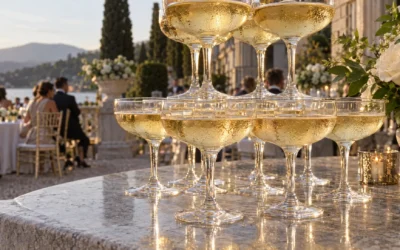
A champagne glass pyramid, for example, works beautifully in premium environments because it combines scale, elegance, precision and ceremony. It is not just a large object in the room. It becomes a focal point, a countdown, a toast and a proof of ambition.
Decide whether you need an official record attempt
Not every event with record energy needs to be an official record attempt. This is an important strategic decision, because official verification adds prestige but also adds time, requirements, documentation and risk.
An official record attempt may involve applications, category confirmation, strict evidence standards, independent witnesses, measuring requirements, adjudication, safety documentation and detailed reporting. If the event is built around the headline value of being officially certified, these steps are essential.
A record-inspired spectacle can be the better choice when the priority is guest experience rather than formal recognition. It still delivers drama, scale and strong visuals, but it avoids some of the pressure associated with validation.
| Format | Best for | Main risk | How to avoid costly errors |
|---|---|---|---|
| Official world record attempt | PR-led campaigns, major openings, global brand activations | Failing verification due to unclear rules or evidence gaps | Confirm category rules early and assign a documentation lead |
| Record-inspired luxury spectacle | Private events, weddings, hospitality moments, brand dinners | Overselling the claim or confusing guests | Use clear wording and focus on experience rather than certification |
| Hybrid concept | Events that want spectacle with possible certification | Timeline pressure and scope creep | Separate the guest experience plan from the verification workstream |
The mistake is not choosing one format over another. The mistake is choosing too late, after creative plans, budgets and venue contracts are already fixed.
Test feasibility before approving the creative vision
Luxury event concepts often begin with moodboards, renderings and dramatic show moments. For world record events, feasibility must come before final creative approval. If the structure, route, venue access or guest flow cannot support the concept, the most beautiful idea becomes fragile.
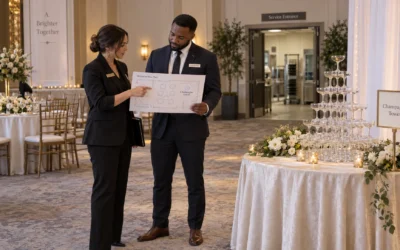
A feasibility review should cover floor loading, ceiling height, rigging options, surface stability, humidity, wind exposure, fire exits, service access, backstage space, power supply, insurance requirements and local permissions. For champagne pyramids, additional details matter: glass type, base structure, table engineering, pouring method, breakage allowance, temperature control and proximity to guests.
Destination events require an even tighter logistics mindset. Island venues, remote resorts and historic properties can create restrictions around transport, access windows and local mobility. For example, planners working in small island destinations may need to coordinate crew and guest movements with local providers such as electric cart rental in Terre-de-Haut to keep arrivals, setup and departures smooth. The principle applies everywhere: premium spectacle depends on practical movement behind the scenes.
The feasibility stage should end with a clear answer: yes, the concept can be delivered safely and elegantly in this venue, or no, the scale or format must change.

Know the mistakes that usually become expensive
World record events become costly when risk is discovered late. The earlier a risk appears on the planning table, the easier it is to solve with design, timing, budget or specialist expertise.
| Costly error | Why it happens | Possible consequence | Prevention |
|---|---|---|---|
| Choosing the wrong record category | The idea is selected before rules are checked | The attempt cannot be verified or must be redesigned | Confirm requirements before announcing the concept |
| Underestimating venue limits | Creative ambition moves faster than technical review | Structural, access or safety issues appear late | Conduct a venue survey with the specialist team early |
| Treating documentation as an afterthought | PR and production take priority over evidence | Certification or credibility is weakened | Appoint a verification and evidence coordinator |
| Overcomplicating the guest moment | Too many reveals, speeches or sponsor elements are added | The key record moment loses impact | Build one central climax and protect it |
| Choosing a general supplier for a specialist build | The concept looks simple from the outside | Execution becomes slow, unsafe or visually imperfect | Use a team with proven record-scale experience |
| Saving money on rehearsal and contingency | Budget pressure removes invisible safeguards | Delays, breakage or awkward pauses occur live | Protect time for testing, spares and fallback plans |
A premium audience rarely sees the complexity that prevented a problem. They only feel the result: calm timing, confident staff, seamless staging and a moment that looks inevitable.
Build a verification plan as carefully as the show plan
If the event is pursuing official recognition, verification is not paperwork at the end. It is a parallel production track. The record attempt must be designed around the rules from the beginning.
This can affect who may witness the attempt, how measurements are taken, what video angles are required, how the attempt begins and ends, what counts as a valid result and which evidence must be submitted afterward. If an adjudicator is attending, their needs must be integrated into the show flow without making the guest experience feel technical or bureaucratic.
Even if the event is not officially certified, documentation still matters. Press, sponsors and guests need proof. High-quality photography, timed video, behind-the-scenes footage, interviews, drone or crane shots where permitted and clear final numbers can turn the event into content that lives long after the evening.
For luxury brands, documentation should be elegant as well as accurate. A record attempt that looks beautiful in person but chaotic on camera loses part of its value.
Design the record moment as a performance
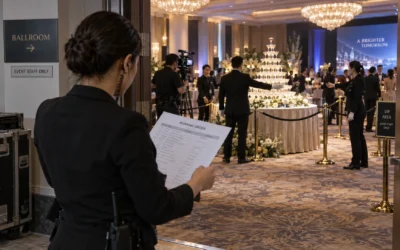
A record event should not simply happen in the corner of the room. It should be choreographed as a premium performance. Guests need to understand what is being attempted, why it matters and when the decisive moment will occur.
This is where many events lose impact. The build may be impressive, but the final reveal is rushed. Or the record is announced, but guests cannot see the key action. Or the lighting is right for the room, but wrong for cameras.
A polished record moment considers:
- Sightlines for VIPs, press and general guests.
- Lighting that flatters the structure and the people involved.
- Music, silence or countdown timing that creates suspense.
- A clear role for the host, ambassador, founder or couple.
- Safe distance between guests and the installation.
- Camera positions that capture both scale and emotion.
With champagne pyramids, the final pour is often the emotional peak. It must feel calm, ceremonial and exact. When executed well, the room becomes quiet for a second, every phone comes up and the event gains its signature image.
Budget for impact, not only for production
A world record event is not a decor line item. It is a strategic experience that can influence media value, sponsor appeal, guest perception and brand memory. Looking only at the physical production cost creates a distorted view of ROI.
The smarter question is: what must this event generate to justify the investment? For a hotel opening, that may be international hospitality press and social content. For a luxury brand, it may be sponsor visibility, client engagement and earned media. For a wedding or private celebration, it may be the unforgettable emotional moment that defines the evening.
A practical budget should include production, specialist labor, travel, venue adaptations, insurance, verification, content creation, PR support, contingency and post-event distribution. Cutting the last three often weakens the value of the first seven.
| Phase | Budget priority | Why it matters |
|---|---|---|
| Pre-event | Feasibility, design, technical planning, PR preparation | Prevents expensive late changes and builds anticipation |
| Event day | Specialist execution, safety, guest flow, media capture | Protects the live experience and the decisive moment |
| Post-event | Press assets, social edits, sponsor reporting, case study content | Turns one evening into long-term brand value |
Cost control is not about making the concept smaller by default. It is about spending where the event’s reputation is most exposed.
Choose partners who understand precision under pressure
A record-scale event is not the right place to test an unproven supplier relationship. The partner must understand luxury service, technical risk, guest experience and public scrutiny at the same time.
For champagne pyramid events, this expertise is especially specific. The work requires patience, hand precision, material knowledge, team discipline and a deep understanding of how a fragile structure behaves at scale. It also requires the confidence to advise a client when a different size, position or timing will produce a better result.
Luuk Broos Events specializes in record-breaking champagne pyramid experiences, from smaller luxury towers to world record attempts. The team has delivered record-scale projects for prestigious settings and brand collaborations, including high-profile work with partners such as Moët & Chandon and Atlantis The Palm Dubai. That kind of track record matters because the visible spectacle is only the final layer. Underneath it is planning, repetition, safety thinking and calm execution.
For planners, the right specialist reduces complexity rather than adding to it. Instead of coordinating multiple separate parties for the centerpiece, engineering logic, build method and show moment, you work with a team that understands the full arc from concept to final pour.
Protect the event with contingency planning
Contingency planning is not pessimism. In luxury events, it is part of the standard of care. The best teams plan for what guests should never notice.
A world record event should have backup plans for delayed shipments, broken materials, weather changes, VIP lateness, technical faults, press arrival issues, lighting failure, crowding, schedule compression and last-minute venue restrictions. Some contingencies are operational, such as spare glasses or alternate access routes. Others are narrative, such as how the host communicates a delay without lowering the energy in the room.
The key is to decide in advance who has authority to make changes. On event day, ambiguity is expensive. A clear command structure allows the production team, venue, PR lead and specialist builder to respond quickly without creating visible tension.
Keep the story simple for guests and media
The more complex the record, the harder it is for people to share. Luxury audiences appreciate detail, but they remember clarity. A strong record story should be easy to repeat at dinner, in a caption or in a press headline.
Instead of overwhelming guests with technical information, frame the event around one elegant message: the largest, the first, the tallest, the most refined, the most ambitious, the most meaningful. If charity, heritage, craftsmanship or a brand anniversary is part of the story, connect it directly to the record moment.
This is where champagne pyramid events have a natural advantage. They are instantly understandable and visually rich. Guests do not need a long explanation to feel the suspense of thousands of glasses stacked with perfect precision, then completed by a final pour.
A practical pre-approval checklist
Before committing to a world record event, planners should be able to answer a few decisive questions with confidence. If any answer is unclear, the concept needs more development before it is sold internally or announced publicly.
- What is the strategic purpose of the record?
- Is this an official attempt or a record-inspired spectacle?
- Have the rules, evidence requirements and timelines been confirmed?
- Has the venue been checked for height, load, access and guest flow?
- Who is responsible for safety, verification, PR and final decision-making?
- What is the visual climax and how will every important guest see it?
- What content will be captured and distributed after the event?
- What contingency budget and fallback options are in place?
A world record event should feel daring to the audience, but controlled to the planning team.
Frequently asked questions
How long does it take to organize a world record event? The timeline depends on the record type, venue, verification requirements and production complexity. Official attempts usually need more lead time because rules, evidence, adjudication and technical planning must be confirmed before the event is announced.
Is an official record always better than a record-inspired event? Not always. An official record can add credibility and PR value, but a record-inspired spectacle may be better for private events, weddings or occasions where the guest experience matters more than certification.
What is the biggest risk when planning a world record event? The biggest risk is discovering feasibility issues too late. Venue restrictions, unclear rules, safety requirements or missing documentation can create expensive changes if they are not addressed early.
Can a world record event work for a luxury wedding? Yes, if the concept suits the couple, venue and guest experience. For many weddings, a spectacular champagne tower or record-inspired centerpiece may deliver the desired wow-factor without the complexity of official certification.
Why are champagne pyramids effective for premium record events? Champagne pyramids combine elegance, suspense, craftsmanship and strong visual impact. They create a natural ceremony around the final pour, which makes them memorable for guests and highly shareable for media and social content.
Create spectacle without leaving success to chance
A world record event should be ambitious, but never improvised. The difference between an unforgettable luxury moment and a costly mistake is the quality of planning behind the scenes: the right concept, the right venue checks, the right verification process and the right specialist team.
If you are exploring a record-breaking champagne pyramid, a luxury champagne tower or a high-impact centerpiece for a gala, hotel opening, brand activation or private celebration, Luuk Broos Events can help shape the idea into a precise, memorable and professionally executed experience.
Contact Luuk Broos Events to discuss how your next event can become the moment guests remember long after the final glass is poured.