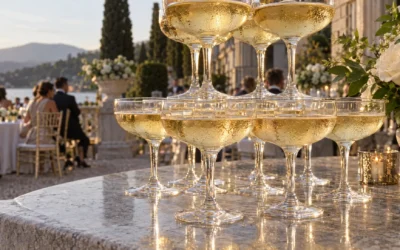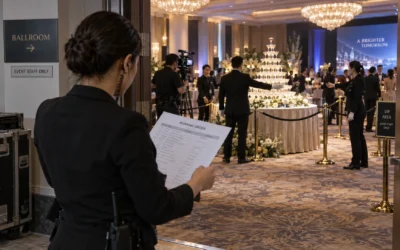


For a luxury event, the number of glasses in a champagne tower is not a small operational detail. It shapes the scale of the centerpiece, the confidence of the pour, the guest experience, the photography, the service flow and, ultimately, how premium the moment feels.
The short answer is simple: you need enough glasses to create the visual height you want, plus a serious reserve, plus separate service glassware if guests will be served beyond the tower itself. The more useful answer depends on the purpose of the tower. A wedding toast, a hotel opening, a brand activation and a world-record attempt all require very different planning.
If you are searching for champagne tower glasses bulk, pause before ordering hundreds of coupes. The real question is not only “How many glasses do we need?” It is “How many glasses do we need for the spectacle to feel flawless?”
The basic champagne tower glass formula
Most classic champagne towers are built as square pyramids using coupe glasses. The top level has 1 glass, the level below has 4 glasses, then 9, then 16 and so on. In other words, each level is a square.
If the base is 8 by 8 glasses, the tower has 8 levels. The total number of display glasses is the sum of all square levels from 1 to 8.
Total glasses = n(n + 1)(2n + 1) / 6
In this formula, n is the number of levels, which is also the number of glasses along one side of the base.
| Tower levels | Base layout | Display glasses needed | Typical visual impression |
|---|---|---|---|
| 3 levels | 3 x 3 | 14 glasses | Small tabletop accent |
| 4 levels | 4 x 4 | 30 glasses | Intimate toast moment |
| 5 levels | 5 x 5 | 55 glasses | Elegant private celebration |
| 6 levels | 6 x 6 | 91 glasses | Refined wedding or dinner feature |
| 7 levels | 7 x 7 | 140 glasses | Strong visual centerpiece |
| 8 levels | 8 x 8 | 204 glasses | Premium reception feature |
| 9 levels | 9 x 9 | 285 glasses | High-impact gala moment |
| 10 levels | 10 x 10 | 385 glasses | Large luxury event statement |
| 11 levels | 11 x 11 | 506 glasses | Major brand or hospitality activation |
| 12 levels | 12 x 12 | 650 glasses | Large-scale spectacle |
| 13 levels | 13 x 13 | 819 glasses | Press-worthy installation |
| 14 levels | 14 x 14 | 1,015 glasses | Large public or media event |
| 15 levels | 15 x 15 | 1,240 glasses | Major spectacle requiring specialist planning |
This table gives you the display count only. It does not include breakage reserve, rehearsal glasses, serving glasses, packaging loss, inspection rejects or any additional glasses needed for styling.
For premium events, the display count is only the beginning.
Start with the purpose, not the guest count
A common mistake is to calculate champagne tower glasses based purely on the number of guests. That sounds logical, but it often leads to the wrong result.
A champagne tower is usually both a visual centerpiece and a ceremonial moment. It may not need to serve every guest directly from the tower. At many luxury events, the tower creates the hero moment while service teams handle guest pours separately to maintain speed, consistency and elegance.
Before choosing the number of glasses, define the role of the tower. Is it a dramatic reveal during a brand launch? A wedding couple’s signature toast? A VIP photo moment? A sponsor activation? A finale for a gala dinner? The clearer the purpose, the easier it becomes to choose the right scale.
If you are still deciding what kind of tower fits the event, the guide on choosing the right champagne tower for event goals is a useful next step.
The three glass counts every planner should calculate
When planning a tower professionally, do not think in one number. Think in three separate numbers.
| Glass count | What it covers | Why it matters |
|---|---|---|
| Display glasses | The actual glasses stacked in the tower | Determines the height, shape and visual impact |
| Reserve glasses | Backup glasses for inspection rejects, breakage and last-minute adjustments | Protects the setup from stress and compromise |
| Service glasses | Glasses used to serve guests before, during or after the tower moment | Keeps hospitality smooth and avoids delays |
For smaller private events, a 10% reserve may be enough if logistics are simple and controlled. For luxury events with complex load-in, international transport, tight timing, media pressure or very large structures, a 15% to 20% reserve is often more realistic.
For example, an 8-level tower uses 204 display glasses. With a 15% reserve, you should plan for approximately 235 tower glasses. If the event has 300 guests and everyone needs a glass for a toast, you may also need separate service glassware for the wider guest experience.
The most polished events separate spectacle planning from beverage service planning. That distinction prevents the tower from being overloaded with expectations it was not designed to meet.
A practical sizing guide by event type
The right glass count depends on venue scale, ceiling height, guest distance, sightlines, lighting, photography and the level of attention you want the tower to command. The table below gives a practical starting point for luxury planners.
| Event type | Common guest range | Suggested tower scale | Display glasses | Planning note |
|---|---|---|---|---|
| Private dinner or suite event | 30 to 80 guests | 4 to 5 levels | 30 to 55 | Best for intimate, close-up elegance |
| Luxury wedding reception | 100 to 250 guests | 6 to 8 levels | 91 to 204 | Strong visual centerpiece without overwhelming the room |
| Gala dinner or awards evening | 200 to 500 guests | 8 to 10 levels | 204 to 385 | Works well as a staged toast or finale moment |
| Brand launch or VIP activation | 300 to 800 guests | 9 to 12 levels | 285 to 650 | Designed for cameras, social content and sponsor visibility |
| Hotel opening or destination event | 500 to 1,500+ guests | 10 to 13+ levels | 385 to 819+ | Requires detailed technical and venue coordination |
| World-record concept | Custom | Fully engineered plan | Custom count | Built around publicity, feasibility and precision |
A tower does not need to be enormous to feel luxurious. A perfectly proportioned 7-level tower in the right lighting can feel more premium than a larger tower placed awkwardly in a crowded room. Scale matters, but proportion matters more.

How many bottles of champagne do you need?
Glass count and bottle count are related, but they are not identical. A standard champagne bottle contains 750 ml. If each guest receives a 125 ml pour, one bottle serves about six glasses. If each pour is 100 ml, one bottle serves about seven and a half glasses.
For a tower pour, you should also plan for overflow, foam, spillage, variation between glass fill levels and the visual nature of the cascade. A buffer is not optional if you want the moment to feel controlled.
The table below uses a 15% beverage buffer for planning.
| Glasses to fill | Bottles at 100 ml per glass, with buffer | Bottles at 125 ml per glass, with buffer |
|---|---|---|
| 100 glasses | 16 bottles | 20 bottles |
| 250 glasses | 39 bottles | 48 bottles |
| 500 glasses | 77 bottles | 96 bottles |
| 1,000 glasses | 154 bottles | 192 bottles |
This does not mean every tower glass must be filled for service. Sometimes the pour is choreographed for the visual effect, while catering teams serve fresh glasses separately. For high-end hospitality, this is often the more elegant solution because guests receive consistent pours without waiting around the tower.
If the tower pour is intended as the emotional peak of the evening, timing and choreography become just as important as quantity. The article on how champagne glass tower pouring creates a flawless finale explores that moment in more detail.
Should you buy champagne tower glasses in bulk?
Buying champagne tower glasses in bulk can make sense for event agencies, venues or production teams that repeatedly create similar towers. However, bulk buying is not always the most efficient or safest choice for a one-off luxury event.
The challenge is not simply having enough coupe glasses. The glasses must be consistent in shape, rim diameter, bowl depth, stem height and base stability. Small inconsistencies can affect how cleanly the tower stacks, how the liquid cascades and how confident the structure feels during the pour.
Before ordering bulk glassware, consider the full operational burden: transport, cleaning, polishing, storage, repacking, insurance, inspection and replacement. Hundreds of glasses also need protective crates and careful handling. A bargain purchase can become expensive quickly if the glasses are not suitable for stacking or if too many arrive damaged.
For repeat use, bulk ownership can be a smart investment. For major luxury events, world-record attempts or high-visibility brand moments, working with a specialist team is often the stronger option. The value is not only in the glassware. It is in the design, precision, setup discipline, safety process and ability to make the moment feel effortless in front of important guests.
Glass quality matters more than the headline number
A champagne tower is unforgiving. One unstable glass can affect the confidence of the entire structure. That is why professional planning always includes inspection and consistency checks.
The ideal tower glass should have a stable base, a balanced stem, a consistent rim and a shape that supports clean stacking. Vintage coupes may look beautiful, but mixed sets can create alignment problems. Thin, delicate glasses may feel elegant, but they can be harder to handle at scale. Heavy glasses may feel stable, but they increase load considerations for the table or platform.
For premium events, the glassware should be chosen for both aesthetics and performance. The look matters for photography, but the structure must also behave predictably during setup and pouring.
This is especially important when the tower is positioned as a brand statement. If the event is designed to impress VIPs, sponsors, media or international guests, the audience will not only notice the height of the tower. They will notice whether the entire moment feels calm, refined and expertly controlled.
Hidden glass counts planners often forget
Even experienced planners can underestimate the number of glasses required because they focus only on the tower shape. The hidden requirements can be just as important.
| Additional need | Why it may require extra glasses |
|---|---|
| Inspection rejects | Some glasses may have chips, scratches, uneven rims or instability |
| Setup breakage | Glass can break during unpacking, polishing, transport or stacking |
| Rehearsal or test setup | Complex towers may require checks before the live moment |
| VIP or sponsor glasses | Special guests may need pre-set service or reserved toast glasses |
| Photography styling | Hero shots may need extra glasses around the tower or on trays |
| Post-pour service | Guests may still need fresh glasses after the ceremonial pour |
This is why a professional glass count should always include a reserve. Running short on glassware creates pressure at exactly the wrong moment. In luxury event production, the guest should never feel that pressure.
Venue conditions can change the number you need
The same 10-level tower can feel very different in two venues. A controlled ballroom, an outdoor terrace, a yacht deck, a hotel lobby and a temporary event structure all create different planning requirements.
Outdoor settings may require additional reserve because of wind, transport distance and setup complexity. Historic venues may have floor restrictions or limited access. A hotel opening may involve multiple stakeholders, security paths, press areas and brand installations around the tower. In each case, the glass count is part of a wider technical plan.
Also consider guest proximity. A tower placed too close to guest movement requires more control and more protection. A tower placed too far from the audience may need more height to read properly in the room. The right number of glasses is therefore connected to layout, staging, lighting and camera angles.
Example glass count scenarios
For a 180-guest luxury wedding, a 7-level tower with 140 display glasses can create a beautiful central moment. With a 15% reserve, the tower glass requirement becomes roughly 161 glasses. If every guest needs a toast glass, plan additional service glassware separately.
For a 450-guest gala dinner, a 9 or 10-level tower may be more appropriate. A 10-level tower uses 385 display glasses. With a 15% reserve, plan for about 443 tower glasses. If the tower is part of the finale, bottle count, service timing and lighting cues should be coordinated with the run of show.
For a hotel opening or international brand activation, the tower may need to work harder. A 12-level tower uses 650 display glasses. With a 20% reserve, the planning number becomes about 780 tower glasses. At this scale, the event is no longer just about ordering glassware. It becomes a specialist production involving venue checks, build sequence, pour choreography and media planning.
For context, Luuk Broos and his team have worked at a completely different scale, including a largest champagne glass tower built with 50,166 glasses. That kind of achievement shows why precision, patience and planning matter long before the first glass is placed.
The best answer: calculate, then curate
So, how many champagne tower glasses do you really need?
Start with the tower formula. Add a professional reserve. Separate display glasses from service glasses. Adjust for venue conditions. Then ask whether the number supports the event’s real objective: creating a moment guests will remember, photograph and talk about.
A champagne tower should never feel like a stack of glasses that happens to be in the room. It should feel intentional. It should match the architecture, the guest profile, the brand tone, the run of show and the emotional high point of the event.
That is the difference between having enough glasses and having the right tower.
Frequently asked questions
How do I calculate champagne tower glasses? Use the square pyramid formula: n(n + 1)(2n + 1) / 6, where n is the number of levels. For example, an 8-level tower needs 204 display glasses before adding reserve.
Do I need one champagne tower glass per guest? Not always. The tower may be designed as a visual centerpiece or ceremonial pour, while guests are served separately by the hospitality team. This often creates a smoother luxury experience.
How many extra glasses should I order? For controlled smaller events, add at least around 10% reserve. For premium, large-scale or logistically complex events, 15% to 20% is a more realistic planning range.
Can I use any coupe glass for a champagne tower? No. The glasses should be consistent in shape, height, rim, base and stability. Mixed or unsuitable glasses can make stacking and pouring less predictable.
Is it better to buy champagne tower glasses in bulk or work with a specialist? Bulk buying can make sense for repeated in-house use. For a high-profile event, a specialist can provide expertise in design, safety, setup, choreography and visual impact, not just glassware.
How many bottles are needed for a champagne tower? A 750 ml bottle serves about six 125 ml pours. For tower planning, add a buffer for overflow, foam and spillage, especially if the pour is part of a live event moment.
Create a champagne tower that feels effortless
If your event needs more than a beautiful stack of glasses, Luuk Broos Events can help shape the tower into a true spectacle. From custom pyramid sizes to world-record concepts, professional build teams and publicity-focused planning, the goal is always the same: a precise, luxurious and unforgettable event moment.
For luxury weddings, brand activations, hotel openings, galas and international celebrations, the right glass count is only the start. The real impact comes from craftsmanship, timing and trust.
Explore how Luuk Broos Events can turn your champagne tower into the centerpiece guests remember long after the final toast.