

A world-record attempt can deliver an extraordinary event moment, but spectacle alone does not establish a record. Behind different world records are precise definitions, measurement methods and evidence requirements that determine whether an achievement qualifies.
For luxury event planners, understanding that process protects both the production and the story told afterward. A champagne pyramid may look exceptional in photographs, yet its record status depends on what was measured, which rules applied and whether the evidence supports the claim. The strongest concepts make those requirements part of the event design from the beginning.
Measurement, verification and recognition are different steps
Measurement establishes the result. That might be a height, an elapsed time, a number of eligible objects or a count of participants who completed a defined action.
Verification establishes whether that result was achieved under the applicable rules. Reviewers need to assess more than the final number. They may need evidence of the equipment used, the conditions during the attempt and whether anything occurred that invalidated the result.
Recognition is the record authority’s acceptance of the achievement. A successful measurement does not automatically produce an officially recognized title.
Guinness World Records is one record authority, but it is not the only organization that recognizes world records. International sports federations also maintain records within their disciplines. Their standards and recognition processes are not interchangeable, so identifying the responsible authority comes before selecting a measurement method.
How different world records are measured
The title determines the metric. Words such as “largest,” “fastest” and “most” are not sufficient on their own: each needs an exact definition.
Guinness World Records’ criteria for record titles emphasize qualities including measurability, standardization and verifiability. These principles make comparisons possible between attempts held in different places and at different times.
| Record category | What establishes the result | What verification needs to resolve |
|---|---|---|
| Height, length or area | A defined physical dimension | Measurement boundaries, instrument suitability and required conditions |
| Largest number of objects | A count of qualifying items | Eligibility, duplicate counting and whether the completed arrangement qualifies |
| Shortest completion time | Elapsed time between defined start and finish points | Timing accuracy, completion of the task and rule violations |
| Highest speed | Speed measured under the relevant protocol | Distance, timing, equipment and permitted conditions |
| Mass participation | The number of people completing a specified activity | Participant eligibility, participation evidence and exclusions |
| Largest collection | The number of distinct qualifying items | Category definitions, duplicates and any ownership requirements |
The same event can suggest several possible titles, but those titles are not equivalent. A structure containing the most objects is not necessarily the tallest, and the largest gathering is not necessarily the largest group to complete a coordinated activity.
Comparing different world records therefore starts with the qualifying definition, not the headline number.
Matching the measurement method to the achievement
Physical dimensions need defined boundaries
For height or length records, the first question is where measurement begins and ends. A platform, decorative element or projecting component might affect the result, depending on the title’s rules.
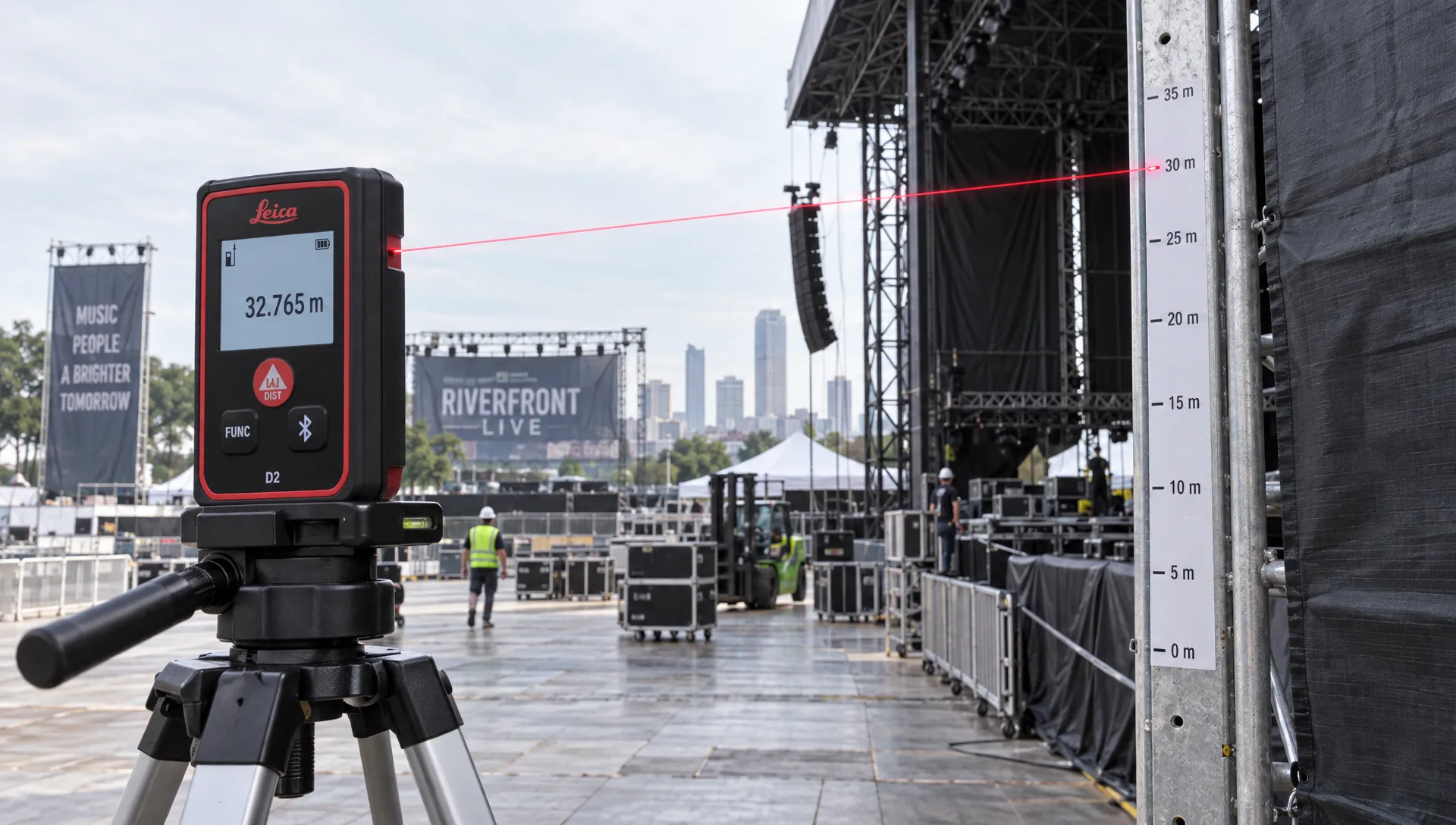
The next question is how the measurement can be demonstrated reliably. A tape, survey instrument or other device must suit the scale and required precision. Perspective in a photograph cannot replace a prescribed physical measurement.
Measurement uncertainty also matters when an attempt approaches the existing benchmark. If the apparent improvement is smaller than the measurement method can reliably distinguish, the evidence may not establish a new record. The authority’s rules determine the acceptable method, precision and any rounding requirements.
For an event team, this means reserving access for measurement before guests, staging or decorative finishes obscure the relevant points.
Counts need eligibility checks, not just arithmetic
Counting appears straightforward until the rules define what counts.
An inventory may establish how many glasses arrived at a venue, but it does not prove how many eligible glasses formed part of a qualifying completed pyramid. Spare stock, broken items and objects outside the defined structure cannot simply be included in the result.
Across different world records, a defensible count connects every included item or participant to the eligibility rules. Depending on the category, that may involve numbered sections, photographs, participant records or a documented counting procedure.
Mathematical calculations can support a count, but their assumptions need evidence. A formula for a complete geometric arrangement is only useful if the actual structure matches that arrangement. Missing items or incomplete sections can make a theoretically correct calculation inaccurate in practice.
Timing requires an agreed start and finish
A stopwatch reading has little value without defined start and finish events. Does timing begin on a signal, on the participant’s first movement or when an object crosses a line? Does it end when an action stops or when a specified task is fully completed?
Those distinctions can change the result. The rules may also address pauses, penalties, permitted assistance and timing equipment.
Speed records add another measurement problem: distance and time must both be established under the applicable protocol. Sporting records can also depend on environmental conditions and equipment rules. World Athletics’ published rules, for example, illustrate why a sporting performance cannot be assessed from a finish time alone.
The practical lesson is to agree on the measurement protocol before rehearsing the attempt.
How the evidence is checked
Verification of different world records usually involves two connected questions: does the evidence establish the result, and does it demonstrate compliance with the rules?
A dramatic final photograph may answer neither question fully. It can show the finished spectacle while leaving the count, construction conditions or duration unproven. Evidence should therefore be designed around what a reviewer needs to establish, rather than what looks strongest in a publicity campaign.
Witnesses and specialists have distinct roles
A witness may confirm what happened during the attempt. A qualified measurement professional may establish a dimension. An adjudicator may assess compliance and the result within the scope of the record authority’s process.
These roles should not be treated as interchangeable. A supplier who knows the installation closely may be useful operationally but may not meet a requirement for an independent witness. Likewise, a celebrity guest’s presence does not substitute for technical evidence.
The required qualifications, independence and responsibilities depend on the title and authority. Confirm them in the applicable guidelines rather than assuming a generic witness arrangement will be accepted.
An on-site adjudicator is not automatically required for every Guinness World Records attempt. Available routes and arrangements should be confirmed directly with the organization.
Evidence must connect the whole claim
A useful evidence package allows a reviewer to follow the attempt from its relevant starting conditions to the final result.
Depending on the guidelines, this may include video, photographs, measurement reports, witness statements and counting records. Guinness World Records’ evidence guidance explains the submission process, while the record-specific instructions determine what an individual attempt requires.
Common weaknesses include obstructed camera views, missing footage, unclear measurements and totals that cannot be reconciled with supporting records. An edited highlight film serves a different purpose from verification footage and should not replace it.
For different world records, evidence quality depends on traceability: a reviewer should be able to connect the claimed result to the documented attempt without relying on the organizer’s assurances. Preserve original files, label supporting documents clearly and keep backups.
A champagne pyramid shows why category wording matters
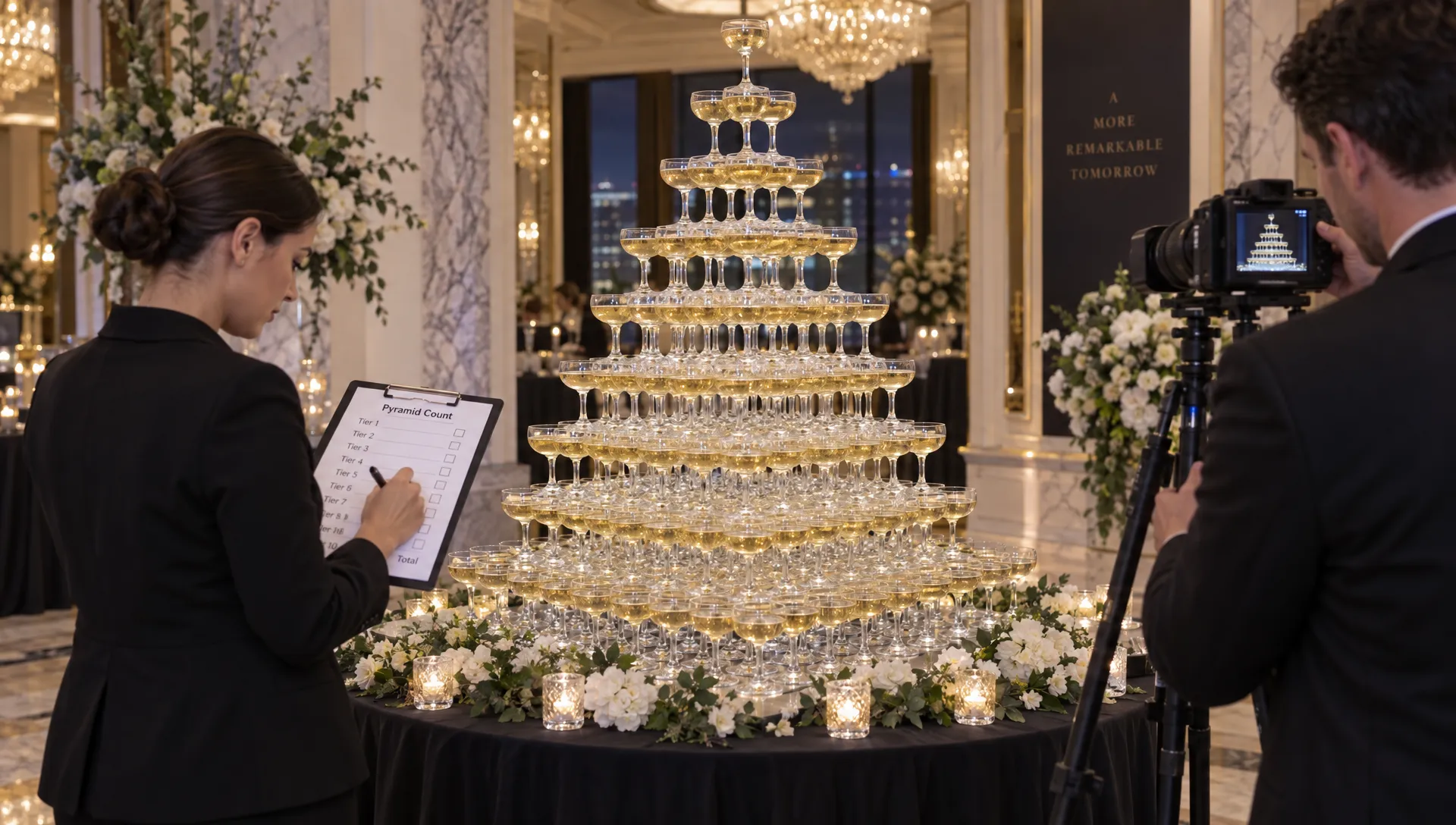
Consider a luxury hotel opening built around a champagne glass pyramid. Before anyone calculates a target, the team needs to establish what the proposed title measures.
A title based on the number of glasses is different from one based on height. Neither automatically proves a claim about the amount of champagne poured. Each would require its own definition and evidence.
For a glass-count title, the central questions concern eligible glasses and the qualifying completed structure. If the guidelines specify a stability period, pouring condition or other completion requirement, the evidence must demonstrate that requirement too. It should not be assumed from the event’s visual presentation.
This is where different world records create different production demands. A camera position chosen for a beautiful pouring sequence may not show enough detail for counting. A guest barrier may protect the installation but also restrict a witness’s sightline. Both needs must be resolved in the production plan.
Our guide to Guinness World Record rules for event planners explores how those requirements translate into event decisions.
Verification is also separate from safety approval. Glass handling, structural stability, floor loading, guest separation and controlled dismantling require appropriate assessment, whether the installation is record-sized or a smaller centerpiece. A record title is not a safety certification.
When can an event announce a verified result?
A record attempt, a submitted claim and an officially recognized achievement are different statuses. Event communications should reflect the status actually reached.
Before confirmation, “world-record attempt” is more accurate than “new world record.” If an authority confirms the achievement on site, communications can reflect that decision. If evidence requires later review, the production schedule should not promise immediate recognition.
Different world records may also have different recognition timelines because their evidence and governing processes differ. Build that uncertainty into press materials and prepare wording for both a confirmed result and a result awaiting review.
The benchmark deserves a separate check. An old article or certificate may document a genuine past achievement without identifying the current record. Before committing to a target, verify the current world record through the relevant authority.
This protects the brand from announcing an outdated benchmark, overstating a result or presenting an independently measured achievement as officially recognized when it is not.
Frequently asked questions
Who verifies world records? It depends on the category. Guinness World Records assesses titles within its system, while international sports federations recognize records within their disciplines. Other organizations maintain record registers too, so a claim should name the authority that recognized it.
Are different world records verified using the same evidence? No. A timed challenge needs evidence of timing and task completion, while an object-count record needs evidence of eligibility and quantity. The applicable guidelines determine the required documents, recordings and witnesses.
Can photographs alone prove a world record? They may support a claim, but they should not be assumed sufficient. Photographs often cannot establish elapsed time, continuous compliance, an exact count or conditions outside the frame. Follow the evidence requirements for the specific title.
Does breaking the published number guarantee recognition? No. The attempt must also meet the relevant rules and provide acceptable evidence. Confirming the benchmark is only one part of establishing a valid result.
Can a smaller champagne tower still create a premium event moment? Yes. A carefully proportioned tower can provide a striking centerpiece without pursuing a record. That allows the concept to prioritize the venue, guest experience and event objectives without making an unverified record claim.
Build the spectacle around a credible result
The most convincing record experiences make precision part of the presentation. Guests see a remarkable centerpiece; behind it sits a controlled process for measuring, documenting and communicating the achievement.
Luuk Broos Events specializes in record-breaking champagne pyramids and smaller champagne towers, combining professional building expertise with a tailor-made event approach. For a hotel opening, brand activation or private celebration, discuss the intended impact, venue constraints and record ambition early. The right scale is the one that serves the event and can be delivered with the care its guests expect.