

The most memorable wedding champagne tower is not necessarily the tallest. It is the one that belongs to the celebration: positioned where guests can enjoy it, revealed at the right moment and designed around the couple’s taste. The cascading pour gives the reception a shared focal point, but the experience surrounding it makes the difference.
For luxury wedding planners, the creative opportunity is to turn a familiar tradition into something personal. These seven concepts offer different ways to do that, from a garden reception opening to a late-night celebration, with practical guidance on scale and service.
Start with the moment, not the glass count
Before choosing dimensions or décor, decide what the tower should contribute to the reception. A welcome spectacle needs a different setting from an intimate family toast. A dramatic evening reveal requires different lighting and guest positioning from a relaxed afternoon pour.
Use the couple’s priorities to narrow the creative direction:
| Reception priority | Concept to explore | Detail that makes it work |
|---|---|---|
| A formal opening | Black-tie entrance pour | Clear sightlines and a coordinated musical cue |
| A romantic transition | Garden-to-dinner celebration | A sheltered setting near the reception route |
| A sense of place | Destination-inspired centerpiece | Materials and surroundings that reflect the venue |
| A personal visual signature | Rosé celebration | A restrained palette built around the wine |
| Family connection | Generations toast | Short, intentional participation |
| A second evening highlight | Late-night champagne salon | A fresh setting away from the dance floor |
| One focused reception ritual | Cake-and-champagne sequence | Separate actions within one coordinated moment |
Seven wedding champagne tower ideas for a distinctive reception
1. Open a black-tie reception with a ceremonial pour
Make the couple’s entrance the beginning of the experience. Guests arrive with drinks already served, the music shifts and attention turns toward a tower positioned against a composed architectural backdrop.
The couple performs the opening pour together, followed by a short welcome. Keeping those actions connected gives the reception a confident beginning without asking guests to move between several focal points.
This concept works especially well in a ballroom, historic dining room or contemporary venue with strong symmetry. Keep signage and surrounding décor restrained so the glass structure remains legible from across the room.
The defining detail: Give the photographer a clear position without blocking the guests’ view. A striking photograph should come from a well-designed experience, not interrupt it.
2. Create a garden-to-dinner transition
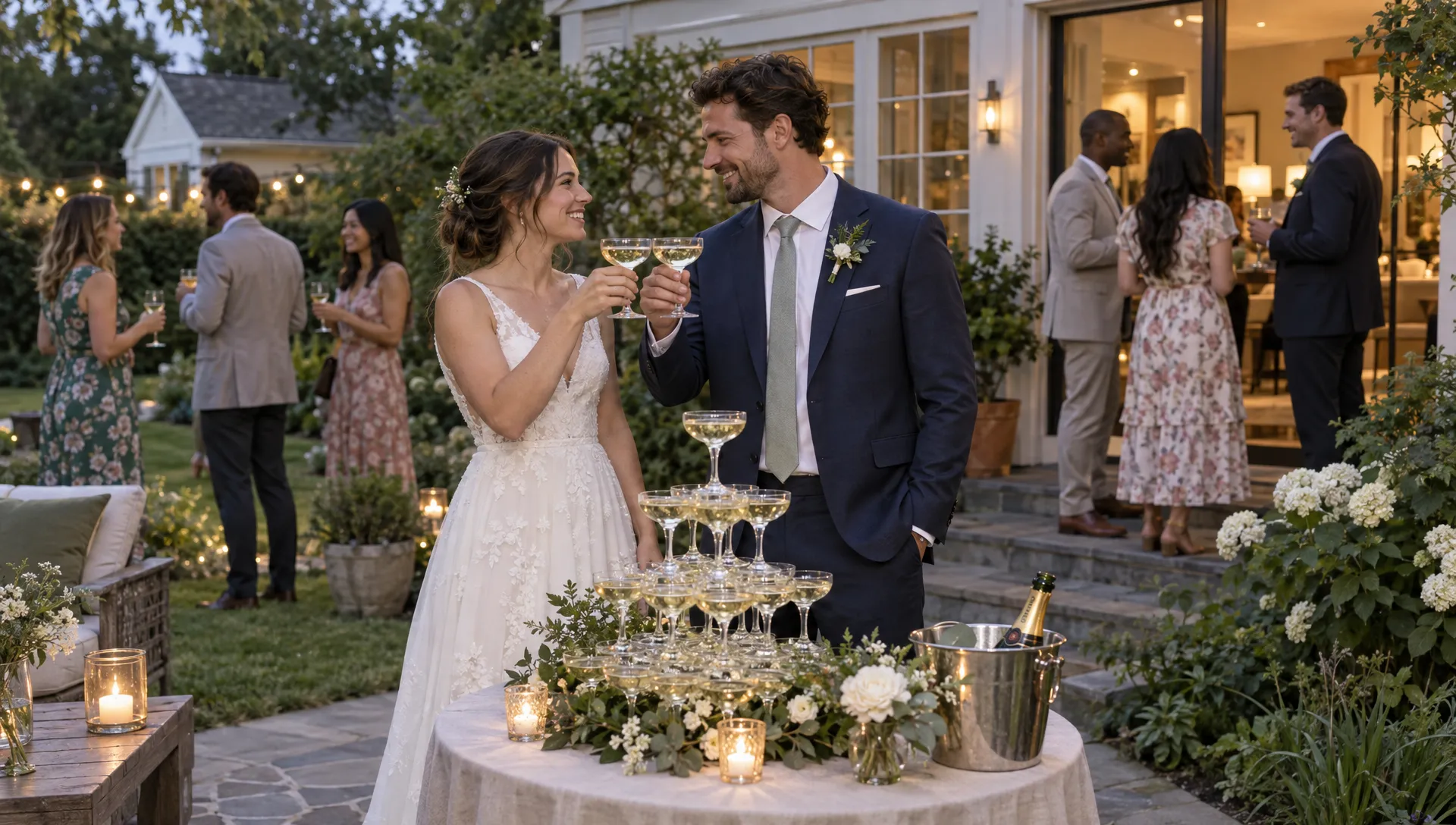
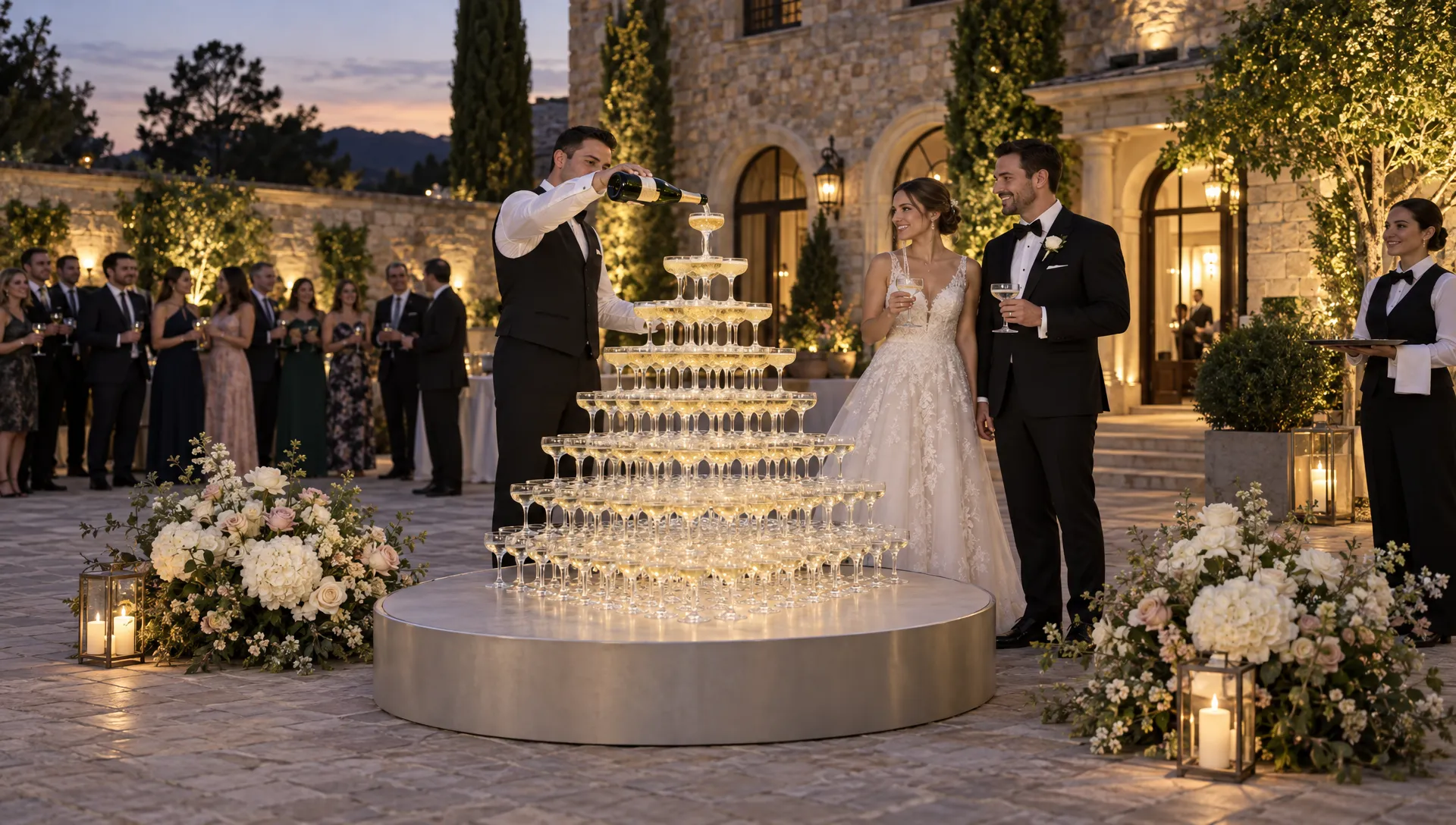
A wedding champagne tower can mark the passage from an outdoor cocktail reception into dinner. Rather than announcing that guests must immediately take their seats, invite them to gather for a shared pour near the route to the dining space.
Draw from the garden’s existing character: pale flowers, soft greenery or stone architecture may provide enough context without an elaborate backdrop. Keep arrangements separate from the support surface and away from service access.
The location must be technically suitable, not simply picturesque. Uneven ground, wind and changing weather all need assessment, with an indoor alternative agreed in advance.
The defining detail: Let the tower connect two parts of the celebration rather than become an additional stop. For a deeper look at the visual details, explore how to style a champagne wedding tower with real elegance.
3. Reflect the destination without creating a theme set
For a destination wedding, take inspiration from the venue rather than decorating the tower with literal travel references. A courtyard’s proportions, a hotel’s architectural lines or the colors of a coastal landscape can guide the surrounding design.
At a Mediterranean property, for example, warm stone and a restrained botanical palette might provide the setting. In a city hotel, a clean architectural backdrop and evening lighting may feel more appropriate.
The experience should remain recognizably the couple’s celebration, not a promotional display for the location. Avoid placing souvenirs, loose decorative objects or florals among the glasses.
The defining detail: Choose one strong connection to the destination and carry it through the surrounding reception design. The tower itself can remain beautifully simple.
4. Build a rosé celebration around the couple’s taste
Rosé offers a distinctive alternative when it is genuinely the couple’s preferred style. Its color can connect with blush flowers, warm metallic accents or deeper berry tones without requiring an entirely pink reception.
A wedding champagne tower built around rosé works best when the beverage is part of the story, not merely a color choice. A wine associated with an anniversary dinner or a favorite shared trip gives the moment a personal reason to exist.
Taste the intended wine with the catering team and consider where the pour falls in the meal. Confirm the appearance in the actual glassware under the planned lighting rather than relying on a bottle photograph.
The defining detail: Use a brief introduction to explain the choice. One sincere sentence from the couple can give the spectacle more meaning than extensive signage.
5. Turn the pour into a generations toast
For couples who want family involvement without adding another long speech, the tower can frame a short intergenerational celebration. Parents, grandparents or chosen family gather beside the couple, with one designated person offering a few words.
Participation does not need to mean that everyone handles a bottle. Keeping the pouring roles limited makes the action clearer and allows family members to enjoy the moment without feeling responsible for its execution.
Ask the couple privately who they want involved. Family structures and relationships vary, so avoid assigning ceremonial roles by assumption. The same care applies to alcohol preferences and mobility needs.
The defining detail: Position participants so nobody is hidden behind the structure. Separately prepared glasses allow everyone to join the toast without disturbing the tower.
6. Introduce a late-night champagne salon
Instead of using the tower at the beginning of the reception, create a second evening destination in an adjoining lounge or quieter part of the venue. Guests discover a more intimate setting after dinner, with comfortable seating and a distinct musical atmosphere.
The wedding champagne tower becomes the opening gesture for this change of pace. It can suit couples who want a sophisticated alternative to another dance-floor announcement or a crowded bar moment.
Plan the invitation carefully so it does not divide the reception unintentionally. The lounge should feel connected to the celebration, with staff guiding the transition and alcohol-free drinks receiving equal attention.
The defining detail: Give the setting its own purpose. A late-night salon should offer conversation and hospitality, not simply relocate the same décor.
7. Pair the tower with cake service, without competing focal points
Couples who prefer fewer formal interruptions can bring the cake and tower into one reception sequence. The key is to connect them in time while keeping their functions separate.
Begin with the cake cutting, allow the photographer to finish that moment, then direct attention to the pour. Alternatively, reverse the sequence if the tower is intended to introduce dessert. Avoid simultaneous actions, which force guests and cameras to choose where to look.
The cake display and glass structure need their own appropriate support and working space. Visual coordination should never mean crowding both onto an unsuitable table.
The defining detail: Design one clear transition between the two rituals. Guests experience a complete celebration rather than a succession of announcements.
Choose a scale that supports the idea
Height is only one measure of impact. A carefully positioned tower with a strong backdrop can command more attention than a larger structure placed behind tables or in a circulation route.
For an illustrative square-based pyramid, the total glass count is the sum of the square layers. A four-tier arrangement has a 4 × 4 base, followed by 3 × 3, 2 × 2 and one top glass.
| Number of tiers | Glasses in the base layer | Total glasses |
|---|---|---|
| 3 | 9 | 14 |
| 4 | 16 | 30 |
| 5 | 25 | 55 |
| 6 | 36 | 91 |
These are mathematical counts, not construction recommendations. The builder must determine the appropriate glassware, configuration and support for the setting. Other arrangements can use different counts.
The tower does not have to contain one glass per guest. It can provide the ceremonial centerpiece while the catering team serves the toast separately. This allows creative scale and guest service to be planned independently.
Once the concept is chosen, use a dedicated wedding tower planning framework to coordinate supplier responsibilities, venue requirements and the reception schedule.
Make the beverage service as considered as the design
Plan the wedding champagne tower as a ceremonial pour first, then calculate how the full guest list will be served. Ask the builder and caterer to agree who handles bottles, who serves drinks and when the structure can be dismantled. Guests should not remove glasses from a standing tower.
Bottle quantities depend on the intended serving size, guest count and pouring method. As a simple volume calculation, a 750 ml bottle provides six 125 ml servings before any losses. That does not establish how many bottles a cascading display requires, so have the team calculate display and guest-service quantities separately.
Choose wine by taste and menu compatibility rather than prestige alone. Champagne specifically comes from France’s Champagne region, as explained by the Comité Champagne. Other sparkling wines can suit a wedding, but should be described accurately.
Provide alcohol-free options with the same attention to presentation. If an alcohol-free sparkling drink is proposed for the tower itself, confirm suitability with the builder rather than assuming it will perform identically.
Frequently asked questions
How many glasses do you need for a champagne tower at a wedding? It depends on the design. A square-based four-tier pyramid contains 30 glasses, while five tiers contain 55. The guest count does not have to determine the tower size because drinks can be served separately. Have the specialist confirm the final configuration and service plan.
Who usually gives the toast during the pour? There is no required speaker. The couple can say a few words, or invite a parent, friend or other chosen person. For a wedding champagne tower, one short toast usually keeps attention on the shared moment without duplicating the main speeches.
What is the best Champagne to buy for a wedding? The best choice fits the couple’s taste, menu and budget. Ask the caterer or wine supplier to recommend options and arrange a tasting. A non-vintage brut can be a useful starting point for comparison, while rosé may suit couples who prefer its flavor and visual character.
Should you pop the bottle for the photographs? A controlled opening is the safer choice around glass structures, guests and formal clothing. Keep the bottle directed away from people and let an experienced server manage opening and handover. Plan the photograph around the pour rather than a flying cork.
Create a reception moment with a specialist
A successful wedding champagne tower combines an original idea with disciplined execution. The setting, guest experience and service plan should support one another, leaving the couple free to enjoy the moment.
Luuk Broos Events specializes in champagne pyramids, from smaller towers to world-record-scale projects, with a professional builder team and a tailor-made approach. To explore a concept for your reception, discuss your wedding vision with Luuk Broos Events. Share the venue, guest count, preferred moment and design direction so the conversation begins with the experience you want to create.