

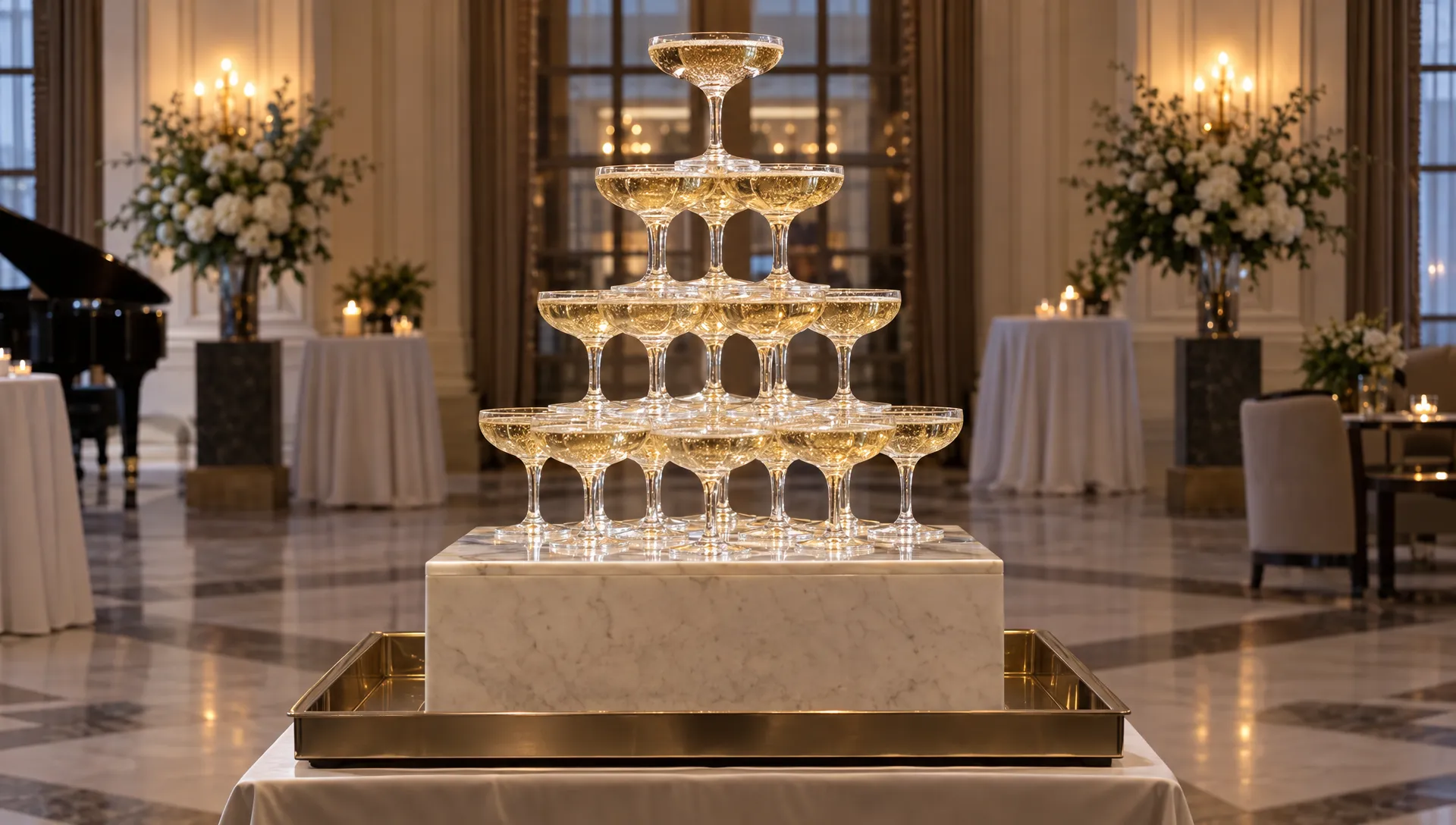
A champagne tower stand should do more than complement the glassware. It must provide a stable, suitable foundation, accommodate the intended pour and look composed under event lighting. For a hotel opening, luxury wedding or brand reception, those practical details are part of the presentation, even when guests never notice them.
The strongest choice starts with the complete installation, not a photograph of an attractive pedestal. Before approving a stand, establish what it will support, where it will sit and how the team will build, pour and clear the display.
Distinguish a display rack from a pouring base
Suppliers sometimes use similar product names for very different structures. A tiered rack holds glasses on separate shelves or in individual slots. A base for a traditional champagne pyramid supports glasses stacked directly on one another, with liquid cascading from the top.
These formats are not interchangeable. A decorative drinks rack may suit a self-service reception but may not be designed for a stacked tower or a live overflow pour. Likewise, a photography plinth is not automatically suitable simply because its top appears wide enough.
Ask the supplier to confirm the intended use in writing. Product photographs, material thickness and descriptions such as “heavy duty” do not establish suitability for your particular installation.
Choose a champagne tower stand by its working load
Assess the complete loaded display, not just the empty glasses. The proposed load includes glassware, liquid and anything else supported by the platform, such as a collection tray or decorative elements.
Give the supplier the actual glass model, planned quantity and expected liquid volume. Ask for documented capacity information that applies to the assembled stand and the way the load will be distributed. A rating for evenly distributed storage may not answer questions about a tower concentrated over a smaller footprint.
The top panel, supporting frame, joints and any extensions must be suitable together. A substantial-looking frame does not compensate for a flexible tabletop. For large or unusual installations, involve the venue’s technical team and an appropriately qualified structural professional where required.
Check the floor as part of the installation
The champagne tower stand also needs a suitable floor beneath it. Temporary decking, raised floors, thick carpet and uneven stone each require attention before the design is approved.
Ask who will verify floor suitability, load distribution and level. For the floor assessment, the weight of the stand itself matters too. Any leveling system or load-spreading arrangement should be approved for the installation, rather than improvised during setup.
Complete these checks before stacking begins. Moving or adjusting a base beneath an assembled glass tower introduces avoidable risk.
Set the platform dimensions and pouring height together
The platform must accommodate the tower’s actual bottom tier, any containment system and the clearances required by the builder. Do not size it solely from a reference photograph or a nominal glass count.
Glass dimensions affect the footprint. Even coupes that look similar can differ in bowl width, foot size and stacking behavior. Confirm the exact arrangement before ordering a custom top. Our guide to choosing champagne tower glasses explains why the builder should assess the specific model.
A champagne tower stand should also place the top glass at a workable pouring height. A taller pedestal may improve visibility while making the ceremonial pour harder to control. Review the combined height of the base and tower, along with the reach and position of the person pouring.
If access equipment is necessary, have the production team plan it separately. A decorative ledge or the stand itself must not become an improvised step.
Allow for the working area, not only the footprint
Mark the proposed position on the venue plan, including space for builders, pouring access and guest separation. Consider nearby doors, service routes, dance floors and temporary staging.
A tower may fit neatly into a reception layout yet leave no practical approach for staff carrying bottles or clearing glassware. Resolve that conflict before confirming the stand dimensions.
Select a finish that works under event lighting
Material alone does not establish structural suitability. Metal, timber and acrylic constructions can perform very differently depending on their design, joints and condition. Choose the finish only after the supporting structure has been assessed.
For the visual review, request images of the actual item or a finish sample. Inspect corners, seams, exposed fixings and the lower edge, especially if the installation will be photographed at guest eye level.
The finish of a champagne tower stand can change how clearly the glasses read. A mirrored surface may reflect lighting equipment and service activity. Clear acrylic can reveal internal supports, scratches or a collection system. Dark finishes can provide contrast but may show dried splashes.
A custom decorative surround can help integrate the base with a sponsor palette or wedding design. Confirm that it will not obstruct access, conceal an issue that needs inspection or introduce an unapproved contact surface beneath the glassware.
Keep branding proportionate. The glass pyramid should remain visually distinct, with logos positioned where the agreed photography angles can capture them without competing with the pour.
Make spill containment part of the design
A cascading pour needs a deliberate liquid-management plan. The amount reaching the base depends on the tower arrangement and pouring method, so the builder should define the expected requirements rather than relying on a generic tray.
Discuss containment before choosing the final platform. A raised tray edge can affect bottom-tier placement, while an added liner or protective layer may change the contact surface. Neither should be introduced without approval.
The champagne tower stand should allow the agreed containment arrangement to function without leaving wet flooring or exposed collection equipment in guest areas. If drainage is proposed, confirm routing, protection and responsibility for monitoring it.
Also establish who will manage splashes, inspect the surrounding floor and respond if service must pause. Towels within reach of the team are useful, but they are not a substitute for planned containment.
For the wider sequence, including access and service coordination, use these champagne tower setup considerations alongside the stand specification.
Compare rental, purchase and custom fabrication
The right sourcing route depends on frequency of use, design requirements and the resources available to inspect, transport and store the stand. Compare the complete scope rather than the headline price.
| Sourcing route | When to consider it | What to verify |
|---|---|---|
| Rental | A one-off event where an existing design meets the brief | Actual dimensions, documented suitability, condition, delivery and assembly responsibilities |
| Purchase | Repeated events using a consistent, approved tower format | Storage, transport protection, inspection requirements and replacement components |
| Custom fabrication | A specific footprint, finish or brand treatment that existing stock cannot provide | Technical design, fabrication schedule, finish samples and installation requirements |
A rental champagne tower stand may still require a separate delivery crew, protective flooring or a decorative surround. A purchased option may create ongoing handling and storage obligations. Custom fabrication adds design decisions that need approval before production begins.
Request an itemized scope covering delivery access, assembly, collection and any venue restrictions. This makes proposals easier to compare and reduces the chance of an attractive base becoming an awkward production problem.
Give suppliers a brief they can assess
A concise technical brief is more useful than a mood board alone. Share the visual direction, but accompany it with the information needed to evaluate the proposed installation.
Include these essentials in the same document:
- Tower configuration: Intended glass model, quantity, arrangement and planned liquid volume.
- Venue conditions: Exact location, floor construction, access dimensions and available setup time.
- Stand requirements: Proposed footprint, total display height, finish and any branding treatment.
- Operating plan: Pouring position, containment approach, guest separation and clearance sequence.
- Approval responsibilities: Who confirms structural suitability, venue acceptance and readiness before the pour.
Ask the supplier to identify assumptions and exclusions. If the proposed champagne tower stand is only suitable under certain conditions, those conditions should be clear before the order is placed.
Agree on a pre-build inspection as well. The responsible team should check the assembled base, surface condition, joints, locking mechanisms where applicable and approved positioning before glassware is stacked. Damage, rocking or an unexpected change in the installation should trigger a review, not an improvised workaround.
Frequently asked questions
Can an ordinary event table support a champagne tower? Possibly, but appearance and familiarity are not enough. The builder and supplier need to assess its construction, working load, rigidity, dimensions and suitability for the intended arrangement. A folding banquet table should not be assumed suitable without that assessment.
Does a champagne tower stand need a raised rim? Not necessarily. Containment can take different forms, but it must be planned with the builder. A rim must not interfere with glass placement, and a flat platform still needs an agreed approach to overflow and floor protection.
Can the stand be moved after the glasses are stacked? Plan for it to remain in its approved position. Do not assume that casters or a mobile base make an assembled tower safe to move. Any proposed movement requires a specialist-designed method and explicit approval.
How many glasses determine the stand size? Glass count is only one factor. The exact glass dimensions and stacking layout determine the bottom-tier footprint. Confirm that footprint with the builder, then allow for the approved containment system and working clearances.
Plan the foundation alongside the spectacle
The most polished installations resolve the supporting details early, leaving guests to enjoy the glasswork and the moment of the pour. Approve the stand as part of the complete tower design, rather than sourcing it as a separate decorative accessory.
Luuk Broos Events specializes in champagne pyramids, from smaller towers to world-record-scale spectacles. Discuss your venue, event objectives and proposed display with the team so the foundation, presentation and live experience can be considered together.